My years of experience living in the midst of Islam in Southern Philippines have taught me that the endeavor to live together in respectful understanding for one another is a journey of thousands miles… Where to begin and what should be the first step are always the daunting challenges for people who have embark on the journey.
The first is best described by assuming an attitude and a disposition that a pilgrim takes as he/she embarks on the hajj. “Labbayka” is the word that comes out of his/her mouth as he/she begins the journey to God’s abode. Labbayka ‘inna hum - Here I am … ready to do your bidding…
In my desire to live and struggle with Muslim minorities in the Southern Philippines , I have always been guided by what the Qur’an positively says about the Christians… And through these, I continue to struggle to enflesh that type of Christian witnessing that my Muslim neighbors can easily understand.
Three (3) Quranic Passages…
The first text is from Sura 5: 82 that says… “and nearest among them in love to the believers wilt thou find those who say ‘we are Christians’, because amongst these are men who are devoted to learning and men who have renounced the world, and they are not arrogant.” (wa latajidanna aqrabahum mmawaddatan lilladhina amanu-l-lladhina qaalu nnaanasaaraa dhaalika bianna minhum qasisina waruhbaanaan wa annahum laa yastakbiruna.)
I resolve that I shall be true to this in my dealing with my Muslim neighbors… To be a…
• A person of learning;
• A person that renounces the world and NOT greedy; and
• A person who is not haughty or arrogant!
Yes, I strive to be that person nearest to them in Love… because I am a Christian.
The second text is taken from Qur’an 57: 27 that states… “…we sent after them Jesus the Son of Mary and bestowed on him the Gospel; and we ordained on the hearts of those who followed him COMPASSION AND MERCY’. (waja’aalnaa fi qulusbi-lladhina-ttaba’uhu raa’fatan wa –rahmatan).
The two key descriptions of Jesus’ followers are Compassion and Mercy… Is this NOT the very heart of religion and the very heart of God? God is Rahmaan and Rahim -“loving-kindness”. The heart of religion and a believer as described in Sura 50:37: "A believer who remembers the need for a feeling heart, a hearing mind and a present self… to his/her neighbor…" (“…inna fi dhalika la-dhikra li-man kana lahu qalb aw alqa al-sam’wa wa huwa shahid”)
Reflecting on this passage, I wander whether the call for us is precisely to retrieve these key descriptions and allow them to bear upon the relationship between the worship that we bring and the behavior that we come by… or putting it in another way, allowing the “coincidence” between the heart of God and the heart of the believer.
The third text is from Sura 49: 14 that says “…we made you into nations and tribes that you may know each other (not that you may despise each other). The most honored of you in the sight of God is the most righteous of you”. (Ya_ ay yuhal na_su in na_ halaqna_kum min zakariw wa unsa_ wa ja'alna_kum suu_baw wa qaba_ ila litaa_rafu_ in na akramakum indal la_hi atqa_kum in nal la_ha alimun kabir.)
Still in another Qur’anic passage, Sura 11: 118, it says: “If thy Lord had so willed He could have made mankind one People: but (he willed it otherwise, ands so) they will not cease to dispute.” (Wa lau sya_'a rabbuka laja'alan na_sa ummataw wa_hidataw wa la_ yaza_lu_na mukhtalifin(a).)
But what is this righteousness being asked of us…? Sura 2: 178 tells us… “It is not righteousness that ye turn your faces to the East and the West; but righteous is he who believeth in Allah and the Last Day and the angels and the Scripture and the Prophets; and giveth his wealth, for love of Him, to kinsfolk and to orphans and the needy and the wayfarer and to those who ask, and to set slaves free; and observeth proper worship and payeth the poor due. And those who keep their treaty when they make one, and the patient in tribulation and adversity and time of stress. Such are they who are sincere. Such are the God fearing.” (Ya_ ayyuhal lazina a_manu_ kutiba 'alaikumul qisa_su fil qatla_, al hurru bil hurri wal 'abdu bil 'abdi wal unsa_ bil unsa_, faman 'ufiya lahu_ min akhihi syai'un fat tiba_'um bil ma'ru_fi wa ada_'un ilaihi bi ihsa_n(in), za_lika takhfifum mir rabbikum wa rahmah(tun), fa mani'tada_ ba'da za_lika fa lahu_ 'aza_bun alim(un).)
This is the concrete response to the Qura’nic invitation to “excel each other in good deeds” that constitute true piety and righteousness. (Bapa Eliseo Mercado, OMI)
Kargador at Dawn

Work in the Vineyard
Thursday, June 08, 2006


Tuesday, June 06, 2006
Dhikr as Remembrance of God in GOOD WORK...
Remembrance of God is the foundation of good deeds. Dhikr is a form of Sadaqa – generous charity. Sadaqa is the generous sharing of one’s life and property.
Dhikr leads to being charitable in all the senses.
* Becoming Charitable and Generous in our Knowing and Seeing…
* Becoming Charitable and Generous in our Hearing and in our Utterances
* Becoming Charitable and Generous in our Feeling and Loving…
* Becoming Charitable and Generous in our reaching out to our neighbors…
Dhikr leads to being charitable in all the senses.
* Becoming Charitable and Generous in our Knowing and Seeing…
* Becoming Charitable and Generous in our Hearing and in our Utterances
* Becoming Charitable and Generous in our Feeling and Loving…
* Becoming Charitable and Generous in our reaching out to our neighbors…
Sunday, June 04, 2006


Dhikr for Pentecost Sunday (B)
“Jesus breathed on them and said to them, "Receive the Holy Spirit. Whose sins you forgive are forgiven them, and whose sins you retain are retained." (John 20: 22-23)
We have received NOT the spirit of slavery and live in fear, but the spirit that makes us sons and daughters of God that empowers us to call God – Abba!
We have received NOT the spirit of slavery and live in fear, but the spirit that makes us sons and daughters of God that empowers us to call God – Abba!
Saturday, June 03, 2006
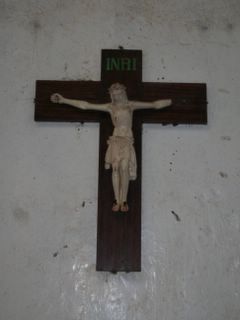
Only one thing matters...
The gospel of today (03 May) tells how Jesus reproves Peter of having too many peripheral concerns… Only one thing matters: “YOU FOLLOW ME” (John 21:22).
Today, we celebrate the feast of the 22 martyrs of Uganda. There are three names that we easily remember: Charles Lwanga, Mattias Mulumba Kalemba and the boy Kitisto.
There were more than 22 martyrs of Uganda. Paul VI in his homily during the canonization rite also mentioned of other Christians who were martyred yet belonging to the Anglican confession.
The witness of these martyrs in the 19th century reminds us of the contemporary martyrdom of the many Christians in Southern Sudan during the more than two decades of civil war that ended with the signing of the Comprehensive Peace Agreement in January 2006.
The Christians in Southern Sudan thought that they were abandoned by the world and by God during the times of persecution...
John Paul II during his historic visit in the Sudan in 1993 reminded the Christians that they are NOT forgotten nor abandoned by God... Their names are "written on the palm of the hands of Christ pierced by the nails of crucifixion."
Therefore, with full confidence we cry out: "The Lord is our help and our shield. In him do our hearts find joy. We trust in his holy name". (Psalm 28: 7)
Today, we celebrate the feast of the 22 martyrs of Uganda. There are three names that we easily remember: Charles Lwanga, Mattias Mulumba Kalemba and the boy Kitisto.
There were more than 22 martyrs of Uganda. Paul VI in his homily during the canonization rite also mentioned of other Christians who were martyred yet belonging to the Anglican confession.
The witness of these martyrs in the 19th century reminds us of the contemporary martyrdom of the many Christians in Southern Sudan during the more than two decades of civil war that ended with the signing of the Comprehensive Peace Agreement in January 2006.
The Christians in Southern Sudan thought that they were abandoned by the world and by God during the times of persecution...
John Paul II during his historic visit in the Sudan in 1993 reminded the Christians that they are NOT forgotten nor abandoned by God... Their names are "written on the palm of the hands of Christ pierced by the nails of crucifixion."
Therefore, with full confidence we cry out: "The Lord is our help and our shield. In him do our hearts find joy. We trust in his holy name". (Psalm 28: 7)
Tuesday, May 30, 2006
Have we not all the same God?
Have we not all the same God? Has not one God created us?
Why do we deal treacherously, a person against neighbor?
Justice shall you pursue, that you may live in your land.
If a stranger sojourns with you in your land, you shall not wrong him/her.
The stranger that sojourns with you, shall be unto you as the native among you, and you shall love him/her as yourself. One law shall be among you for the native and the stranger alike.
If your neighbor becomes poor and his/her means fail, you shall uphold him/her.
Harden not your hearts to the needy in your midst, nor shut your hand to the needy; But open your hand unto him/her, and lend him/her sufficient for his/her needs.
Hate not your brother/sister in your heart; love your neighbour as yourself.
You shall deal your bread to the hungry, and bring the poor that are cast out to your house. When you see the naked, cover him/her, and hide not yourself from your own flesh.
You have given man/woman understanding and insight and have shown him/her what is good and evil. You have revealed unto him/her what is good; you have given him/her to choose between right and wrong.
You have given him/her a mind, that he might use hisher blessings wisely; a heart You have given him/her and free will that he/she might consider his/her ways and live according to Your will.
We are mindful of all the great gifts which You, O Lord, have given us; may we use them wisely that they may not be in vain. You have been told, o man/woman, what is good, and what the Lord requires of you; to do justly, to love mercy, and to walk humbly with your God.
Then shall your light break forth as the morning, and your healing shall spring forth speedily; your righteousness shall go before you, the Glory of God shall be your protection.
Behold how good and how pleasant it is, when people dwell together in unity.
May the Lord bless you and keep you.
May the Lord's countenance shine upon you, and be gracious unto you.
May the Lord's blessing be upon you and give you peace. Amen
Why do we deal treacherously, a person against neighbor?
Justice shall you pursue, that you may live in your land.
If a stranger sojourns with you in your land, you shall not wrong him/her.
The stranger that sojourns with you, shall be unto you as the native among you, and you shall love him/her as yourself. One law shall be among you for the native and the stranger alike.
If your neighbor becomes poor and his/her means fail, you shall uphold him/her.
Harden not your hearts to the needy in your midst, nor shut your hand to the needy; But open your hand unto him/her, and lend him/her sufficient for his/her needs.
Hate not your brother/sister in your heart; love your neighbour as yourself.
You shall deal your bread to the hungry, and bring the poor that are cast out to your house. When you see the naked, cover him/her, and hide not yourself from your own flesh.
You have given man/woman understanding and insight and have shown him/her what is good and evil. You have revealed unto him/her what is good; you have given him/her to choose between right and wrong.
You have given him/her a mind, that he might use hisher blessings wisely; a heart You have given him/her and free will that he/she might consider his/her ways and live according to Your will.
We are mindful of all the great gifts which You, O Lord, have given us; may we use them wisely that they may not be in vain. You have been told, o man/woman, what is good, and what the Lord requires of you; to do justly, to love mercy, and to walk humbly with your God.
Then shall your light break forth as the morning, and your healing shall spring forth speedily; your righteousness shall go before you, the Glory of God shall be your protection.
Behold how good and how pleasant it is, when people dwell together in unity.
May the Lord bless you and keep you.
May the Lord's countenance shine upon you, and be gracious unto you.
May the Lord's blessing be upon you and give you peace. Amen
Sunday, May 28, 2006
Dhikr for the Ascension Sunday (B)
“These signs will accompany those who believe: in my name they will drive out demons, they will speak new languages. They will pick up serpents (with their hands), and if they drink any deadly thing, it will not harm them. They will lay hands on the sick, and they will recover." (Mark 16: 17-18)
What are the new signs that must accompany our following of Christ today?
• Is it FELLOWSHIP in his name – regardless of color, race, belief, language and gender?
• Is it our fellowship with the poor and the excluded?
• Is it our capacity to do the “extra mile” and to give away our extra coat as well?
What are the new signs that must accompany our following of Christ today?
• Is it FELLOWSHIP in his name – regardless of color, race, belief, language and gender?
• Is it our fellowship with the poor and the excluded?
• Is it our capacity to do the “extra mile” and to give away our extra coat as well?
Saturday, May 27, 2006
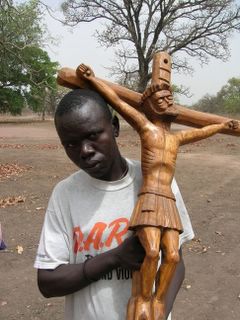
"Planted in the house of the Lord..."
Peace!
Simply sharing with you the passage that struck me while saying Psalm 92...
"Planted in the house of the Lord
they will flourish in the courts of our God,
still bearing fruit when they are old,
still full of sap, still green,
to proclaim that the Lors is just;
in him, my rock, there is no wrong."
This passage challenges us to remain ever fresh - 'continue to bear fruit and to feel still full of sap' - in our ministry nothwithstanding age and whatever conditions where we find ourselves...
The key is to ensure that we are, indeed, 'planted and rooted in the house of the Lord'.
Simply sharing with you the passage that struck me while saying Psalm 92...
"Planted in the house of the Lord
they will flourish in the courts of our God,
still bearing fruit when they are old,
still full of sap, still green,
to proclaim that the Lors is just;
in him, my rock, there is no wrong."
This passage challenges us to remain ever fresh - 'continue to bear fruit and to feel still full of sap' - in our ministry nothwithstanding age and whatever conditions where we find ourselves...
The key is to ensure that we are, indeed, 'planted and rooted in the house of the Lord'.
Thursday, May 25, 2006
"The Lord has abandoned us!"
People, sometimes, think: "the Lord has abandoned us! He has forgotten us" (Is. 49:14. And God answers with the words of the great prophet: "can a woman forget her own baby, and not love the child she bore? Even if a mother should forget her child, I will never forget you. I have written your name on the palms of my hands" (Is. 49: 15-16).
Yes, on the palms of the hands of Christ, pierced by the nails of the crucifixion. The name of each one of you is written on those palms.
Therefore, with full confidence we cry out: "the Lord is our help and our shield. In him do our hearts find joy. We trust in his Holy Name" (Ps. 28:7) Amen.
(Prayer of John Paul II duirnh his short visit in Khartoum on February 10, 1993 expressing his solidarity with the persecuted Christians in the Sudan.)
Yes, on the palms of the hands of Christ, pierced by the nails of the crucifixion. The name of each one of you is written on those palms.
Therefore, with full confidence we cry out: "the Lord is our help and our shield. In him do our hearts find joy. We trust in his Holy Name" (Ps. 28:7) Amen.
(Prayer of John Paul II duirnh his short visit in Khartoum on February 10, 1993 expressing his solidarity with the persecuted Christians in the Sudan.)
Tuesday, May 23, 2006
To love a person...
"To love someone," Fr. Vernier said, "is to reveal his beauty to him, to reveal to him that he is a person, that he is important, that he can do beautiful things with his life."
Love, Vanier continued, must not be only emotional. People must be loved "with intelligence to help them get up again," "to want to go beyond the walls, through the walls," "to reveal to those who have been crushed that they are of value."
"What I wish to transmit before I die is that life is beautiful if we are determined little by little to demolish the walls that separate us," he said.
According to the founder of L'Arche, we must be honest with ourselves and acknowledge an important truth: "I am not superior to you, I am not better than you, I am like you. I have my frailty, my limitations which, perhaps, I have often hidden; you have your limitations, perhaps more visible, but behind your limitations you are a person, your heart is."
"For the walls to disappear, for us to be able to be vulnerable to one another, to not let ourselves be led by competitiveness, for the world to find peace, we need a community of brothers and sisters of Jesus," he said.
Love, Vanier continued, must not be only emotional. People must be loved "with intelligence to help them get up again," "to want to go beyond the walls, through the walls," "to reveal to those who have been crushed that they are of value."
"What I wish to transmit before I die is that life is beautiful if we are determined little by little to demolish the walls that separate us," he said.
According to the founder of L'Arche, we must be honest with ourselves and acknowledge an important truth: "I am not superior to you, I am not better than you, I am like you. I have my frailty, my limitations which, perhaps, I have often hidden; you have your limitations, perhaps more visible, but behind your limitations you are a person, your heart is."
"For the walls to disappear, for us to be able to be vulnerable to one another, to not let ourselves be led by competitiveness, for the world to find peace, we need a community of brothers and sisters of Jesus," he said.
Saturday, May 20, 2006

Friends of Jesus
In the Gospel for the 6th Sunday of Easter (B), Jesus calls us his friends...
“I no longer call you slaves, because a slave does not know what his master is doing. I have called you friends, because I have told you everything I have heard from my Father.” (John 15: 15)
Among the many names given to the followers of Jesus, the title: “FRIENDS of Jesus” is, no doubt, the closest to the heart of discipleship.
Many people who have become "pilgrims" have cherished the call to be Jesus's FRIENDS and indeed, we are…!
“I no longer call you slaves, because a slave does not know what his master is doing. I have called you friends, because I have told you everything I have heard from my Father.” (John 15: 15)
Among the many names given to the followers of Jesus, the title: “FRIENDS of Jesus” is, no doubt, the closest to the heart of discipleship.
Many people who have become "pilgrims" have cherished the call to be Jesus's FRIENDS and indeed, we are…!
Thursday, May 18, 2006
The HEART of the matter…
Today, May 18, 2006, a passage from the Acts echoes the core of the Badaliyya movement… the heart of our solidarity with all believers…
“And God, who knows the heart, bore witness by granting them the Holy Spirit just as he did us. He made no distinction between us and them, for by faith he purified their hearts (Acts 15: 8-9)
Many spiritual masters and directors claim that Spiritual Life is a matter of the heart. These are some of the famous phrases that point to this reality:
• Being single-hearted…
• A clean/purified heart...
• The heart of the matter…
• Religion of the heart…
• God dwelling in the heart…
We invite our readers to add to the enumeration…
“And God, who knows the heart, bore witness by granting them the Holy Spirit just as he did us. He made no distinction between us and them, for by faith he purified their hearts (Acts 15: 8-9)
Many spiritual masters and directors claim that Spiritual Life is a matter of the heart. These are some of the famous phrases that point to this reality:
• Being single-hearted…
• A clean/purified heart...
• The heart of the matter…
• Religion of the heart…
• God dwelling in the heart…
We invite our readers to add to the enumeration…
Sunday, May 14, 2006
Dhikr for the 5th Sunday of Easter (B)
“If you remain in me and my words remain in you, ask for whatever you want and it will be done for you” (John 15: 7)
The challenge is to remain steadfast in the faith both in good times as well as in bad times… We have Jesus’ guarantee that our prayers will be heard...!
The challenge is to remain steadfast in the faith both in good times as well as in bad times… We have Jesus’ guarantee that our prayers will be heard...!
Saturday, May 13, 2006
Sudan: "Passion for Christ, Passion for Humanity..."
In Southern Sudan, many catechists were martyred during the two decades of civil war and their blood became an oasis of strength as they begin to shape the destiny of the new Sudan.
The catechists, local clergy and missionaries accompanied the Christian community wherever they journeyed. All bear the marks of war - physically, psychologically and spiritually. "like malaria, it is already in our blood", a local priest said.
Following the signing of the Comprehensive Peace Agreement (CPA) in January 2005, this is a "kairos" moment for the new Sudan. It is the opportunity to put into effect the 5 R's of the CPA: Reconciliation, Rehabilitation, Reconstruction, Repatriation and Re-education.
The prophet Isaiah captures this moment: "For now I create a new heaven and a new earth, and the past will not be remembered, and will come no more to the minds of people... No more will the sound of weeping or the sounds of cries be heard in her... they will build houses and inhabit them, plant vineyards and eat their fruit: (Isaiah 65: 17-25).
The catechists, local clergy and missionaries accompanied the Christian community wherever they journeyed. All bear the marks of war - physically, psychologically and spiritually. "like malaria, it is already in our blood", a local priest said.
Following the signing of the Comprehensive Peace Agreement (CPA) in January 2005, this is a "kairos" moment for the new Sudan. It is the opportunity to put into effect the 5 R's of the CPA: Reconciliation, Rehabilitation, Reconstruction, Repatriation and Re-education.
The prophet Isaiah captures this moment: "For now I create a new heaven and a new earth, and the past will not be remembered, and will come no more to the minds of people... No more will the sound of weeping or the sounds of cries be heard in her... they will build houses and inhabit them, plant vineyards and eat their fruit: (Isaiah 65: 17-25).

Friday, May 12, 2006
Prayer for Peace
O Risen Lord,
Your breathe your Holy Spirit on us
and tell us: "Peace be yours".
Opening ourselves to your peace -
letting it penetrate the harsh and
rocky ground of our hearts -
means preparing ourselves to be
bearers of reconciliation
whereever you may place us.
But you know that at times
we are at a loss.
So come and lead us
to wait in silence,
to let a ray of hope shine forth
in our world. (Brother Roger, Taize)
n.b.
We ask our readers to participate in a special prayer
for peace in Sri Lanka, DR Congo and the Sudan.
Your breathe your Holy Spirit on us
and tell us: "Peace be yours".
Opening ourselves to your peace -
letting it penetrate the harsh and
rocky ground of our hearts -
means preparing ourselves to be
bearers of reconciliation
whereever you may place us.
But you know that at times
we are at a loss.
So come and lead us
to wait in silence,
to let a ray of hope shine forth
in our world. (Brother Roger, Taize)
n.b.
We ask our readers to participate in a special prayer
for peace in Sri Lanka, DR Congo and the Sudan.
Tuesday, May 09, 2006
Unity with the Divine...
The journey to God aims to arrive at communion/unity with God. Jesus in the Gospel tells us of his communion with the Father: "the Father and I are one" (John 10: 30).
When we embark on our journey to God's abode, we desire to arrive at this communion with God.
In the midst of the up's and down's, including perils and fears of the path, we are steadfast in our faith that Jesus accompanies us - all throughout the journey.
When we embark on our journey to God's abode, we desire to arrive at this communion with God.
In the midst of the up's and down's, including perils and fears of the path, we are steadfast in our faith that Jesus accompanies us - all throughout the journey.
Monday, May 08, 2006

Wisdom of Heart...
While reading this morning's Psalm 90, a sobering phrase has struck me. The phrase is "wisdom of heart". Here is the complete text...
"Make us know the shortness of our life
that we may gain wisdom of heart."
The challenge for us is to ask for that GRACE as we advance in years...
"Make us know the shortness of our life
that we may gain wisdom of heart."
The challenge for us is to ask for that GRACE as we advance in years...
Sunday, May 07, 2006
Dhikr for the 4th Sunday of Easter (B)
“I am the good shepherd, and I know mine and mine know me, just as the Father knows me and I know the Father; and I will lay down my life for the sheep." (John 10: 14 - 15)
We are, indeed, called to become THAT GOOD SHEPHERD… with people entrusted to our care and service.
We are, indeed, called to become THAT GOOD SHEPHERD… with people entrusted to our care and service.
Saturday, May 06, 2006
Three Challenges of Acting Justly…
The first challenge in our desire to act justly is to struggle to bring justice into society. Concretely, this means to make an “option for the poor”. This is not a matter of being biased against the rich or discriminating morally against them as we are, often, accused.
It is simply a question of recognizing the more than a century-old history of the Church’s social teachings, beginning with Rerum Novarum by Leo XIII in 1892. The rich and the powerful are well able to look for themselves and their own interests. The poor, however, need special protection from society and those in authority.
The second challenge is to recognize that we – Church people – are privileged in many ways. It is very difficult for people like us to break with the vested interests of our own class, our institutions, friends, associates and comfort zones.
The third challenge is a paradigm shift. There is the real need for a change of outlook – a change of heart, a conversion! There is the need for a new UNDERSTANDING of how our society and communities work – and particularly how they are structured in ways that favor certain groups – usually the rich and the powerful. Then there is the need for a PASSIONATE COMMITMENT to correct injustices, not just on an “ad hoc” basis but the will and the act to replace the unjust structures with ones that are equitable.
It is simply a question of recognizing the more than a century-old history of the Church’s social teachings, beginning with Rerum Novarum by Leo XIII in 1892. The rich and the powerful are well able to look for themselves and their own interests. The poor, however, need special protection from society and those in authority.
The second challenge is to recognize that we – Church people – are privileged in many ways. It is very difficult for people like us to break with the vested interests of our own class, our institutions, friends, associates and comfort zones.
The third challenge is a paradigm shift. There is the real need for a change of outlook – a change of heart, a conversion! There is the need for a new UNDERSTANDING of how our society and communities work – and particularly how they are structured in ways that favor certain groups – usually the rich and the powerful. Then there is the need for a PASSIONATE COMMITMENT to correct injustices, not just on an “ad hoc” basis but the will and the act to replace the unjust structures with ones that are equitable.
Thursday, May 04, 2006
Acting and Living JUSTLY...
To act and live justly means much more than paying our debt and not staling from others. It means, above all, working to build a society that is just - a society in which the structures are just and the relationships of peoples are just. Some concrete examples are the following:
• Minorities are not discriminated;
• Migrants are respected;
• Women are not treated as second-class citizens;
• Wealth and labor are equitably distributed; and
• God’s creation is held as trust.
At the international level, the same kind of bias operates and as a result the poor countries lag behind further and further from the wealthy nations.
• Minorities are not discriminated;
• Migrants are respected;
• Women are not treated as second-class citizens;
• Wealth and labor are equitably distributed; and
• God’s creation is held as trust.
At the international level, the same kind of bias operates and as a result the poor countries lag behind further and further from the wealthy nations.
Wednesday, May 03, 2006
What God asks of us...
"This is what Yahweh asks of you, only this:
THAT YOU ACT JUSTLY,
THAT YOU LOVE TENDERLY,
THAT YOU WALK HUMBLY WITH YOUR GOD."
(Micah 6: 8)
THAT YOU ACT JUSTLY,
THAT YOU LOVE TENDERLY,
THAT YOU WALK HUMBLY WITH YOUR GOD."
(Micah 6: 8)
Saturday, April 29, 2006

Dhikr for the 3rd Sunday of Easter (B)
“And Jesus said to them, thus it is written that the Messiah would suffer and rise from the dead on the third day and that repentance, for the forgiveness of sins, would be preached in his name to all the nations, beginning from Jerusalem. You are witnesses of these things." (Luke 24: 45-48)
We are, indeed, witnesses of the life, teachings and deeds of the Risen Lord.
We are, indeed, witnesses of the life, teachings and deeds of the Risen Lord.
Wednesday, April 26, 2006
Call to Prayer & Fasting for Peace in Sri Lanka
Greetings of Peace from Rome!
The OMI General Service of Justice, Peace and Integrity of Creation reiterates Fr. General’s Appeal for Peace in Sri Lanka made in February 2006.
“Through baptism and through our vows we are a priestly people and prayer is a most powerful way to mediate peace. Anytime during the next four weeks would be most opportune for our prayerful intervention. Collective prayer sessions with the use of symbols, novenas, meditating in silence…or any other suitable form of prayer would be in order. We need to remind ourselves that prayer is an integral component of evangelization.”
“We also invite our friends, partners and co-workers, both lay and religious, to join us in this spiritual endeavour for PEACE in Sri Lanka.”
This time as Sri Lanka is again on the brink of war, we invite everyone to participate in the call for PRAYER and FASTING for Peace called by the Catholic Bishops Conference of Sri Lanka.
Reports from the ground tell us that the political situation in Sri Lanka has worsened these past weeks. Violence and killing continue to escalate with the recent suicide bombing inside the Military Camp in the capital and the aerial bombings in the North-East of the country. Once again the Ceasefire Agreement between the Government of Sri Lanka (GoSL) and the Liberation Tiger Tamil Ealam (LTTE) is observed more in violation that people fear an immanent declaration of an all-out war and the closure of the main highway (A 9 Highway) that connects the South and the North.
In the midst of these wanton killings coupled by anxieties and uncertainties, prayers and fasting for peace has become, seemingly, our only remaining recourse. We invite all people of goodwill, especially OMI Institutions, Houses, Centers and Parishes to include a special intention for Sri Lanka in their daily prayers and to devote four (4) Fridays beginning on the 27th of April in Fasting for Peace in Sri Lanka.
Pace e Bene!
Eliseo “Jun” Mercado, OMI
Director
General Service of Justice, Peace & Integrity of Creation
Oswald Firth, OMI
1st Assistant General
Portfolio on Mission and JPIC
26 April 2006
The OMI General Service of Justice, Peace and Integrity of Creation reiterates Fr. General’s Appeal for Peace in Sri Lanka made in February 2006.
“Through baptism and through our vows we are a priestly people and prayer is a most powerful way to mediate peace. Anytime during the next four weeks would be most opportune for our prayerful intervention. Collective prayer sessions with the use of symbols, novenas, meditating in silence…or any other suitable form of prayer would be in order. We need to remind ourselves that prayer is an integral component of evangelization.”
“We also invite our friends, partners and co-workers, both lay and religious, to join us in this spiritual endeavour for PEACE in Sri Lanka.”
This time as Sri Lanka is again on the brink of war, we invite everyone to participate in the call for PRAYER and FASTING for Peace called by the Catholic Bishops Conference of Sri Lanka.
Reports from the ground tell us that the political situation in Sri Lanka has worsened these past weeks. Violence and killing continue to escalate with the recent suicide bombing inside the Military Camp in the capital and the aerial bombings in the North-East of the country. Once again the Ceasefire Agreement between the Government of Sri Lanka (GoSL) and the Liberation Tiger Tamil Ealam (LTTE) is observed more in violation that people fear an immanent declaration of an all-out war and the closure of the main highway (A 9 Highway) that connects the South and the North.
In the midst of these wanton killings coupled by anxieties and uncertainties, prayers and fasting for peace has become, seemingly, our only remaining recourse. We invite all people of goodwill, especially OMI Institutions, Houses, Centers and Parishes to include a special intention for Sri Lanka in their daily prayers and to devote four (4) Fridays beginning on the 27th of April in Fasting for Peace in Sri Lanka.
Pace e Bene!
Eliseo “Jun” Mercado, OMI
Director
General Service of Justice, Peace & Integrity of Creation
Oswald Firth, OMI
1st Assistant General
Portfolio on Mission and JPIC
26 April 2006
Tuesday, April 25, 2006
The Feast of St. Mark - the Father of the Coptic Church
(Editor's Note: During my stay in Cairo and Alexandria in the 80's, I have made contact with the Coptic Church and I have seen, touched and witnessed the three important ccontributions of the Coptic Church - first, the understanding of the mystery of our Christian Faith, second, the life of Monasticism in the desert, and third,the cross that is at the core in the life of the Coptic Church.)
The Coptic Church is based on the teachings of Saint Mark who brought Christianity to Egypt during the reign of the Roman emperor Nero in the first century, a dozen of years after the Lord's ascension.
The Copts have survived as a strong religious entity that prides themselves on their contribution to the Christian world. The Coptic Church regards itself as a strong defendant of Christian faith. The Nicene Creed, which is recited in all churches throughout the world, has been authored by one of its favorite sons, Saint Athanasius, the Pope of Alexandria for 46 years, from 327 A.D. to 373 A.D.
The contributions of the Coptic Church to Christendom are many. From the beginning, it played a central role in Christian theology---and especially to protect it from the Gnostics heresies. The Coptic Church produced thousands of texts, biblical and theological studies which are important resources for archeology.
1. The Catechetical School of Alexandria is the oldest Catechetical School in the world. Soon after its inception around 190 A.D. by the Christian scholar Pantanaeus, the school of Alexandria became the most important institution of religious learning in Christendom. Many prominent bishops from many areas of the world were instructed in that school under scholars such as Athenagoras, Clement, Didymus, and the great Origen, who was considered the father of theology and who was also active in the field of commentary and comparative Biblical studies.
2. Monasticism was born in Egypt and was instrumental in the formation of the Coptic Church's character of submission and humbleness, thanks to the teachings and writings of the Great Fathers of Egypt's Deserts. Monasticism started in the last years of the third century and flourished in the fourth century. Saint Anthony, the world's first Christian monk was a Copt from Upper Egypt. Saint Pachom, who established the rules of monasticism, was a Copt. And, Saint Paul, the world's first anchorite is also a Copt. Other famous Coptic desert fathers include Saint Makarios, Saint Moses the Black, and Saint Mina the wonderous. The more contemporary desert fathers include the late Pope Cyril VI and his disciple Bishop Mina Abba Mina.
3. The greatest glory of the Coptic Church is its Cross. Copts take pride in the persecution they have sustained as early as May 8, 68 A.D., when their Patron Saint Mark was slain on Easter Monday after being dragged from his feet by Roman soldiers all over Alexandria's streets and alleys. The Copts have been persecuted by almost every ruler of Egypt. Their Clergymen have been tortured and exiled even by their Christian brothers after the schism of Chalcedon in 451 A.D. and until the Arab's conquest of Egypt in 641 A.D. To emphasize their pride in their cross, Copts adopted a calendar, called the Calendar of the Martyrs, which begins its era on August 29, 284 A.D., in commemoration of those who died for their faith during the rule of Diocletian the Roman Emperor. This calendar is still in use all over Egypt by farmers to keep track of the various agricultural seasons and in the Coptic Church Lectionary.
At the Council of Chalcedon in 451, the Coptic Church was unfairly accused of following the teachings of Eutyches, who believed in monophysitism. This doctrine maintains that the Lord Jesus Christ has only one nature, the divine, not two natures, the human as well as the divine.
The Coptic Church has never believed in monophysitism the way it was portrayed in the Council of Chalcedon! In that Council, monophysitism meant believing in one nature. Copts believe that the Lord is perfect in His divinity, and He is perfect in His humanity, but His divinity and His humanity were united in one nature called "the nature of the incarnate word", which was reiterated by Saint Cyril of Alexandria. Copts, thus, believe in two natures "human" and "divine" that are united in one "without mingling, without confusion, and without alteration" (from the declaration of faith at the end of the Coptic divine liturgy). (Based on the Encyclopedia of Coptic Church)
The Coptic Church is based on the teachings of Saint Mark who brought Christianity to Egypt during the reign of the Roman emperor Nero in the first century, a dozen of years after the Lord's ascension.
The Copts have survived as a strong religious entity that prides themselves on their contribution to the Christian world. The Coptic Church regards itself as a strong defendant of Christian faith. The Nicene Creed, which is recited in all churches throughout the world, has been authored by one of its favorite sons, Saint Athanasius, the Pope of Alexandria for 46 years, from 327 A.D. to 373 A.D.
The contributions of the Coptic Church to Christendom are many. From the beginning, it played a central role in Christian theology---and especially to protect it from the Gnostics heresies. The Coptic Church produced thousands of texts, biblical and theological studies which are important resources for archeology.
1. The Catechetical School of Alexandria is the oldest Catechetical School in the world. Soon after its inception around 190 A.D. by the Christian scholar Pantanaeus, the school of Alexandria became the most important institution of religious learning in Christendom. Many prominent bishops from many areas of the world were instructed in that school under scholars such as Athenagoras, Clement, Didymus, and the great Origen, who was considered the father of theology and who was also active in the field of commentary and comparative Biblical studies.
2. Monasticism was born in Egypt and was instrumental in the formation of the Coptic Church's character of submission and humbleness, thanks to the teachings and writings of the Great Fathers of Egypt's Deserts. Monasticism started in the last years of the third century and flourished in the fourth century. Saint Anthony, the world's first Christian monk was a Copt from Upper Egypt. Saint Pachom, who established the rules of monasticism, was a Copt. And, Saint Paul, the world's first anchorite is also a Copt. Other famous Coptic desert fathers include Saint Makarios, Saint Moses the Black, and Saint Mina the wonderous. The more contemporary desert fathers include the late Pope Cyril VI and his disciple Bishop Mina Abba Mina.
3. The greatest glory of the Coptic Church is its Cross. Copts take pride in the persecution they have sustained as early as May 8, 68 A.D., when their Patron Saint Mark was slain on Easter Monday after being dragged from his feet by Roman soldiers all over Alexandria's streets and alleys. The Copts have been persecuted by almost every ruler of Egypt. Their Clergymen have been tortured and exiled even by their Christian brothers after the schism of Chalcedon in 451 A.D. and until the Arab's conquest of Egypt in 641 A.D. To emphasize their pride in their cross, Copts adopted a calendar, called the Calendar of the Martyrs, which begins its era on August 29, 284 A.D., in commemoration of those who died for their faith during the rule of Diocletian the Roman Emperor. This calendar is still in use all over Egypt by farmers to keep track of the various agricultural seasons and in the Coptic Church Lectionary.
At the Council of Chalcedon in 451, the Coptic Church was unfairly accused of following the teachings of Eutyches, who believed in monophysitism. This doctrine maintains that the Lord Jesus Christ has only one nature, the divine, not two natures, the human as well as the divine.
The Coptic Church has never believed in monophysitism the way it was portrayed in the Council of Chalcedon! In that Council, monophysitism meant believing in one nature. Copts believe that the Lord is perfect in His divinity, and He is perfect in His humanity, but His divinity and His humanity were united in one nature called "the nature of the incarnate word", which was reiterated by Saint Cyril of Alexandria. Copts, thus, believe in two natures "human" and "divine" that are united in one "without mingling, without confusion, and without alteration" (from the declaration of faith at the end of the Coptic divine liturgy). (Based on the Encyclopedia of Coptic Church)
Sunday, April 23, 2006
Dhikr for the 2nd Sunday of Easter (B) - WhitSunday
“Jesus said to him, "Have you come to believe because you have seen me? Blessed are those who have not seen and have believed." (John 20:29)
Believing is not a question of seeing and touching… It is a question of TRUST!
DHIKR SIMPLE METHOD...
Dhikr is an Arabic word for remembrance. In the “tariqa” (the way) movement, dhikr developed into a form of prayer… It is a prayer of the heart… following three simple steps:
1. Write in one’s heart a certain passage of the Holy Writ…
2. Make the same passage ever present in one’s lips.
3. Then wait for God’s disclosure on the meaning of the passage…that interprets one’s life NOW…!
It takes a week of remembering (dhikr)…or even more days to relish the beauty of this method…
Believing is not a question of seeing and touching… It is a question of TRUST!
DHIKR SIMPLE METHOD...
Dhikr is an Arabic word for remembrance. In the “tariqa” (the way) movement, dhikr developed into a form of prayer… It is a prayer of the heart… following three simple steps:
1. Write in one’s heart a certain passage of the Holy Writ…
2. Make the same passage ever present in one’s lips.
3. Then wait for God’s disclosure on the meaning of the passage…that interprets one’s life NOW…!
It takes a week of remembering (dhikr)…or even more days to relish the beauty of this method…
SAHARA - JABARA*: It’s worth the effort
(Editor's note: I am re-publishing this OMI experience in the Sahara Mission, because of the interest that the Sahara generated by the Badaliyya Blogspot.)
*Jabara: News sent out for centuries among the desert people, without the help of press, radio, and TV.
One of the many inquisitive journalists that passed through here, notebook and ballpoint poised to take notes for his “best-seller,” when he was told the statistics of Christians of every race, language, country, and color that we know about…only know about…in these 280,000 square kilometers of what was once the “Spanish West Sahara,” and is now the “beloved Southern provinces” of Morocco, and specifically, the statistics of the Catholics that are in Laayoune and Dakhla, was unable to hide his surprise in the question he posed: “Is it worth the effort that you are here?”
Since I doubted that he could understand or that I would even know how to explain it, I simply answered him by asking a question: is it worth the effort for the lonely tree to grow on top of a mountain, or the one on the high plain or in the desert; and what about the little spring that bubbles up, hidden in some corner of the planet, especially in the Sahara? The ones to answer should be the birds, or the mountain dwellers, or the exhausted travelers, or the workers in Castile and Andalusia, or the desert nomads.
Nor is it a surprising question, because some Oblates in the province ask us the same question. “What are you doing there? Why don’t you just come home?”
But if the example of the tree or the spring does not convince them or seems childish, the only thing we can say is that “it all depends…”
It all depends on one’s notion of Church and of the Mystical Body, the “Great Mystery” of which Pius XII spoke. We repeat the answer which, according to what they told us 50 years ago, a little boy in communist Korea gave to the authorities who told him that there was no Church and that all the Christians had gone away: “I am the Church!”
His answer and idea have special meaning in the Muslim world, where, as some of them tell us, we are no more than a drop of water in the ocean, trying to absorb their greatness, connecting with them, and trying to share their joys and hopes, their dreams and their disappointments – as the Council says – and more so now, in the circumstances and ordeals they are experiencing. We are not unlike the grain of salt in the fable, who understood the sea only when he jumped into it.
We neither measure nor take into account whether they are the poorest or if they suffer the most. That would make no sense, because pain and suffering cannot be measured. In the Gospel, one does not read: “Blessed are the poorest…or those who weep the most…or come to me, you who are most burdened…or the most persecuted.” Nor did Christ raise up those who were the “deadest.” It only says “the poor…the burdened…the persecuted.” Those are pages from the Gospel that resonate in a special way in the Sahara ever since the latest events of last May, well known because of the coverage they had in all the media, and which continue to this day.
This is the situation in which they have lived for the past 30 years: the diaspora, and deportation to the camps of Tinduf. There is the separation of families – almost every family has someone there. There is poverty and marginalization. It’s an almost total obstacle for youth who have no future or feel that they are in a little boat where “up ahead, there are light and dreams; behind, there are hunger and suffering. To the left and to the right, there are distant boats with lights on them…and below, there is death.” That’s what one of them told us who, coming home by sea, lost his way in a storm. Just when he thought he had finally reached the beaches of Fuerteventura, he discovered that he was once again in Tarfaya, his point of departure.
Added to all that are the internal fights for political and economic reasons and the awareness that their resources (fish and phosphates) are being exploited – for that is the toll the government is exacting for the massive development of the housing and logistical infrastructure.
There is disenchantment, disappointment, and lack of trust for MINURSO – the UN Mission for the Referendum – which has yet to happen after 15 years of presence in the Sahara, even though one must recognize that they have been working. These are some of the reasons for their feeling that they have been abandoned by governments and international organizations: such unhappiness…and such patience.
The detention, imprisonment, and mistreatment received by one of their most distinguished leaders and a defender of human rights was the spark that set fire to and provoked their determination and unleashed the demonstrations, including hunger strikes.
The people, especially youth, women and even children, went to the streets late at night in numerous demonstrations, claiming independence and demanding their rights. The demonstrations were put down with violence and without giving it a second thought by the security forces, the terrifying GUS (Urban Security Groups), reinforced by the army, in an impressive show of force throughout the whole city, but especially in the most crowded neighborhoods where the great majority of Saharan families live. These had to endure damage and even destruction of their homes for having left their doors open so that those who were fleeing in panic from the security forces could hide. The forces followed them all the way in and physically abused them, even throwing some out the window, according to the stories one hears. One woman even gave birth in the street (to put it delicately). There were deaths and many serious injuries that were not treated in the hospitals, some because they could not go, and others, because they did not want to go for fear of being detained and taken to jail, the terrifying “Black Jail,” or the jails up North. Therefore, some of them had to be taken care of secretly, in private homes or in the desert, so as not to be found and arrested.
All of that unleashed an impressive unity and solidarity movement among the Saharans who have gone out of their way to help the sick and injured and needy families.
To all those problems, we should add that of the sub-Saharan emigrants, or those from other continents, hidden in the peripheral or remote neighborhoods, among the dunes and the ponds, or among the cliffs and the hidden beaches, waiting for the moment to be able to jump in their little boat that will take them to that “world of light” which they think is in front of them, “leaving behind hunger and suffering,” even though down there in the sea, with boats and lights to the left and right, death is also waiting for them, as that young man told us. They are detained in police stations in hazardous conditions, at the mercy of the charity and the aid of this good people, until they are “sent away,” one would say.
In this atmosphere, one notices a spirit of unity and solidarity and a warm understanding, even unspoken. This spirit is overshadowed only by the empty stare, the cold shoulder, and the rudeness of the informants and the spies that are there, unfortunately, sowing fear and mistrust even within families, even though people generally know who they are.
But over all, there is the sure hope that they will achieve victory. For that, they fight and it keeps them going.
They are in no hurry. They are counting on the time factor. They know how to wait. They have it in their blood and who knows? Perhaps it is genetic, because that is what they have done for centuries as nomads, with no other clock than waiting. They know that the clouds that guide their steps, their movements, will finally release the long awaited water, the gift of God, which is a remedy for its own deficiency, and which gives new birth to that remarkable life which during years of drought pulsates and blooms in the desert.
That is the world where we find ourselves, seemingly standing alone. Just as the lonely tree or the hidden spring are there in case someone needs shade or a bit of water, there is someone trying quietly to bear a grain of sand in this dune of hardships, poverty and punishment, even though unfortunately, it is not as much as would be needed or as much as we would want.
Therefore, we continue being totally convinced that, as in the title, at the beginning of these few thoughts: IT IS WORTH THE EFFORT! (NOSOTROS OMI, Newsletter of the Province of Spain, January 2006)
*Jabara: News sent out for centuries among the desert people, without the help of press, radio, and TV.
One of the many inquisitive journalists that passed through here, notebook and ballpoint poised to take notes for his “best-seller,” when he was told the statistics of Christians of every race, language, country, and color that we know about…only know about…in these 280,000 square kilometers of what was once the “Spanish West Sahara,” and is now the “beloved Southern provinces” of Morocco, and specifically, the statistics of the Catholics that are in Laayoune and Dakhla, was unable to hide his surprise in the question he posed: “Is it worth the effort that you are here?”
Since I doubted that he could understand or that I would even know how to explain it, I simply answered him by asking a question: is it worth the effort for the lonely tree to grow on top of a mountain, or the one on the high plain or in the desert; and what about the little spring that bubbles up, hidden in some corner of the planet, especially in the Sahara? The ones to answer should be the birds, or the mountain dwellers, or the exhausted travelers, or the workers in Castile and Andalusia, or the desert nomads.
Nor is it a surprising question, because some Oblates in the province ask us the same question. “What are you doing there? Why don’t you just come home?”
But if the example of the tree or the spring does not convince them or seems childish, the only thing we can say is that “it all depends…”
It all depends on one’s notion of Church and of the Mystical Body, the “Great Mystery” of which Pius XII spoke. We repeat the answer which, according to what they told us 50 years ago, a little boy in communist Korea gave to the authorities who told him that there was no Church and that all the Christians had gone away: “I am the Church!”
His answer and idea have special meaning in the Muslim world, where, as some of them tell us, we are no more than a drop of water in the ocean, trying to absorb their greatness, connecting with them, and trying to share their joys and hopes, their dreams and their disappointments – as the Council says – and more so now, in the circumstances and ordeals they are experiencing. We are not unlike the grain of salt in the fable, who understood the sea only when he jumped into it.
We neither measure nor take into account whether they are the poorest or if they suffer the most. That would make no sense, because pain and suffering cannot be measured. In the Gospel, one does not read: “Blessed are the poorest…or those who weep the most…or come to me, you who are most burdened…or the most persecuted.” Nor did Christ raise up those who were the “deadest.” It only says “the poor…the burdened…the persecuted.” Those are pages from the Gospel that resonate in a special way in the Sahara ever since the latest events of last May, well known because of the coverage they had in all the media, and which continue to this day.
This is the situation in which they have lived for the past 30 years: the diaspora, and deportation to the camps of Tinduf. There is the separation of families – almost every family has someone there. There is poverty and marginalization. It’s an almost total obstacle for youth who have no future or feel that they are in a little boat where “up ahead, there are light and dreams; behind, there are hunger and suffering. To the left and to the right, there are distant boats with lights on them…and below, there is death.” That’s what one of them told us who, coming home by sea, lost his way in a storm. Just when he thought he had finally reached the beaches of Fuerteventura, he discovered that he was once again in Tarfaya, his point of departure.
Added to all that are the internal fights for political and economic reasons and the awareness that their resources (fish and phosphates) are being exploited – for that is the toll the government is exacting for the massive development of the housing and logistical infrastructure.
There is disenchantment, disappointment, and lack of trust for MINURSO – the UN Mission for the Referendum – which has yet to happen after 15 years of presence in the Sahara, even though one must recognize that they have been working. These are some of the reasons for their feeling that they have been abandoned by governments and international organizations: such unhappiness…and such patience.
The detention, imprisonment, and mistreatment received by one of their most distinguished leaders and a defender of human rights was the spark that set fire to and provoked their determination and unleashed the demonstrations, including hunger strikes.
The people, especially youth, women and even children, went to the streets late at night in numerous demonstrations, claiming independence and demanding their rights. The demonstrations were put down with violence and without giving it a second thought by the security forces, the terrifying GUS (Urban Security Groups), reinforced by the army, in an impressive show of force throughout the whole city, but especially in the most crowded neighborhoods where the great majority of Saharan families live. These had to endure damage and even destruction of their homes for having left their doors open so that those who were fleeing in panic from the security forces could hide. The forces followed them all the way in and physically abused them, even throwing some out the window, according to the stories one hears. One woman even gave birth in the street (to put it delicately). There were deaths and many serious injuries that were not treated in the hospitals, some because they could not go, and others, because they did not want to go for fear of being detained and taken to jail, the terrifying “Black Jail,” or the jails up North. Therefore, some of them had to be taken care of secretly, in private homes or in the desert, so as not to be found and arrested.
All of that unleashed an impressive unity and solidarity movement among the Saharans who have gone out of their way to help the sick and injured and needy families.
To all those problems, we should add that of the sub-Saharan emigrants, or those from other continents, hidden in the peripheral or remote neighborhoods, among the dunes and the ponds, or among the cliffs and the hidden beaches, waiting for the moment to be able to jump in their little boat that will take them to that “world of light” which they think is in front of them, “leaving behind hunger and suffering,” even though down there in the sea, with boats and lights to the left and right, death is also waiting for them, as that young man told us. They are detained in police stations in hazardous conditions, at the mercy of the charity and the aid of this good people, until they are “sent away,” one would say.
In this atmosphere, one notices a spirit of unity and solidarity and a warm understanding, even unspoken. This spirit is overshadowed only by the empty stare, the cold shoulder, and the rudeness of the informants and the spies that are there, unfortunately, sowing fear and mistrust even within families, even though people generally know who they are.
But over all, there is the sure hope that they will achieve victory. For that, they fight and it keeps them going.
They are in no hurry. They are counting on the time factor. They know how to wait. They have it in their blood and who knows? Perhaps it is genetic, because that is what they have done for centuries as nomads, with no other clock than waiting. They know that the clouds that guide their steps, their movements, will finally release the long awaited water, the gift of God, which is a remedy for its own deficiency, and which gives new birth to that remarkable life which during years of drought pulsates and blooms in the desert.
That is the world where we find ourselves, seemingly standing alone. Just as the lonely tree or the hidden spring are there in case someone needs shade or a bit of water, there is someone trying quietly to bear a grain of sand in this dune of hardships, poverty and punishment, even though unfortunately, it is not as much as would be needed or as much as we would want.
Therefore, we continue being totally convinced that, as in the title, at the beginning of these few thoughts: IT IS WORTH THE EFFORT! (NOSOTROS OMI, Newsletter of the Province of Spain, January 2006)
Saturday, April 22, 2006
Listen to God or Listen to the "Powerful"...
The Easter experience of Jesus' disciples must have been very compelling and transforming...
Peter and John had found courage to confront the powers of this world. The question they raised is still valid for us today.., "it is right in God's sight to listen to men of power rather than to God."
The experience of the Risen Lord is, truly, compelling that no power can keep the disciples from speaking what they have heard, seen and touched...!
The challenge, today, is for believers to experience anew both as individuals and as a community that "compelling and transforming presence of the Risen Lord who continues dwell in our midst...
Peter and John had found courage to confront the powers of this world. The question they raised is still valid for us today.., "it is right in God's sight to listen to men of power rather than to God."
The experience of the Risen Lord is, truly, compelling that no power can keep the disciples from speaking what they have heard, seen and touched...!
The challenge, today, is for believers to experience anew both as individuals and as a community that "compelling and transforming presence of the Risen Lord who continues dwell in our midst...
Friday, April 21, 2006
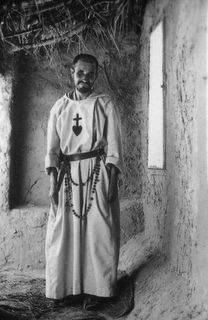
The "Hidden" Life of Jesus in Nazareth…
(Editor’s Note: As I write this piece, I remember our confreres in the Western Sahara, in Turkmenistan, and in the many island of the Sulu Archipelago who spent their entire lives in “mission” understood only in terms of “Nazareth”.)
"Nazareth" for Charles de Foucauld means sharing the life of men and women, like the Son of God, that lead an ordinary, everyday human life.
People who patiently live and work in many Muslim areas are beginning to understand the meaning of the “hidden life” of Jesus in Nazareth. By contemplating on Jesus in Nazareth, they begin to touch the mystery of Jesus’ ordinary and unknown life in Nazareth.
Charles de Foucauld in his almost solitary life in the Sahara concluded that the “fuga mundi” was not the destiny. Like the other great founders of Religious movement (Francis of Assisi, Iñigo Loyola, Francis de Sales, etc.) he understood that this world where the Son of God lived is good, and that it is good for us to live in it too, profoundly, to the point of dying in it so as to transfigure it like "the grain of wheat that falls into the earth and dies".
“Nazareth” is understood not as a “hidden” life that is the opposite of what is visible. It is, rather, an insistence on the need to be in the world and to undertake fully the work of a witness in the world. Charles de Foucauld makes it clear that Francis of Assisi wished to imitate Jesus' public life, while he himself wants to imitate his hidden life. But this imitation of the hidden life is in no way a non-response to the world or a withdrawal from mission.
It is a different type of witness and proclamation. For Charles de Foucauld, it is a question of bringing Christ to "those who do not know him" "preaching not with words, but by example". For him, "the hidden life has not been imitated": it is actually the life he wants to lead in the Church, and his disciples with him. In no way is it hiding as an end in itself, but a striving for fruitfulness: the grain of wheat must die if "it is to bear much fruit".
Charles de Foucauld wanted to transform the death of Jesus as a death to self and a death "to all that is not Jesus". It is witness and proclamation that involve two important points. The first is that of time and of patient waiting. And the second is a sense of goodness.
He spoke of his task in the Sahara as a work a time "of preparation, of the first tilling". Then he spoke of a “sense of patient waiting” with Jesus who, in speaking of his daily duties, said: "All this is to arrive at Jesus Christ, God knows when, perhaps after a few centuries".
If one axis consists in that sense of waiting and great patience which is the opposite of a craving for immediate and spectacular conversion, the other axis can be defined by the sense of goodness. It is a simple goodness, without undue concern for conversion, a "goodness without ideologies", very close to that expressed by Levinas, which is always addressed to a specific human being in his daily life, a friendship in return for friendship, which gives rise to trust.
The acceptance of long delays and a long-term mission, and the desire to strictly respect the culture and convictions of others, could be expressed in what de Foucauld told a layman from Lyons: "Banish the militant spirit from our midst". This term, stressed by de Foucauld, is used by him in its etymological sense: the old soldier does not want to "take up arms" but to engage only, he says, in the "apostolate of goodness". And at the secular level, de Foucauld asked his friends, as he wrote on 21 February 1915 to Massignon, to co-operate in "progress" and "in increasing the material well-being" of the peoples among whom they lived: "There is in this an impulse to give, a collective activity to be organized and private initiatives to be determined, helped and encouraged".
"Nazareth" for Charles de Foucauld means sharing the life of men and women, like the Son of God, that lead an ordinary, everyday human life.
People who patiently live and work in many Muslim areas are beginning to understand the meaning of the “hidden life” of Jesus in Nazareth. By contemplating on Jesus in Nazareth, they begin to touch the mystery of Jesus’ ordinary and unknown life in Nazareth.
Charles de Foucauld in his almost solitary life in the Sahara concluded that the “fuga mundi” was not the destiny. Like the other great founders of Religious movement (Francis of Assisi, Iñigo Loyola, Francis de Sales, etc.) he understood that this world where the Son of God lived is good, and that it is good for us to live in it too, profoundly, to the point of dying in it so as to transfigure it like "the grain of wheat that falls into the earth and dies".
“Nazareth” is understood not as a “hidden” life that is the opposite of what is visible. It is, rather, an insistence on the need to be in the world and to undertake fully the work of a witness in the world. Charles de Foucauld makes it clear that Francis of Assisi wished to imitate Jesus' public life, while he himself wants to imitate his hidden life. But this imitation of the hidden life is in no way a non-response to the world or a withdrawal from mission.
It is a different type of witness and proclamation. For Charles de Foucauld, it is a question of bringing Christ to "those who do not know him" "preaching not with words, but by example". For him, "the hidden life has not been imitated": it is actually the life he wants to lead in the Church, and his disciples with him. In no way is it hiding as an end in itself, but a striving for fruitfulness: the grain of wheat must die if "it is to bear much fruit".
Charles de Foucauld wanted to transform the death of Jesus as a death to self and a death "to all that is not Jesus". It is witness and proclamation that involve two important points. The first is that of time and of patient waiting. And the second is a sense of goodness.
He spoke of his task in the Sahara as a work a time "of preparation, of the first tilling". Then he spoke of a “sense of patient waiting” with Jesus who, in speaking of his daily duties, said: "All this is to arrive at Jesus Christ, God knows when, perhaps after a few centuries".
If one axis consists in that sense of waiting and great patience which is the opposite of a craving for immediate and spectacular conversion, the other axis can be defined by the sense of goodness. It is a simple goodness, without undue concern for conversion, a "goodness without ideologies", very close to that expressed by Levinas, which is always addressed to a specific human being in his daily life, a friendship in return for friendship, which gives rise to trust.
The acceptance of long delays and a long-term mission, and the desire to strictly respect the culture and convictions of others, could be expressed in what de Foucauld told a layman from Lyons: "Banish the militant spirit from our midst". This term, stressed by de Foucauld, is used by him in its etymological sense: the old soldier does not want to "take up arms" but to engage only, he says, in the "apostolate of goodness". And at the secular level, de Foucauld asked his friends, as he wrote on 21 February 1915 to Massignon, to co-operate in "progress" and "in increasing the material well-being" of the peoples among whom they lived: "There is in this an impulse to give, a collective activity to be organized and private initiatives to be determined, helped and encouraged".
Thursday, April 20, 2006
Basetti-Sani's Testimony...
(Editor's Note: Fr. Basetti-Sani, OFM used to visit the Philippines and shared his life and studies on Islam. His special passion was to "connect" the mystical experiences of St. Francis with the important events in the early contacts between the Christians of Najran and the prophet of Islam. This same stories as "lived" by St. Francis inspired the famous painter Giotto in his works at the upper Basilica of St. Francis in Assisi.)
Basetti-Sani writes,” Louis Massignon had alerted me against an unjust condemnation of (Islam) that precluded any sincere and productive dialogue between Christians and Muslims.
Islam is a mystery linked with the blessing obtained by Abraham from God for his son Ishmael and Ishmael's progeny. This line of thought, taken from the Bible, is the one to take in order to grasp the significance of Islam.
Before we parted Massignon gave me two thoughts meant as guidelines in my reorientation. One was from Augustine, ' Love sees with new eyes', and the other was from John of the Coss,'Where there is no love put love, and you will find Love'.
It was true: my eyes had seen badly...Later, when my eyes were to see clearly, I would discover in Islam and the Muslims the reflections of the infinite goodness of God”. (Basetti-Sani. 1977. “The Koran in the Light of Christ” Franciscan Herald Press IL pp..17-18)
Basetti-Sani writes,” Louis Massignon had alerted me against an unjust condemnation of (Islam) that precluded any sincere and productive dialogue between Christians and Muslims.
Islam is a mystery linked with the blessing obtained by Abraham from God for his son Ishmael and Ishmael's progeny. This line of thought, taken from the Bible, is the one to take in order to grasp the significance of Islam.
Before we parted Massignon gave me two thoughts meant as guidelines in my reorientation. One was from Augustine, ' Love sees with new eyes', and the other was from John of the Coss,'Where there is no love put love, and you will find Love'.
It was true: my eyes had seen badly...Later, when my eyes were to see clearly, I would discover in Islam and the Muslims the reflections of the infinite goodness of God”. (Basetti-Sani. 1977. “The Koran in the Light of Christ” Franciscan Herald Press IL pp..17-18)
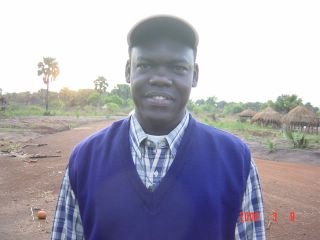
Easter Greetings from South Sudan...
Christ is risen!
Christ is truly risen,
Alleluia…Alleluia
It is not so easy to understand that the life of Jesus did not end on the cross, but that his Father led him from death to eternal life.
Like the women who stood before the empty tomb on the morning of Easter, we will only discover the mystery of the resurrection through faith.
Even when we stand before the tomb of our hopes, not everything is lost. The experience with the Risen Redeemer requires from us that we remain always open for new encounters with Him. Jesus can and will encounter us every day again.
With this in mind, I wish you a Happy Easter and the Blessing of the Risen Redeemer.
May your eyes, your ears, and your hearts always be open for new encounters with Him and with others!
Fr. Emmanuel Lodongo Sebit
Diocese of Yei
Southern Sudan
Christ is truly risen,
Alleluia…Alleluia
It is not so easy to understand that the life of Jesus did not end on the cross, but that his Father led him from death to eternal life.
Like the women who stood before the empty tomb on the morning of Easter, we will only discover the mystery of the resurrection through faith.
Even when we stand before the tomb of our hopes, not everything is lost. The experience with the Risen Redeemer requires from us that we remain always open for new encounters with Him. Jesus can and will encounter us every day again.
With this in mind, I wish you a Happy Easter and the Blessing of the Risen Redeemer.
May your eyes, your ears, and your hearts always be open for new encounters with Him and with others!
Fr. Emmanuel Lodongo Sebit
Diocese of Yei
Southern Sudan
Wednesday, April 19, 2006
Recognizing the Risen Lord in the Breaking of the Bread...
(Wednesday within the Octave of Easter - Luke 24: 13-35)
Bapa Eliseo “Jun” Mercado, OMI
The journey through life is akin to the disciples' walk to Emmaus... It is a journey full of uncertainties and fears, yet hopeful that there is something going on beyond their comprehension.
• First, there is the obstacle that prevents them to recognize the presence of the Risen Lord in their midst.
• Second, there is the fact that the Risen Lord is “completely transformed”. He is beyond look or appearances, beyond taste and touch, and beyond smell and hearing that ordinarily would make our five senses know and recognize a presence.
• Third, there is the remembrance of the Lord’s teaching of “sharing shelter with strangers”, “food to the hungry” and “rest to the weary”. The disciples invited the “Stranger”: “stay with us, because it is almost evening and the day is now nearly over”.
• Fourth, at the shared table, the disciple’s eyes were opened at the BREAKING OF THE BREAD… and they RECOGNIZED THE RISEN LORD!
The key to the mystery of life as we journey through life with all its uncertainties, fears and “untold” expectations… is the capacity to share our lives with others, especially with people in need. That key will open our eyes to recognize the presence of the Risen Lord at the breaking of the Bread. But first, we need to share our table with the poor and the strangers…
Bapa Eliseo “Jun” Mercado, OMI
The journey through life is akin to the disciples' walk to Emmaus... It is a journey full of uncertainties and fears, yet hopeful that there is something going on beyond their comprehension.
• First, there is the obstacle that prevents them to recognize the presence of the Risen Lord in their midst.
• Second, there is the fact that the Risen Lord is “completely transformed”. He is beyond look or appearances, beyond taste and touch, and beyond smell and hearing that ordinarily would make our five senses know and recognize a presence.
• Third, there is the remembrance of the Lord’s teaching of “sharing shelter with strangers”, “food to the hungry” and “rest to the weary”. The disciples invited the “Stranger”: “stay with us, because it is almost evening and the day is now nearly over”.
• Fourth, at the shared table, the disciple’s eyes were opened at the BREAKING OF THE BREAD… and they RECOGNIZED THE RISEN LORD!
The key to the mystery of life as we journey through life with all its uncertainties, fears and “untold” expectations… is the capacity to share our lives with others, especially with people in need. That key will open our eyes to recognize the presence of the Risen Lord at the breaking of the Bread. But first, we need to share our table with the poor and the strangers…
Tuesday, April 18, 2006
"Cut to the heart..."
When the people heard the proclamation that Jesus is RISEN from the dead, "THEY WERE CUT TO THE HEART..." (Acts 2:37)
Like Peter and companions are we able to proclaim, anew, the GOOD NEWS and be witnesses of the Risen Lord that CUT THE HEARTS OF MEN AND WOMEN of our times..?
Like Peter and companions are we able to proclaim, anew, the GOOD NEWS and be witnesses of the Risen Lord that CUT THE HEARTS OF MEN AND WOMEN of our times..?
Monday, April 17, 2006
Pasquetta Reflection... Confession and Belief
"But what saith it? The word is nigh thee, even in thy mouth, and in thy heart: that is, the word of faith, which we preach; that if thou shall confess with thy mouth the Lord Jesus, and shall believe in thine heart that God hath raised him from the dead, thou shall be saved. For with the heart man believeth unto righteousness; and with the mouth confession is made unto salvation." (Romans 10: 8-10)

Saturday, April 15, 2006
Easter Dhikr
"Do not be alarmed; you are looking for Jesus of Nazareth. who was crucified. He has been raised; he is not here. Look, there is the place they laid him." (Mark 16: 6)
Jesus is, truly, Risen! Alleluia! With Jesus' resurrection we have the guarantee that, in the end, good shall prevail over evil; life over death; and grace over sin!
Easter Blessings to one and all!
Love and Prayers,
Bapa Eliseo "Jun" Mercado, OMI
Rome, Italy
Easter 2006
Jesus is, truly, Risen! Alleluia! With Jesus' resurrection we have the guarantee that, in the end, good shall prevail over evil; life over death; and grace over sin!
Easter Blessings to one and all!
Love and Prayers,
Bapa Eliseo "Jun" Mercado, OMI
Rome, Italy
Easter 2006
Friday, April 14, 2006
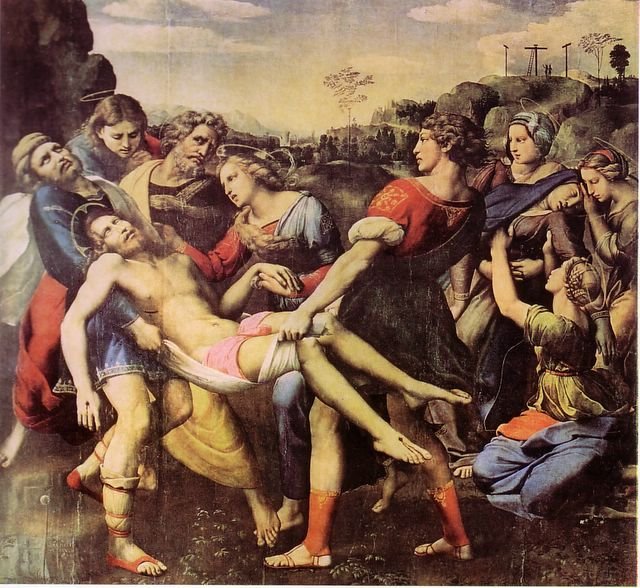
Jesus Christ: Our Ransom that we may have life to the full!
Jesus Christ is our Ransom...
Bapa Eliseo "Jun" Mercado, OMI
The celebration of the Lord's Passion is the narrative of the PRICE Jesus paid that we may have life...
• He experienced the betrayal by one of his own …
• He found himself all alone before the powers of the world…
• The Custodians of the Law and the Covenant condemned him to die…
• The power of this world washed its hands and gave him away to be flogged and crucified…
• He was abandoned in his utter powerlessness and weakness…
• He died on the Cross as our Ransom!
Jesus was steadfast in his obedience to the will of his Father… He embraced, albeit with fear and trembling, the consequences of his decision to pay the PRICE that we may live and live to the full.
In Jesus’ Passion and Resurrection, our God is, truly, revealed…
• Our God is NOT the all powerful one, but the God who loves and who is willing to pay the price that we may have life.
• Our God is NOT the all victorious one, but the God who is courageous to rise up in every fall and always ready to pick up the pieces and to begin anew.
• Our God is the bread broken and shared and the blood shed to free us from the tyranny of sin and the evil in our heart
• Our God brings to fulfillment the covenant established with us by the blood of Jesus, our Lord! God’s fidelity endures for thousands of generations.
“It is finished!”
Go and tell the whole world, the Good News that Jesus who died for us on the CROSS is RISEN!
Happy Easter to one and all!!!
Bapa Eliseo "Jun" Mercado, OMI
The celebration of the Lord's Passion is the narrative of the PRICE Jesus paid that we may have life...
• He experienced the betrayal by one of his own …
• He found himself all alone before the powers of the world…
• The Custodians of the Law and the Covenant condemned him to die…
• The power of this world washed its hands and gave him away to be flogged and crucified…
• He was abandoned in his utter powerlessness and weakness…
• He died on the Cross as our Ransom!
Jesus was steadfast in his obedience to the will of his Father… He embraced, albeit with fear and trembling, the consequences of his decision to pay the PRICE that we may live and live to the full.
In Jesus’ Passion and Resurrection, our God is, truly, revealed…
• Our God is NOT the all powerful one, but the God who loves and who is willing to pay the price that we may have life.
• Our God is NOT the all victorious one, but the God who is courageous to rise up in every fall and always ready to pick up the pieces and to begin anew.
• Our God is the bread broken and shared and the blood shed to free us from the tyranny of sin and the evil in our heart
• Our God brings to fulfillment the covenant established with us by the blood of Jesus, our Lord! God’s fidelity endures for thousands of generations.
“It is finished!”
Go and tell the whole world, the Good News that Jesus who died for us on the CROSS is RISEN!
Happy Easter to one and all!!!
Thursday, April 13, 2006
Mourning a dear friend: Sr. Hope, RGS...
Sr. Esperanza “Parang” Quirino, RGS
(A partner, co-workers, mentor and a very dear FRIEND)
On Saturday, 8 April 2006, I received an email that a beloved friend, Sr. Parang also known as Sr. Hope passed away at 7:30 am on the same day.
The succinct announcement of her passing away said it all who this person was…
“Yes, our dear Parang has gone home to our Shepherd God at 7:30 this morning. Last night at past 10:00 pm. Parang collapsed on her way home from Church after “kumpisalan ng Bayan” (Communal Penitential Rite). She was conscious up to the end. The people were around her in the hospital. She even asked them to sing. The parish priest came who joined them for singing. Then he administered the anointing of the sick and after this she just passed quietly. She kept on telling them earlier that she could see her mother fetching her. Parang is an example of one who died with her "slippers” on.”
That same day and the days that followed, I mourned for her and reminisced the years we were together in Kabacan, North Cotabato. It was a reminiscence of a shared ministry with all the joys, hardships, frustrations and success characterized by deep bond of friendship not only between Parang and I but more so a remembrance of God’s love and care for the people of Kabacan and for the workers of the Gospel.
Kabacan was known, then, as a real “tough” place! Few people dared to cross the great Aringay River known to many as “Ilocoskovakia”.
The Ilocanos, of all the migrant peoples of the Cotabato valley, are known for hard work and thrift. They expect no less from their ministers!
By God’s providence, I was a “superman” Pastor of the place from 1976-80, and Sr. Parang was a “superwoman” Parish Sister.
Looking back, it must be “terrible”, awesome and fascinating, as well,sight to see a team of a “superman” and a “superwoman” trying to evangelize and conscientize the heart of “Ilocandia” in Cotabato valley during the Martial Law years of the great Ilocano Dictator, Apo Ferdinand Marcos, then President of the Republic of the Philippines.
Parang was a GREAT ILOCANA! There was in her an immediate recognition of “something made in Ilocos” by the people, especially the older generations who came from the Ilocos region. She was one of them and they saw in her, yet, another GREAT ILOCANO –her uncle, Elpidio Quirino, the second President of the Republic.
Parang was a great and patient mentor, particularly in everything Ilocano, including the language. She would translate into Ilocano my homilies and interventions in assemblies until I developed the courage to speak it and made it my own. With Parang and some lay leaders, we developed an Ilocano Cursillo and through the cursillo developed the basic Christian Community in the barrios of Kabacan.
Parang was an example of a Missionary Religious with “FIRE” - a Passion for Christ and Compassion for humanity”. She was tireless in her ministry, especially to the poor and the most marginalized. True to her RGS slogan: she made the poor and the most abandoned feel most important and valuable persons in the eyes of God.
Even before death, distance, space and times were never obstacles to her dedicated service. Her speed and travels were phenomenal – by bus, by boat or by TDK (truck de karga)! She was devotee of the God of the impossible!
But what stood out was not her wonderful works or speed, but her testimony to a deep prayer life and a simple life-style. Many times, she would say that she had to pray hard and lead a simple and frugal life because she talked too much and she was an Ilocana!
From her I learned that prayer is the important ingredient to a happy missionary life. We all have our share of frustrations, failures and successes. But what truly spells the difference is our faith and trust in God as we stand before him in prayer.
As I mourned Parang’s passage into a new life, I am assured, more than ever, of the mystery of the resurrection.
The 2006 celebration of Holy Week, particularly of the Triduum, has become special to me… as I mourn my friend's passing away.
As my unlce Johnny wirtes in his Sunday column, the passing away of friend is the mystery of encountering anew the crucified Jesus in a new way.
Like the disciples at Emmaus, it is an experience of "our eyes were opened," the evangelists add, "and they recognized Him in the breaking of bread".
They met Jesus after Calvary and arrived at certitude: this Jesus who died on the cross had entered into a radically transformed life. They "brought Peter the Rock out of Simon the betrayer, or the executed Paul out of the executing Saul, or the church of martyrs out of the scattered and fearful disciples."
The disciples’ experience has been refracted to us over the centuries. Even those who live out the implications of Easter—Mother Teresa or John Paul II or the Christians in South Sudan - stammer to articulate its meaning.
"Not everything has a name," Aleksandhr Solzhenitsyn writes. "Some things lead us into the realm beyond words…For an instant, you glimpse the Inaccessible. And the soul cries out for it." (Bapa Eliseo Mercado, OMI)
(A partner, co-workers, mentor and a very dear FRIEND)
On Saturday, 8 April 2006, I received an email that a beloved friend, Sr. Parang also known as Sr. Hope passed away at 7:30 am on the same day.
The succinct announcement of her passing away said it all who this person was…
“Yes, our dear Parang has gone home to our Shepherd God at 7:30 this morning. Last night at past 10:00 pm. Parang collapsed on her way home from Church after “kumpisalan ng Bayan” (Communal Penitential Rite). She was conscious up to the end. The people were around her in the hospital. She even asked them to sing. The parish priest came who joined them for singing. Then he administered the anointing of the sick and after this she just passed quietly. She kept on telling them earlier that she could see her mother fetching her. Parang is an example of one who died with her "slippers” on.”
That same day and the days that followed, I mourned for her and reminisced the years we were together in Kabacan, North Cotabato. It was a reminiscence of a shared ministry with all the joys, hardships, frustrations and success characterized by deep bond of friendship not only between Parang and I but more so a remembrance of God’s love and care for the people of Kabacan and for the workers of the Gospel.
Kabacan was known, then, as a real “tough” place! Few people dared to cross the great Aringay River known to many as “Ilocoskovakia”.
The Ilocanos, of all the migrant peoples of the Cotabato valley, are known for hard work and thrift. They expect no less from their ministers!
By God’s providence, I was a “superman” Pastor of the place from 1976-80, and Sr. Parang was a “superwoman” Parish Sister.
Looking back, it must be “terrible”, awesome and fascinating, as well,sight to see a team of a “superman” and a “superwoman” trying to evangelize and conscientize the heart of “Ilocandia” in Cotabato valley during the Martial Law years of the great Ilocano Dictator, Apo Ferdinand Marcos, then President of the Republic of the Philippines.
Parang was a GREAT ILOCANA! There was in her an immediate recognition of “something made in Ilocos” by the people, especially the older generations who came from the Ilocos region. She was one of them and they saw in her, yet, another GREAT ILOCANO –her uncle, Elpidio Quirino, the second President of the Republic.
Parang was a great and patient mentor, particularly in everything Ilocano, including the language. She would translate into Ilocano my homilies and interventions in assemblies until I developed the courage to speak it and made it my own. With Parang and some lay leaders, we developed an Ilocano Cursillo and through the cursillo developed the basic Christian Community in the barrios of Kabacan.
Parang was an example of a Missionary Religious with “FIRE” - a Passion for Christ and Compassion for humanity”. She was tireless in her ministry, especially to the poor and the most marginalized. True to her RGS slogan: she made the poor and the most abandoned feel most important and valuable persons in the eyes of God.
Even before death, distance, space and times were never obstacles to her dedicated service. Her speed and travels were phenomenal – by bus, by boat or by TDK (truck de karga)! She was devotee of the God of the impossible!
But what stood out was not her wonderful works or speed, but her testimony to a deep prayer life and a simple life-style. Many times, she would say that she had to pray hard and lead a simple and frugal life because she talked too much and she was an Ilocana!
From her I learned that prayer is the important ingredient to a happy missionary life. We all have our share of frustrations, failures and successes. But what truly spells the difference is our faith and trust in God as we stand before him in prayer.
As I mourned Parang’s passage into a new life, I am assured, more than ever, of the mystery of the resurrection.
The 2006 celebration of Holy Week, particularly of the Triduum, has become special to me… as I mourn my friend's passing away.
As my unlce Johnny wirtes in his Sunday column, the passing away of friend is the mystery of encountering anew the crucified Jesus in a new way.
Like the disciples at Emmaus, it is an experience of "our eyes were opened," the evangelists add, "and they recognized Him in the breaking of bread".
They met Jesus after Calvary and arrived at certitude: this Jesus who died on the cross had entered into a radically transformed life. They "brought Peter the Rock out of Simon the betrayer, or the executed Paul out of the executing Saul, or the church of martyrs out of the scattered and fearful disciples."
The disciples’ experience has been refracted to us over the centuries. Even those who live out the implications of Easter—Mother Teresa or John Paul II or the Christians in South Sudan - stammer to articulate its meaning.
"Not everything has a name," Aleksandhr Solzhenitsyn writes. "Some things lead us into the realm beyond words…For an instant, you glimpse the Inaccessible. And the soul cries out for it." (Bapa Eliseo Mercado, OMI)
Saturday, April 08, 2006

Good Friday People
GOOD FRIDAY PEOPLE by Juan L. Mercado
( Looking for a book that will carry you beyond Palm Sunday? Written by Dr. Shiela Cassidy, “Good Friday People” looks at broken men and women – and the grace that shines through them. She was jailed and tortured by the Chilean military, for treating rebels. Dr Cassidy is a UK hospice medical director -- Juan L. Mercado )
"Good Friday people is a phrase I coined, for those who find themselves called to powerlessness and suffering,” she writes. “(These) are men and women, broken in body and assaulted in mind --- deprived not merely of things we take for granted.
"God calls them to walk the same road His Son trod.... I have no clever answer to the eternal 'Why' of suffering . But whatever it's cause and outcome, it is never without meaning."
Nobel laureate Elie Wiesel captures this “sense of the absence of God”, Cassidy notes. Then 14-years old, Weisel was forced, along with other Jewish prisoners at Auschwitz , to watch the Gestapo execute a child.
"Where is God? Where is He now?’ someone behind me asked, Weisel recalls in his book: Night "And I heard a voice within me answer him: ‘Where is He?. Here He is ---He is here hanging on this gallows..
“Never shall I forget these moments which murdered my God and turned my dreams into dust, " Weisel added. "Never shall I forget even if I am condemned to live as long as God Himself. Never."
Weisel had the look of a “Lazarus, risen from the dead yet still a prisoner…stumbling among shameful corpses,” recalled Catholic philosopher Francois Mauriac. In his foreword to Night, Mauriac wrote :
"And I, who believed that God is love, what answer could I give my young questioner whose dark eyes still held the reflection of that angelic sadness which appeared on the face of the hanged child?
"Did I speak to him of that other Israeli, his brother --- the Crucified, whose cross conquered the world?... Did I affirm that conformity to the Cross and suffering was, in my eyes, the key to that impenetrable mystery whereon the faith of his childhood had perished..?
"We do not know the worth of one single drop of blood, one single tear. All is grace. If the Eternal is the Eternal, the last word for each one of us belongs to Him. This is what I should have told this Jewish child," Mauriac adds. "But I could only embrace him weeping."
In her book, Cassidy accompanies "Good Friday people" -- from El Salvador’s Oscar Romero, the timid priest who emerged into a fearless defender of the descamisados, sick people, Maryknoll nun Eta Ford to Marxist folk singer Victor Jara.
Their suffering "make us want to screen our faces, to turn away," Cassidy writes. "Yet, is through them that the grace of God flows to our arid souls... There is a terrible agony in watching someone hollowed out with a knife…even if the end result is an instrument on which is played the music of the universe”.
There is Beth and her third bout with cancer. "Unable to wait for her to die, her man had gone off with another woman. She “spent a life of drawing short straws'." Or the dying Katie. "Day after day, she waited. But the visitor never came: not her mother, nor her lovers, not even her children."
Catherine’s tumor had spread to her brain. She had few symptoms but soon she’d be in deep trouble. Radio therapy could only buy time. “I just want whatever is best for my daughter,” she said as tears fell.
“There is rare beauty in selflessness of this kind,” Cassidy writes. “Some go to their deaths grasping everything. These are people who will call you away from another patient’s deathbed to adjust their television.”
Jesuit priest Rutilo Grande insisted his El Salvador seminarians live among slum dwellers and landless peasants. “However much one may know about poverty and oppression at an intellectual level, meeting the poor themselves is something quite other.”
Like that of Archbishop Oscar Romero, Father Grande’s efforts, helped the poor "rediscover the Old Testament concept of God as liberator of his oppressed people." It was the poor who showed Grande and Romero “what they required of their church,” Cassidy notes. “Not just the catechism and the sacraments but something much harder : to speak out against injustice”.
The military junta goons killed both of them, of course.
But Grande’s system of exposure to “Good Friday people” anchors seminary training today, including the Philippines. And Romero’s address, on receiving the Nobel Peace prize in 1980, still resounds:
“There are those who sell a just man for money and a poor man for a pair of sandals…It is the poor who force us to understand what is really taking place…The poor are the body of Christ. Through them, He lives on in history.” .
Ironically, it is often non-believers who seem closest to following Christ. Chilean singer Victor Jara abandoned studies for the priesthood “and put his ‘honest guitar’ to work on behalf of the marginalized. He too was killed.
“Should I be speaking of a Marxist folk-singer in the same breath as Jesus?,” Cassidy asks. “The answer is surely yes. For did he not embark on his road to Calvary in response to a call to serve the poor.”
"( Yet ), we are all potentially Good Friday people. We are all frail earthen vessels who, should the potter choose, be fashioned in His image and for his own mysterious purposes….And we tremble because we too may be called to powerlessness... “ (Juan Mercado is my uncle and the doyen of Philippine journalism)
( Looking for a book that will carry you beyond Palm Sunday? Written by Dr. Shiela Cassidy, “Good Friday People” looks at broken men and women – and the grace that shines through them. She was jailed and tortured by the Chilean military, for treating rebels. Dr Cassidy is a UK hospice medical director -- Juan L. Mercado )
"Good Friday people is a phrase I coined, for those who find themselves called to powerlessness and suffering,” she writes. “(These) are men and women, broken in body and assaulted in mind --- deprived not merely of things we take for granted.
"God calls them to walk the same road His Son trod.... I have no clever answer to the eternal 'Why' of suffering . But whatever it's cause and outcome, it is never without meaning."
Nobel laureate Elie Wiesel captures this “sense of the absence of God”, Cassidy notes. Then 14-years old, Weisel was forced, along with other Jewish prisoners at Auschwitz , to watch the Gestapo execute a child.
"Where is God? Where is He now?’ someone behind me asked, Weisel recalls in his book: Night "And I heard a voice within me answer him: ‘Where is He?. Here He is ---He is here hanging on this gallows..
“Never shall I forget these moments which murdered my God and turned my dreams into dust, " Weisel added. "Never shall I forget even if I am condemned to live as long as God Himself. Never."
Weisel had the look of a “Lazarus, risen from the dead yet still a prisoner…stumbling among shameful corpses,” recalled Catholic philosopher Francois Mauriac. In his foreword to Night, Mauriac wrote :
"And I, who believed that God is love, what answer could I give my young questioner whose dark eyes still held the reflection of that angelic sadness which appeared on the face of the hanged child?
"Did I speak to him of that other Israeli, his brother --- the Crucified, whose cross conquered the world?... Did I affirm that conformity to the Cross and suffering was, in my eyes, the key to that impenetrable mystery whereon the faith of his childhood had perished..?
"We do not know the worth of one single drop of blood, one single tear. All is grace. If the Eternal is the Eternal, the last word for each one of us belongs to Him. This is what I should have told this Jewish child," Mauriac adds. "But I could only embrace him weeping."
In her book, Cassidy accompanies "Good Friday people" -- from El Salvador’s Oscar Romero, the timid priest who emerged into a fearless defender of the descamisados, sick people, Maryknoll nun Eta Ford to Marxist folk singer Victor Jara.
Their suffering "make us want to screen our faces, to turn away," Cassidy writes. "Yet, is through them that the grace of God flows to our arid souls... There is a terrible agony in watching someone hollowed out with a knife…even if the end result is an instrument on which is played the music of the universe”.
There is Beth and her third bout with cancer. "Unable to wait for her to die, her man had gone off with another woman. She “spent a life of drawing short straws'." Or the dying Katie. "Day after day, she waited. But the visitor never came: not her mother, nor her lovers, not even her children."
Catherine’s tumor had spread to her brain. She had few symptoms but soon she’d be in deep trouble. Radio therapy could only buy time. “I just want whatever is best for my daughter,” she said as tears fell.
“There is rare beauty in selflessness of this kind,” Cassidy writes. “Some go to their deaths grasping everything. These are people who will call you away from another patient’s deathbed to adjust their television.”
Jesuit priest Rutilo Grande insisted his El Salvador seminarians live among slum dwellers and landless peasants. “However much one may know about poverty and oppression at an intellectual level, meeting the poor themselves is something quite other.”
Like that of Archbishop Oscar Romero, Father Grande’s efforts, helped the poor "rediscover the Old Testament concept of God as liberator of his oppressed people." It was the poor who showed Grande and Romero “what they required of their church,” Cassidy notes. “Not just the catechism and the sacraments but something much harder : to speak out against injustice”.
The military junta goons killed both of them, of course.
But Grande’s system of exposure to “Good Friday people” anchors seminary training today, including the Philippines. And Romero’s address, on receiving the Nobel Peace prize in 1980, still resounds:
“There are those who sell a just man for money and a poor man for a pair of sandals…It is the poor who force us to understand what is really taking place…The poor are the body of Christ. Through them, He lives on in history.” .
Ironically, it is often non-believers who seem closest to following Christ. Chilean singer Victor Jara abandoned studies for the priesthood “and put his ‘honest guitar’ to work on behalf of the marginalized. He too was killed.
“Should I be speaking of a Marxist folk-singer in the same breath as Jesus?,” Cassidy asks. “The answer is surely yes. For did he not embark on his road to Calvary in response to a call to serve the poor.”
"( Yet ), we are all potentially Good Friday people. We are all frail earthen vessels who, should the potter choose, be fashioned in His image and for his own mysterious purposes….And we tremble because we too may be called to powerlessness... “ (Juan Mercado is my uncle and the doyen of Philippine journalism)
Friday, April 07, 2006
Allowing God to be God...
On Idolatry…
Bapa Eliseo Mercado, OMI
God is both ….
• the seen and the unseen…
• the known and the unknown…
• the evident and the hidden…
• the near and the far…
Our refusal to let God BE God leads to the creation of idols unto our own image and likeness! Often our ways, thoughts and deeds are NOT God’s. We begin to fashion our idols by…
• our refusal to be nobody compared to God the greatest of all...
• by substituting the God who cares to our surety in our “finger tips”...
• by taking him for granted, especially when we have not need of God...
• by our failure to follow the way of justice & righteousness...
• by holding on to the inconsistencies between my knowing and reality…
• by believing our WRONG FOCUS - the idol- of god...
LET US DESTROY THE IDOLS WE HAVE FASHIONED AND ALLOW GOD TO BE GOD…!
The week before Holy Week, the three young men, Shadrach, Meshach and Abednego, in Daniel 3: 13-20 show us with GREAT COURAGE and FAITH what it means to believe in Yahweh. Before kings and potentates of this world, we have no need to present a defence in whom and on what we believe. They invite us to confess, by our lives, words and deeds, that we shall not serve any other gods and we shall not worship gold, power and establishment that have long been our idols all these years…
Bapa Eliseo Mercado, OMI
God is both ….
• the seen and the unseen…
• the known and the unknown…
• the evident and the hidden…
• the near and the far…
Our refusal to let God BE God leads to the creation of idols unto our own image and likeness! Often our ways, thoughts and deeds are NOT God’s. We begin to fashion our idols by…
• our refusal to be nobody compared to God the greatest of all...
• by substituting the God who cares to our surety in our “finger tips”...
• by taking him for granted, especially when we have not need of God...
• by our failure to follow the way of justice & righteousness...
• by holding on to the inconsistencies between my knowing and reality…
• by believing our WRONG FOCUS - the idol- of god...
LET US DESTROY THE IDOLS WE HAVE FASHIONED AND ALLOW GOD TO BE GOD…!
The week before Holy Week, the three young men, Shadrach, Meshach and Abednego, in Daniel 3: 13-20 show us with GREAT COURAGE and FAITH what it means to believe in Yahweh. Before kings and potentates of this world, we have no need to present a defence in whom and on what we believe. They invite us to confess, by our lives, words and deeds, that we shall not serve any other gods and we shall not worship gold, power and establishment that have long been our idols all these years…
Tuesday, April 04, 2006

John Paul II - the LAMP
"Death is not the extinguishing of life," the Nobel Laureate Rabindranath Tagore wrote. "It is putting out the lamp because dawn has come."
In his final illness, John Paul II taught us how to put out the lamp when the final letting go is asked, as it will be for all of us.
Our celebration of his first death anniversary reminds us of the URGENT NEED to light NEW LAMPS in our very vulnerable and fragile world...
WANTED NEW LAMPS!!!
In his final illness, John Paul II taught us how to put out the lamp when the final letting go is asked, as it will be for all of us.
Our celebration of his first death anniversary reminds us of the URGENT NEED to light NEW LAMPS in our very vulnerable and fragile world...
WANTED NEW LAMPS!!!
Wednesday, March 29, 2006
Testament of Dom Christian de Cherge - Martyr & Badal
(We celebrate the 10th Anniversary of the MARTYRDOM of the 7 Trappist Monks of Tibhirine in Algeria.
On the night of March 26-27, 1996, some 20 gunmen invaded the Monastery of Notre Dame of Atlas in Tibhirine and kidnapped its seven Trappist monks, of French nationality.
A month later, Djamel Zitouni, leader of the Armed Islamic Groups, claimed responsibility for the kidnappings and proposed an exchange of prisoners to France.
The following month, a second communiqué from the group announced: "We have slit the monks' throats." The killings reportedly took place May 21, 1996; their bodies were found nine days later.)
This TESTAMENT was opened on Pentecost Sunday, May 26, 1996)
Facing a GOODBYE ...
If it should happen one day -- and it could be today -- that I become a victim of the terrorism which now seems ready to engulf all the foreigners living in Algeria, I would like my community, my Church and my family to remember that my life was GIVEN to God and to this country.
I ask them to accept the fact that the One Master of all life was not a stranger to this brutal departure.
I would ask them to pray for me: for how could I be found worthy of such an offering?
I ask them to associate this death with so many other equally violent ones which are forgotten through indifference or anonymity.
My life has no more value than any other. Nor any less value. In any case, it has not the innocence of childhood.
I have lived long enough to know that I am an accomplice in the evil which seems to prevail so terribly in the world, even in the evil which might blindly strike me down.
I should like, when the time comes, to have a moment of spiritual clarity which would allow me to beg forgiveness of God and of my fellow human beings, and at the same time forgive with all my heart the one who would strike me down.
I could not desire such a death. It seems to me important to state this.
I do not see, in fact, how I could rejoice if the people I love were indiscriminately accused of my murder.
It would be too high a price to pay for what will perhaps be called, the "grace of martyrdom" to owe it to an Algerian, whoever he might be, especially if he says he is acting in fidelity to what he believes to be Islam.
I am aware of the scorn which can be heaped on the Algerians indiscriminately.
I am also aware of the caricatures of Islam which a certain Islamism fosters.
It is too easy to soothe one's conscience by identifying this religious way with the fundamentalist ideology of its extremists.
For me, Algeria and Islam are something different: it is a body and a soul.
I have proclaimed this often enough, I think, in the light of what I have received from it.
I so often find there that true strand of the Gospel which I learned at my mother's knee, my very first Church, precisely in Algeria, and already inspired with respect for Muslim believers.
Obviously, my death will appear to confirm those who hastily judged me naive or idealistic:
"Let him tell us now what he thinks of his ideals!"
But these persons should know that finally my most avid curiosity will be set free.
This is what I shall be able to do, God willing: immerse my gaze in that of the Father to contemplate with him His children of Islam just as He sees them, all shining with the glory of Christ, the fruit of His Passion, filled with the Gift of the Spirit whose secret joy will always be to establish communion and restore the likeness, playing with the differences.
For this life lost, totally mine and totally theirs, I thank God, who seems to have willed it entirely for the sake of that JOY in everything and in spite of everything.
In this THANK YOU, which is said for everything in my life from now on, I certainly include you, friends of yesterday and today, and you, my friends of this place, along with my mother and father, my sisters and brothers and their families -- you are the hundredfold granted as was promised!
And also you, my last-minute friend, who will not have known what you were doing:
Yes, I want this THANK YOU and this GOODBYE to be a "GOD BLESS" for you, too, because in God's face I see yours.
May we meet again as happy thieves in Paradise, if it please God, the Father of us both.
AMEN! INSHALLAH!
Algiers, 1st December 1993
Tibhirine, 1st January 1994
Christian +
(From Zenith ZE06032821)
On the night of March 26-27, 1996, some 20 gunmen invaded the Monastery of Notre Dame of Atlas in Tibhirine and kidnapped its seven Trappist monks, of French nationality.
A month later, Djamel Zitouni, leader of the Armed Islamic Groups, claimed responsibility for the kidnappings and proposed an exchange of prisoners to France.
The following month, a second communiqué from the group announced: "We have slit the monks' throats." The killings reportedly took place May 21, 1996; their bodies were found nine days later.)
This TESTAMENT was opened on Pentecost Sunday, May 26, 1996)
Facing a GOODBYE ...
If it should happen one day -- and it could be today -- that I become a victim of the terrorism which now seems ready to engulf all the foreigners living in Algeria, I would like my community, my Church and my family to remember that my life was GIVEN to God and to this country.
I ask them to accept the fact that the One Master of all life was not a stranger to this brutal departure.
I would ask them to pray for me: for how could I be found worthy of such an offering?
I ask them to associate this death with so many other equally violent ones which are forgotten through indifference or anonymity.
My life has no more value than any other. Nor any less value. In any case, it has not the innocence of childhood.
I have lived long enough to know that I am an accomplice in the evil which seems to prevail so terribly in the world, even in the evil which might blindly strike me down.
I should like, when the time comes, to have a moment of spiritual clarity which would allow me to beg forgiveness of God and of my fellow human beings, and at the same time forgive with all my heart the one who would strike me down.
I could not desire such a death. It seems to me important to state this.
I do not see, in fact, how I could rejoice if the people I love were indiscriminately accused of my murder.
It would be too high a price to pay for what will perhaps be called, the "grace of martyrdom" to owe it to an Algerian, whoever he might be, especially if he says he is acting in fidelity to what he believes to be Islam.
I am aware of the scorn which can be heaped on the Algerians indiscriminately.
I am also aware of the caricatures of Islam which a certain Islamism fosters.
It is too easy to soothe one's conscience by identifying this religious way with the fundamentalist ideology of its extremists.
For me, Algeria and Islam are something different: it is a body and a soul.
I have proclaimed this often enough, I think, in the light of what I have received from it.
I so often find there that true strand of the Gospel which I learned at my mother's knee, my very first Church, precisely in Algeria, and already inspired with respect for Muslim believers.
Obviously, my death will appear to confirm those who hastily judged me naive or idealistic:
"Let him tell us now what he thinks of his ideals!"
But these persons should know that finally my most avid curiosity will be set free.
This is what I shall be able to do, God willing: immerse my gaze in that of the Father to contemplate with him His children of Islam just as He sees them, all shining with the glory of Christ, the fruit of His Passion, filled with the Gift of the Spirit whose secret joy will always be to establish communion and restore the likeness, playing with the differences.
For this life lost, totally mine and totally theirs, I thank God, who seems to have willed it entirely for the sake of that JOY in everything and in spite of everything.
In this THANK YOU, which is said for everything in my life from now on, I certainly include you, friends of yesterday and today, and you, my friends of this place, along with my mother and father, my sisters and brothers and their families -- you are the hundredfold granted as was promised!
And also you, my last-minute friend, who will not have known what you were doing:
Yes, I want this THANK YOU and this GOODBYE to be a "GOD BLESS" for you, too, because in God's face I see yours.
May we meet again as happy thieves in Paradise, if it please God, the Father of us both.
AMEN! INSHALLAH!
Algiers, 1st December 1993
Tibhirine, 1st January 1994
Christian +
(From Zenith ZE06032821)
Thursday, February 23, 2006
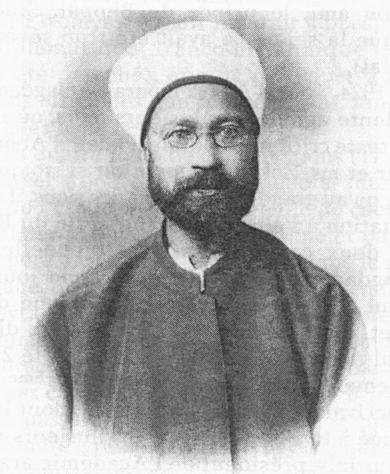
Tuesday, February 21, 2006
Louis Massignon's Vision of Hospitality for Christian-Muslim Relations
Louis Massignon was one of the most important scholars of Islam who ever lived. His influence on the study of Islam in the West was far-reaching, but Massignon was far more than an influential academic. His engagement with Islam was deeply personal and marked his life in profound and dramatic ways.
In a preface to a 1999 biography, Boutros Boutros-Ghali, the former secretary-general of the United Nations, paid tribute to Massignon's passionate engagement with the Other: "Louis Massignon invites us to enter into... the rediscovery of the original dialogue between cultures and religious. ... At a time when our world is prey to new waves of intolerance and new fundamentalisms ... we need to revive, in the hearts of men, this existential spirituality of Louis Massignon: dialogue, openness and tolerance."
A turning point in Massignon's life and the onset of his personal relationship with Islam began at the approach of dawn on May 3, 1908. While being held prisoner aboard a steamship on the Tigris River, accused of being a spy, Louis Massignon received a visit from a "Stranger without a Face" who took away everything he was and gave him everything he would become. Many years later, when he tried to describe this experience, Massignon stammered and resorted to metaphors. Massignon wrote that he saw himself as God, his judge, saw him at that moment--depraved and pretentious, worse than useless, undeserving of love or mercy or even of existence. He had abandoned the faith of his childhood; he was an active homosexual, a slave to his passions.
Massignon reported the execution of this judgment was suspended due to the prayers of five intercessors: Massignon's mother, the writer Juris Huysman who had prayed for Massignon on his deathbed, the Saharan hermit Charles de Foucauld, the tenth-century Sufi mystic al-Hallaj, and the Alousi family, pious Muslims who had given Massignon hospitality in Baghdad. It was thanks to these intercessors, both Christian and Muslim, that he was able to receive pardon. Massignon would later marvel that the prayer that spontaneously came to his lips after the mysterious visitation was in Arabic: "O God, O God, have mercy on me in my weakness!"
Louis Massignon was born on July 25, 1883, at Nogent-sur-Marne. His father was a sculptor who was well known in the French artistic community. Massignon was fascinated by Africa and the desert from his youth. His first trip to Algeria in 1901 confirmed his passion for this totally different world. By the age of 20 he had ceased to practice his Catholic faith and declared himself an agnostic. In 1904 he traveled to Morocco and began to seriously study both classical and dialectic Arab. In 1906 he was in Cairo. There he learned of the legends of al-Hallaj and met Luis de Cuadra, a Spanish nobleman, a convert to Islam, who became his lover and companion. The following year Massignon was sent by the French ministry of education to Baghdad for an archeological expedition into the Mesopotamian desert. It was during this mission that he was detained and accused of espionage and experienced his visitation from God.
While in Baghdad, Massignon had presented himself to the Alousi family of whom he had heard good reports. They didn't know him and had every reason to be suspicious of him. Yet they gave him hospitality, made him part of the family, shared everything with him and protected him as one of their own. After his capture, at great risk to themselves, the Alousi family rescued Massignon when the steamship he was on arrived in Baghdad. They made sure he received the medical attention he needed and helped him escape from Iraq.
When the "Stranger without a Face" presented himself to Massignon, it was like a reversal of his own role with the Alousis. The fact that he had been received as a faceless stranger enabled him to receive the divine visitation. Massignon never forgot that he owed his physical and moral salvation to the hospitality of this Muslim family. Through them and his other intercessors, Massignon encountered the God of Abraham, Isaac and Jacob, the Father, Son and Holy Spirit.
Hospitality, one of the sacred duties of Islam, became a leitmotif for him, a lens through which he saw the entirety of God's relationship with us and our relationship to one another. To receive the other such as he is, in his strangeness and mystery, to accept him and share with him and, at the same time, be received--in this consists the Law and the Prophets and the Fiat, the gracious acceptance of the Incarnate Word by the Virgin Mary.
Massignon's other Muslim intercessor was al-Hallaj. One of the reasons Massignon traveled to Baghdad was his decision to write his doctoral dissertation on this 10th-century mystic who suffered greatly from the divisions in Islam and dreamed of a unified Muslim community. Although his God was the transcendent God of Islam, al-Hallaj claimed an intimate, loving relationship with him. Because of this, Al-Hallaj was condemned as a heretic and crucified; his body was cremated and his ashes thrown into the Tigris River in the area in which Massignon received his visitation.
The rest of Massignon's life was an unfolding of his experience with the Stranger and was dedicated to repaying his debt to his Muslim intercessors. For the next 50 years he studied and made known the life and sayings of al-Hallaj. The quality of his relationship with the mystic/martyr is strikingly summarized in a text written in 1932: "It is not that the study of his [al-Hallaj's] life, full and strong, righteous and undivided, ascending and dedicated, has revealed to me the secret of his heart. It is rather al-Hallaj who has penetrated my heart and penetrates it still."
Massignon thought about the priesthood and about joining missionary priest Charles de Foucauld in the Sahara but finally opted for marriage. Mobilized as an officer in the First World War, he was first stationed in Macedonia, then sent to Syria and Palestine as an aide to the French high commissioner. When Jerusalem was liberated from the Ottoman Turks, Massignon entered the Holy City alongside Lawrence of Arabia. He suffered bitterly when the Allies later broke their promises to the Arab insurgents. After the war he was named professor at the College de France where he taught until 1954. He went to Egypt regularly to give classes, in Arabic, at the University of Cairo. In 1929 he founded the Institute for Islamic Studies in Paris and that same year began giving French lessons in the evenings to illiterate North African immigrants--a work he carried on for several decades.
In 1941 he founded the Institute Dar-es-Salaam in Cairo to promote Arab-Christian studies. At one time president of the Friends of Gandhi, during the struggle for Algerian independence Massignon regularly visited North Africans detained in French prisons. He was arrested several times for participating in nonviolent demonstrations against French brutality toward Arabs both in France and Algeria, and he was physically assaulted by right-wing students for being an "Arab-lover." In 1950, Massignon was ordained a priest in the Greek Melkite rite, which allows for married clergy. He died of a heart attack Oct. 31, 1962.
Louis Massignon was a complex and conflictive personality. His erudition was legendary and often overwhelming. He was a tireless talker, literally bursting with ideas and intuitions, constantly jumping from one theme to another with a logic known only to himself. Yet he possessed a basic simplicity. He based his life on a sacred promise he had made to pray for his Muslim brethren and offer his life for them as they had prayed and risked their lives for him. Everything, from his vast intellectual-powers to the most humble gestures of solidarity and friendship, was at their service. There was an absolute, uncompromising, almost frightening fidelity and commitment. This loyalty extended to all his friendships. He would solemnly offer himself as a victim for the salvation of Luis de Cuadra, his former partner.
Not only did Massignon immerse himself in Arab literature, philosophy and mysticism; he learned to think as a Semite, reason as a Semite and express himself as a Semite. To read Massignon is to enter into another world where all is symbolic, where words point beyond themselves to mysteries that cannot be possessed. He approached Islam from the point of view of Islam itself and saw its values as they are interiorized by the community, as a pious and sincere Muslim would wish to live them. He sees the other as the other wants to see himself. This is the dialogue of hospitality, the reception of the other not on one's own terms but on his.
Massignon was not naive. He was well aware of the pettiness of the Muslim legalists, the intolerance of the fanatics, the avarice and ambition of the unscrupulous, yet he loved what was pure and noble in Islam. And it was this image of what was best in their faith that he presented both to the Arabs and to the Western world. (Would Christians not wish that our church be judged on what it aspires to be rather than on the tarnished witness we give?) Massignon's approach to Islam is not apologetic in any sense of the word nor is there any hint of proselytism. He desired, of course, that his friends arrive at the plentitude of truth but was convinced that what was positive and pure in Islam was a vehicle of grace that did, in fact, lead to the fullness of truth, even if it was not articulated.
Massignon, however, did not seem tempted by Islam as were many of his contemporaries who contrasted the sense of the sacred and the all-penetrating religious reference of the Muslim community with the secular indifference and spiritual apathy of Western culture. The God of Islam is unique and transcendent and the human race was created to witness to this inaccessible oneness. The God Massignon experienced and for whom he lived was the lover of man, the guest of the Virgin, who entered our lives that we might enter his. Massignon never pretended to be a theologian; his piety was very simple, almost childlike. In his life-long dialogue with Islam, he was very clear about where he stood; there was gratitude, respect and genuine love, but there was no accommodating the truth or glossing over irreducible differences on a confessional level. The ultimate and essential dialogue, however, was in the silent purity of the mystical experience, in the communion of the saints where the merciful are shown mercy beyond time and space.
Louis Massignon opened a whole new dimension to Christian-Muslim relations. Cardinal Giovanni Battista Montini, the future Pope Paul VI, was an enthusiastic admirer of his work as were Jacques and Raissa Maritain. The very positive assessment of Islam in the decree on ecumenism of Vatican II was due in great part to the influence of Massignon. For Islamic scholar John Voll of Georgetown University, the enduring legacy of Massignon was to reveal, both to the Western world and the Muslim world, the mystical dimensions latent in Islam.
But Massignon was not always understood by his contemporaries. His patriotism was seriously questioned during the Algerian revolution. His attitude towards the state of Israel alienated many of his closest friends. He did not deny the right of the Jewish people to a homeland but opposed the violence with which they expelled and humiliated the Arab populations to erect what he saw as a secular and materialistic state.
Reactions to Massignon in the Islamic communities were varied. He had many authentic and long-lasting friendships with numerous Muslim scholars. Those most receptive to him were the social radicals who wanted to modernize Islam and who were led by Massignon to rediscover the essential religious and mystical elements of their faith. One wonders what the Middle East would be today had Massignon's disciple, Ali Shari, prevailed in Iran rather than the Ayatollah Khomeini (Shari was assassinated in Paris prior to the overthrow of the shah). Just as numerous, however, were those who felt uncomfortable about a Christian expounding on their religion. Moreover, it was practically unimaginable in certain more traditional circles that a Christian who knew Islam as profoundly as did Massignon would not convert to Islam if he were in good faith. He was thus suspected of ulterior motives. After centuries of polemic and warfare between Christianity and Islam, it was difficult to believe in the absolute gratuity of Massignon's interest and sympathy.
There are many truths lived and preached by Massignon that are relevant to the "clash of civilizations" we are witnessing today. There can be no peace and confraternity without dialogue, and there can be no dialogue without respect for the other such as he is. This implies a basic humility, a capacity for hospitality where one is emptied and enriched. This is the opposite of what is happening around us. But prophets are sent in times of crisis, and Massignon's dedication to empathetic understanding of the other sets a standard for us to follow today.
(by Jerry Ryan is a freelance writer and a longtime worker at the New England Aquarium. Published in National Catholic Reporter Dec. 17, 2004)
In a preface to a 1999 biography, Boutros Boutros-Ghali, the former secretary-general of the United Nations, paid tribute to Massignon's passionate engagement with the Other: "Louis Massignon invites us to enter into... the rediscovery of the original dialogue between cultures and religious. ... At a time when our world is prey to new waves of intolerance and new fundamentalisms ... we need to revive, in the hearts of men, this existential spirituality of Louis Massignon: dialogue, openness and tolerance."
A turning point in Massignon's life and the onset of his personal relationship with Islam began at the approach of dawn on May 3, 1908. While being held prisoner aboard a steamship on the Tigris River, accused of being a spy, Louis Massignon received a visit from a "Stranger without a Face" who took away everything he was and gave him everything he would become. Many years later, when he tried to describe this experience, Massignon stammered and resorted to metaphors. Massignon wrote that he saw himself as God, his judge, saw him at that moment--depraved and pretentious, worse than useless, undeserving of love or mercy or even of existence. He had abandoned the faith of his childhood; he was an active homosexual, a slave to his passions.
Massignon reported the execution of this judgment was suspended due to the prayers of five intercessors: Massignon's mother, the writer Juris Huysman who had prayed for Massignon on his deathbed, the Saharan hermit Charles de Foucauld, the tenth-century Sufi mystic al-Hallaj, and the Alousi family, pious Muslims who had given Massignon hospitality in Baghdad. It was thanks to these intercessors, both Christian and Muslim, that he was able to receive pardon. Massignon would later marvel that the prayer that spontaneously came to his lips after the mysterious visitation was in Arabic: "O God, O God, have mercy on me in my weakness!"
Louis Massignon was born on July 25, 1883, at Nogent-sur-Marne. His father was a sculptor who was well known in the French artistic community. Massignon was fascinated by Africa and the desert from his youth. His first trip to Algeria in 1901 confirmed his passion for this totally different world. By the age of 20 he had ceased to practice his Catholic faith and declared himself an agnostic. In 1904 he traveled to Morocco and began to seriously study both classical and dialectic Arab. In 1906 he was in Cairo. There he learned of the legends of al-Hallaj and met Luis de Cuadra, a Spanish nobleman, a convert to Islam, who became his lover and companion. The following year Massignon was sent by the French ministry of education to Baghdad for an archeological expedition into the Mesopotamian desert. It was during this mission that he was detained and accused of espionage and experienced his visitation from God.
While in Baghdad, Massignon had presented himself to the Alousi family of whom he had heard good reports. They didn't know him and had every reason to be suspicious of him. Yet they gave him hospitality, made him part of the family, shared everything with him and protected him as one of their own. After his capture, at great risk to themselves, the Alousi family rescued Massignon when the steamship he was on arrived in Baghdad. They made sure he received the medical attention he needed and helped him escape from Iraq.
When the "Stranger without a Face" presented himself to Massignon, it was like a reversal of his own role with the Alousis. The fact that he had been received as a faceless stranger enabled him to receive the divine visitation. Massignon never forgot that he owed his physical and moral salvation to the hospitality of this Muslim family. Through them and his other intercessors, Massignon encountered the God of Abraham, Isaac and Jacob, the Father, Son and Holy Spirit.
Hospitality, one of the sacred duties of Islam, became a leitmotif for him, a lens through which he saw the entirety of God's relationship with us and our relationship to one another. To receive the other such as he is, in his strangeness and mystery, to accept him and share with him and, at the same time, be received--in this consists the Law and the Prophets and the Fiat, the gracious acceptance of the Incarnate Word by the Virgin Mary.
Massignon's other Muslim intercessor was al-Hallaj. One of the reasons Massignon traveled to Baghdad was his decision to write his doctoral dissertation on this 10th-century mystic who suffered greatly from the divisions in Islam and dreamed of a unified Muslim community. Although his God was the transcendent God of Islam, al-Hallaj claimed an intimate, loving relationship with him. Because of this, Al-Hallaj was condemned as a heretic and crucified; his body was cremated and his ashes thrown into the Tigris River in the area in which Massignon received his visitation.
The rest of Massignon's life was an unfolding of his experience with the Stranger and was dedicated to repaying his debt to his Muslim intercessors. For the next 50 years he studied and made known the life and sayings of al-Hallaj. The quality of his relationship with the mystic/martyr is strikingly summarized in a text written in 1932: "It is not that the study of his [al-Hallaj's] life, full and strong, righteous and undivided, ascending and dedicated, has revealed to me the secret of his heart. It is rather al-Hallaj who has penetrated my heart and penetrates it still."
Massignon thought about the priesthood and about joining missionary priest Charles de Foucauld in the Sahara but finally opted for marriage. Mobilized as an officer in the First World War, he was first stationed in Macedonia, then sent to Syria and Palestine as an aide to the French high commissioner. When Jerusalem was liberated from the Ottoman Turks, Massignon entered the Holy City alongside Lawrence of Arabia. He suffered bitterly when the Allies later broke their promises to the Arab insurgents. After the war he was named professor at the College de France where he taught until 1954. He went to Egypt regularly to give classes, in Arabic, at the University of Cairo. In 1929 he founded the Institute for Islamic Studies in Paris and that same year began giving French lessons in the evenings to illiterate North African immigrants--a work he carried on for several decades.
In 1941 he founded the Institute Dar-es-Salaam in Cairo to promote Arab-Christian studies. At one time president of the Friends of Gandhi, during the struggle for Algerian independence Massignon regularly visited North Africans detained in French prisons. He was arrested several times for participating in nonviolent demonstrations against French brutality toward Arabs both in France and Algeria, and he was physically assaulted by right-wing students for being an "Arab-lover." In 1950, Massignon was ordained a priest in the Greek Melkite rite, which allows for married clergy. He died of a heart attack Oct. 31, 1962.
Louis Massignon was a complex and conflictive personality. His erudition was legendary and often overwhelming. He was a tireless talker, literally bursting with ideas and intuitions, constantly jumping from one theme to another with a logic known only to himself. Yet he possessed a basic simplicity. He based his life on a sacred promise he had made to pray for his Muslim brethren and offer his life for them as they had prayed and risked their lives for him. Everything, from his vast intellectual-powers to the most humble gestures of solidarity and friendship, was at their service. There was an absolute, uncompromising, almost frightening fidelity and commitment. This loyalty extended to all his friendships. He would solemnly offer himself as a victim for the salvation of Luis de Cuadra, his former partner.
Not only did Massignon immerse himself in Arab literature, philosophy and mysticism; he learned to think as a Semite, reason as a Semite and express himself as a Semite. To read Massignon is to enter into another world where all is symbolic, where words point beyond themselves to mysteries that cannot be possessed. He approached Islam from the point of view of Islam itself and saw its values as they are interiorized by the community, as a pious and sincere Muslim would wish to live them. He sees the other as the other wants to see himself. This is the dialogue of hospitality, the reception of the other not on one's own terms but on his.
Massignon was not naive. He was well aware of the pettiness of the Muslim legalists, the intolerance of the fanatics, the avarice and ambition of the unscrupulous, yet he loved what was pure and noble in Islam. And it was this image of what was best in their faith that he presented both to the Arabs and to the Western world. (Would Christians not wish that our church be judged on what it aspires to be rather than on the tarnished witness we give?) Massignon's approach to Islam is not apologetic in any sense of the word nor is there any hint of proselytism. He desired, of course, that his friends arrive at the plentitude of truth but was convinced that what was positive and pure in Islam was a vehicle of grace that did, in fact, lead to the fullness of truth, even if it was not articulated.
Massignon, however, did not seem tempted by Islam as were many of his contemporaries who contrasted the sense of the sacred and the all-penetrating religious reference of the Muslim community with the secular indifference and spiritual apathy of Western culture. The God of Islam is unique and transcendent and the human race was created to witness to this inaccessible oneness. The God Massignon experienced and for whom he lived was the lover of man, the guest of the Virgin, who entered our lives that we might enter his. Massignon never pretended to be a theologian; his piety was very simple, almost childlike. In his life-long dialogue with Islam, he was very clear about where he stood; there was gratitude, respect and genuine love, but there was no accommodating the truth or glossing over irreducible differences on a confessional level. The ultimate and essential dialogue, however, was in the silent purity of the mystical experience, in the communion of the saints where the merciful are shown mercy beyond time and space.
Louis Massignon opened a whole new dimension to Christian-Muslim relations. Cardinal Giovanni Battista Montini, the future Pope Paul VI, was an enthusiastic admirer of his work as were Jacques and Raissa Maritain. The very positive assessment of Islam in the decree on ecumenism of Vatican II was due in great part to the influence of Massignon. For Islamic scholar John Voll of Georgetown University, the enduring legacy of Massignon was to reveal, both to the Western world and the Muslim world, the mystical dimensions latent in Islam.
But Massignon was not always understood by his contemporaries. His patriotism was seriously questioned during the Algerian revolution. His attitude towards the state of Israel alienated many of his closest friends. He did not deny the right of the Jewish people to a homeland but opposed the violence with which they expelled and humiliated the Arab populations to erect what he saw as a secular and materialistic state.
Reactions to Massignon in the Islamic communities were varied. He had many authentic and long-lasting friendships with numerous Muslim scholars. Those most receptive to him were the social radicals who wanted to modernize Islam and who were led by Massignon to rediscover the essential religious and mystical elements of their faith. One wonders what the Middle East would be today had Massignon's disciple, Ali Shari, prevailed in Iran rather than the Ayatollah Khomeini (Shari was assassinated in Paris prior to the overthrow of the shah). Just as numerous, however, were those who felt uncomfortable about a Christian expounding on their religion. Moreover, it was practically unimaginable in certain more traditional circles that a Christian who knew Islam as profoundly as did Massignon would not convert to Islam if he were in good faith. He was thus suspected of ulterior motives. After centuries of polemic and warfare between Christianity and Islam, it was difficult to believe in the absolute gratuity of Massignon's interest and sympathy.
There are many truths lived and preached by Massignon that are relevant to the "clash of civilizations" we are witnessing today. There can be no peace and confraternity without dialogue, and there can be no dialogue without respect for the other such as he is. This implies a basic humility, a capacity for hospitality where one is emptied and enriched. This is the opposite of what is happening around us. But prophets are sent in times of crisis, and Massignon's dedication to empathetic understanding of the other sets a standard for us to follow today.
(by Jerry Ryan is a freelance writer and a longtime worker at the New England Aquarium. Published in National Catholic Reporter Dec. 17, 2004)
Monday, February 20, 2006
A Tradition of Witnessing...
When I was a young and idealistic priest… in search of a path on how to live and work among Muslims, I stumbled through the help of Frs. George Anawatti, OP and Jacques Jomier, OP and their Dominican companions in Cairo during the early 80’s to touch base with a tradition that began and is identified with Frs. Louis Massignon and Charles de Foucauld. It is the Badaliyya movement… or a Ransom/Substituion Movement.
It is a tradition that draws inspiration from the whole reality of “being a ransom/substitution” before the Lord beginning with Jesus Christ… to mark the relationships with our Muslim neighbors.
This a tradition retrieved by St. Francis of Assisi by being a threat to no one and loving in his powerlessness and poverty all without exclusion thus being empowered to call even the avowed enemies – called at that time as the “Saracens” as “brothers” and “sisters”. Francis lived as a LITTLE and poor brother to all – semper minor!!!
In our contemporary times, Frs. Louis Massignon and and Charles de Foucauld through the mystical paths… discovered anew this inspiration and lived the hospitality of God as both guest and host and fulfilling in their lives and prayers whatever may be lacking or ambiguous in our relationship but at the same time always remaining as “little” brothers to their Muslim neighbors.
Bapa Eliseo Mercado, OMI
It is a tradition that draws inspiration from the whole reality of “being a ransom/substitution” before the Lord beginning with Jesus Christ… to mark the relationships with our Muslim neighbors.
This a tradition retrieved by St. Francis of Assisi by being a threat to no one and loving in his powerlessness and poverty all without exclusion thus being empowered to call even the avowed enemies – called at that time as the “Saracens” as “brothers” and “sisters”. Francis lived as a LITTLE and poor brother to all – semper minor!!!
In our contemporary times, Frs. Louis Massignon and and Charles de Foucauld through the mystical paths… discovered anew this inspiration and lived the hospitality of God as both guest and host and fulfilling in their lives and prayers whatever may be lacking or ambiguous in our relationship but at the same time always remaining as “little” brothers to their Muslim neighbors.
Bapa Eliseo Mercado, OMI
Friday, February 17, 2006

WHAT IS TASAWWUF (SUFISM)?
It is Good character and awareness of God.
It is Love and affection.
It is the cure for hatred and vengeance.
It is the heart attaining tranquility.
It is Attentiveness of mind.
It is Contemplation that travels to God.
It is Surrendering one’s soul to God.
It is the path of faith and communion.
It is the illuminated path.
It is finding the taste of religion.
Tasawwuf is nothing but the “right path”.
And nothing more.
(An Anonymous Persian Poem )
It is Love and affection.
It is the cure for hatred and vengeance.
It is the heart attaining tranquility.
It is Attentiveness of mind.
It is Contemplation that travels to God.
It is Surrendering one’s soul to God.
It is the path of faith and communion.
It is the illuminated path.
It is finding the taste of religion.
Tasawwuf is nothing but the “right path”.
And nothing more.
(An Anonymous Persian Poem )
Monday, February 13, 2006
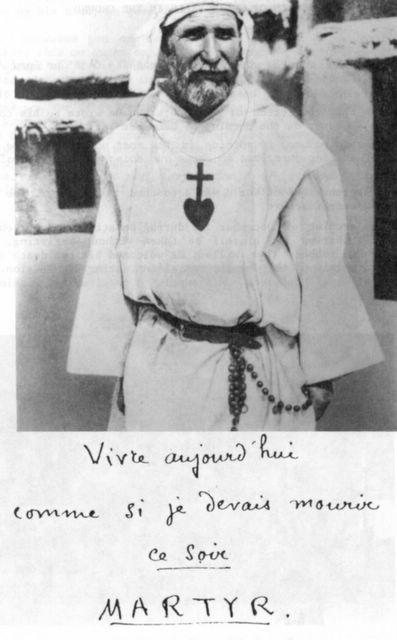
Badal 2: Charles de Foucauld - Martyr
Badal 2: Charles de Foucauld (1858-1916)
Birth: September 15, 1858
Death: December 1, 1916.
He lived for 58 years.
Personality: He was Proud, Aesthete, Temperamental, Pleasure-Loving, Hardheaded, Impetuous and Self-Centered. But He was also Sensitive, Generous, Kind, Honest, and Single-minded.
Career: He was A French Military Officer, Explorer, Monk, Porter at Nazareth, Priest and a Little Brother to the Tuaregs.
1. He began as an agnostic. In his unbelief and as a colonial soldier to Africa, He became “captive” of the black continent and fascinated by Islam. He became truly present in the continent – explored it and learned its peoples and languages.
2. He came back to his Catholic Faith through Islam. It was a powerful experience of conversion. He lived in utter simplicity, became truly poor and lived a monastic life. He went back to the East, the Holy Land and became a Porter at Nazareth.
3. He discovered FRATERNITY as the essence of Jesus’ Caritas.
4. From the Holy Land, He went back to Africa … to be a “little” brother among the Tuaregs… and spent a monastic life almost like a hermit in the desert… in prayer and “welcome” to the pilgrims.
5. Killed in his hut…
6. Beatified – December 16, 2005 in Rome, Italy
(Bapa)
Birth: September 15, 1858
Death: December 1, 1916.
He lived for 58 years.
Personality: He was Proud, Aesthete, Temperamental, Pleasure-Loving, Hardheaded, Impetuous and Self-Centered. But He was also Sensitive, Generous, Kind, Honest, and Single-minded.
Career: He was A French Military Officer, Explorer, Monk, Porter at Nazareth, Priest and a Little Brother to the Tuaregs.
1. He began as an agnostic. In his unbelief and as a colonial soldier to Africa, He became “captive” of the black continent and fascinated by Islam. He became truly present in the continent – explored it and learned its peoples and languages.
2. He came back to his Catholic Faith through Islam. It was a powerful experience of conversion. He lived in utter simplicity, became truly poor and lived a monastic life. He went back to the East, the Holy Land and became a Porter at Nazareth.
3. He discovered FRATERNITY as the essence of Jesus’ Caritas.
4. From the Holy Land, He went back to Africa … to be a “little” brother among the Tuaregs… and spent a monastic life almost like a hermit in the desert… in prayer and “welcome” to the pilgrims.
5. Killed in his hut…
6. Beatified – December 16, 2005 in Rome, Italy
(Bapa)
Saturday, February 11, 2006
A Model Badal: St. Francis of Assisi
Badal: Francis of Assisi
1. It is enough to utter his name and everyone knows who he is. St. Francis was a man of God. And because he was a man of God, he always lived what was essential. So he was a simple, courteous and gentle to everyone, like God in his mercy.
2. The Phenomenological Manifestations of our epoch…
· Emptiness. It is born of a feeling of impotence. There is very little we can do to change our life, our community and society. Finally there is really nothing important…
· Loneliness. It is an experience of lass of contact with nature and others in terms of friendship and gentleness. There is the lack of courage to commit oneself.
· Fear. It is the fruit of objective threats to life, to employment, to collective survival of humanity in general.
· Anxiety. It has its origin in imagined fear, ignorance as to what one ought to do, in whom to trust, and what to expect. When anxiety grips an entire society it means that the whole society feels threatened and senses its approaching end.
· Aggressiveness without objectives. It reveals a rupture with the norms of relationship without which a society cannot be built or defended. What results is anonymity and the loss of the meaning of the self, that is, the worth and sacredness of human person.
From the above, Two consequences ensue… first is Emptiness and second is Loss. It is the loss of language of everyday communication, the loss of meaningful relationship and the lack of vital relationship with nature and habitat.
3. The New Ethos… It is a new way of life with many and varied relationship to nature, to others, to religion and to God. In St. Francis, it was through Pathos – Sympathy and Eros – fraternal communication and tenderness. Manifestations are:
· His Innocence
· His enthusiasm for nature
· His gentleness to all beings
· His capacity for compassion with the poor and “confraternization” with all elements and even death itself.
4. To Be Saint … in the case of Francis…
· It is necessary to be human.
· And to be human, it is necessary to be sensitive and gentle.
“Man knows as much as he does.” Francis’s gentleness was demonstrated, especially in his human relationship. He broke the rigidity of the feudal hierarchy and called all persons as brothers and sisters. He himself was called “little brother” (fratello). He wanted to unite great and small, to treat the wise and simple with brotherly affection, to bind with tie of love those who were held at a distance. He treated everyone with outmost courtesy, even Saracens, Infidels and thieves.
5. Peace… One of the global values lived by Francis was Peace.
· The World is the “regio dissimilitudinis” and behind these dissimilarities are camouflaged injustices and violence.
· Every time Francis began his preaching, he invoked Peace… saying: “the Lord gives you peace.” It is Peace and all good. His group carries out a true mission of peace – “Legatio Pacis”.
· The peace that is proclaimed in word ought always to be present in the heart. Let no one be provoked by us to anger or scandal, but rather let all through your gentleness, be led to Peace, Tranquility and agreement. “BE KINDER WITH YOUR NEIGHBORS.”
6. The Role of Mediation… During the Crusades, Francis had a profound impact on the Sultan and owing to his sympathy, tolerance and respect and love foe peace. Francis gave a vote of confidence to the liberating capacity of kindness, gentleness, patience and understanding. Peace in his own PERSON manifested in his words, poetry and song.
PEACE IS NOT ONLY A GOAL THAT MUST BE REACHED, IT IS ALSO A METHOD.
1. It is enough to utter his name and everyone knows who he is. St. Francis was a man of God. And because he was a man of God, he always lived what was essential. So he was a simple, courteous and gentle to everyone, like God in his mercy.
2. The Phenomenological Manifestations of our epoch…
· Emptiness. It is born of a feeling of impotence. There is very little we can do to change our life, our community and society. Finally there is really nothing important…
· Loneliness. It is an experience of lass of contact with nature and others in terms of friendship and gentleness. There is the lack of courage to commit oneself.
· Fear. It is the fruit of objective threats to life, to employment, to collective survival of humanity in general.
· Anxiety. It has its origin in imagined fear, ignorance as to what one ought to do, in whom to trust, and what to expect. When anxiety grips an entire society it means that the whole society feels threatened and senses its approaching end.
· Aggressiveness without objectives. It reveals a rupture with the norms of relationship without which a society cannot be built or defended. What results is anonymity and the loss of the meaning of the self, that is, the worth and sacredness of human person.
From the above, Two consequences ensue… first is Emptiness and second is Loss. It is the loss of language of everyday communication, the loss of meaningful relationship and the lack of vital relationship with nature and habitat.
3. The New Ethos… It is a new way of life with many and varied relationship to nature, to others, to religion and to God. In St. Francis, it was through Pathos – Sympathy and Eros – fraternal communication and tenderness. Manifestations are:
· His Innocence
· His enthusiasm for nature
· His gentleness to all beings
· His capacity for compassion with the poor and “confraternization” with all elements and even death itself.
4. To Be Saint … in the case of Francis…
· It is necessary to be human.
· And to be human, it is necessary to be sensitive and gentle.
“Man knows as much as he does.” Francis’s gentleness was demonstrated, especially in his human relationship. He broke the rigidity of the feudal hierarchy and called all persons as brothers and sisters. He himself was called “little brother” (fratello). He wanted to unite great and small, to treat the wise and simple with brotherly affection, to bind with tie of love those who were held at a distance. He treated everyone with outmost courtesy, even Saracens, Infidels and thieves.
5. Peace… One of the global values lived by Francis was Peace.
· The World is the “regio dissimilitudinis” and behind these dissimilarities are camouflaged injustices and violence.
· Every time Francis began his preaching, he invoked Peace… saying: “the Lord gives you peace.” It is Peace and all good. His group carries out a true mission of peace – “Legatio Pacis”.
· The peace that is proclaimed in word ought always to be present in the heart. Let no one be provoked by us to anger or scandal, but rather let all through your gentleness, be led to Peace, Tranquility and agreement. “BE KINDER WITH YOUR NEIGHBORS.”
6. The Role of Mediation… During the Crusades, Francis had a profound impact on the Sultan and owing to his sympathy, tolerance and respect and love foe peace. Francis gave a vote of confidence to the liberating capacity of kindness, gentleness, patience and understanding. Peace in his own PERSON manifested in his words, poetry and song.
PEACE IS NOT ONLY A GOAL THAT MUST BE REACHED, IT IS ALSO A METHOD.
Wednesday, February 08, 2006

HEART/QALB
HEART/QALB
What is at the center of Interreligious Relations? My long years living in the Muslim communities have taught me that the real key or the path to any kind of true relationship with a Muslim neighbor is through the heart.
The HEART, in fact, is not only the key or path to each other… but it is also the way we encounter God.
The Spanish Mystic, ‘Ibn ‘Arabi, gave us this legacy…
What is at the center of Interreligious Relations? My long years living in the Muslim communities have taught me that the real key or the path to any kind of true relationship with a Muslim neighbor is through the heart.
The HEART, in fact, is not only the key or path to each other… but it is also the way we encounter God.
The Spanish Mystic, ‘Ibn ‘Arabi, gave us this legacy…
- God is extraordinarily close and proximate to the human heart (e.g., at S 8:24, "He passes between the man and his heart"). What truly matters is God’s uniquely all-encompassing divine knowledge of "what is in their hearts" (S 4:66, 33:51, etc.).
- The divine awareness of what is in the heart extends in particular to people's innermost intentions (especially in contrast to their words and ostensible actions). In consequence, ‘Ibn “Arabi speaks of the heart (as more commonly of the soul, al-nafs) as the enduring "self" or ongoing seat of our moral and spiritual responsibility, as at S 2:225: "...He will call you to account for what your hearts have earned...."
The most obvious in his work is the consistent stress on the divine "responsibility", indeed the ongoing divine Activity, expressed in all the different states of our hearts, including especially our recurrent failures to "remember" God.
The enlightened or divinely supported heart (whether in this world or the next) is said to be the locus of true Remembrance of God (dhikr Allâh, at S13:28).- We also experience God's sealing, veiling, hardening, locking, binding, closing, or frightening hearts - to hearts that as a result (of their own misdeeds or the divine reaction) are "sick" or "blind" and "suffering."
- There are also references to hearts that "fail to understand" (lâ yafqahûn), far more frequently than those who do perceive the divine "Signs," whose hearts are 'âqilûn.
- There is the need to move from these "negative" or perverse states of the human heart to full awareness of God and the corresponding divine Peace and understanding - "softening" and "humbling" or "purification" and "strengthening" of hearts, to the necessity of a "sound" or "repentant" or "mindful" heart (qalb salîm or munîb).
(Bapa Eliseo Mercado, OMI)
Monday, February 06, 2006

The Badaliyya Prayer Movement
The Badaliya Prayer Movement
Badaliya is an Arabic word that means to take the place of or substitute for another. It is a spiritual term that lies at the heart of the Christian faith experience and refers to the mystery of the image of God as Jesus sacrificing his life for all of humanity. To be a follower of Christ is to offer oneself out of love for the well-being of others.
Louis Massignon and Mary Kahil established the Badaliya prayer group in Cairo in 1934. At that time Christians in Egypt were increasingly marginalized as Islam became the dominant religion in the region. The Badaliya was a way to open themselves to befriending and praying with and for their Muslim neighbors. It embraced Massignon's own understanding that by learning the language, and experiencing the traditions and culture of those of other religions our own faith life is enhanced.
The Badaliya prayer was a testimony to the universal love of Christ. A Badaliya prayer group formed in Paris that met monthly as well and many individual lay persons and members of religious communities joined this prayer movement.
My first introduction to the Badaliyya Movement was during my stay in Cairo in 19881-82. While living with the great Masters (George Anawati, OP and Jacques Jomier, OP), I got an invitation to join a prayer group that shared views and prayed together every first Friday of the Month. There I discovered the Badaliyya Prayer Movement...
When I returned to the Southern Philippines, I introduced this prayer movement, first with my students in Islamic Studies, then with my co-workers for peace and interreligious dialogue. I had a small booklet introducing the movement. I loaned it to a Columban Missionary, Fr. Rufus, who was killed while he was being kidnapped in the the 90's. He borrowed the booklet, because of his interest to begin a similar prayer group in Malabang - Balabagan areas (Lanao del Sur). It was an attempt to spread the prayer movement specifically addressing the problematic Muslim-Christian relation in Soputhern Philippines.
We have produced a series of short biography of Badals - through meditation on their lives. We meditate on these lives... taking one Badal per meeting before spending an hour before the Blessed Sacrament - standing, seating and kneeling before God's presence. We pray to become badals - the substitutions or ransom for all that are lacking in the Muslim-Christian Relation.
The Badaliyya Prayer Movement has, in many ways, helped in the difficult and dangerous mission when our group got involved in monitoring the implentation of the ceasefire agreement between the Philippine Government and the Moro Islamic Liberation Front. The prayer and the sharing of ideas were keys in keeping ourselves open and respectful of each other - allowing the mystery of God to jolt us from time to time. The prayer sustained, too, the HOPE in our hearts that in God's own time, peace will reign throughout the Southern Philippines!
Badaliya is an Arabic word that means to take the place of or substitute for another. It is a spiritual term that lies at the heart of the Christian faith experience and refers to the mystery of the image of God as Jesus sacrificing his life for all of humanity. To be a follower of Christ is to offer oneself out of love for the well-being of others.
Louis Massignon and Mary Kahil established the Badaliya prayer group in Cairo in 1934. At that time Christians in Egypt were increasingly marginalized as Islam became the dominant religion in the region. The Badaliya was a way to open themselves to befriending and praying with and for their Muslim neighbors. It embraced Massignon's own understanding that by learning the language, and experiencing the traditions and culture of those of other religions our own faith life is enhanced.
The Badaliya prayer was a testimony to the universal love of Christ. A Badaliya prayer group formed in Paris that met monthly as well and many individual lay persons and members of religious communities joined this prayer movement.
My first introduction to the Badaliyya Movement was during my stay in Cairo in 19881-82. While living with the great Masters (George Anawati, OP and Jacques Jomier, OP), I got an invitation to join a prayer group that shared views and prayed together every first Friday of the Month. There I discovered the Badaliyya Prayer Movement...
When I returned to the Southern Philippines, I introduced this prayer movement, first with my students in Islamic Studies, then with my co-workers for peace and interreligious dialogue. I had a small booklet introducing the movement. I loaned it to a Columban Missionary, Fr. Rufus, who was killed while he was being kidnapped in the the 90's. He borrowed the booklet, because of his interest to begin a similar prayer group in Malabang - Balabagan areas (Lanao del Sur). It was an attempt to spread the prayer movement specifically addressing the problematic Muslim-Christian relation in Soputhern Philippines.
We have produced a series of short biography of Badals - through meditation on their lives. We meditate on these lives... taking one Badal per meeting before spending an hour before the Blessed Sacrament - standing, seating and kneeling before God's presence. We pray to become badals - the substitutions or ransom for all that are lacking in the Muslim-Christian Relation.
The Badaliyya Prayer Movement has, in many ways, helped in the difficult and dangerous mission when our group got involved in monitoring the implentation of the ceasefire agreement between the Philippine Government and the Moro Islamic Liberation Front. The prayer and the sharing of ideas were keys in keeping ourselves open and respectful of each other - allowing the mystery of God to jolt us from time to time. The prayer sustained, too, the HOPE in our hearts that in God's own time, peace will reign throughout the Southern Philippines!
Saturday, February 04, 2006

Friday, February 03, 2006
The WAY of the Badal...
Badal's JOURNEY begins...
I have come and I am standing before his presence… like Samuel speaking to God: "Speak, for your servant heareth..." or like the Pilgrim visiting the House of God.
1. The first image is God as a Host…
- We are his guests…
- God makes us feel at ease…
- To feel at home in Him and in his abode…
- To be at rest in his presence…
- To let go… and trust Him…
2. The second image is the Lord as Companion in our journey…
- Pilgrimage… the journey to the House of God...
- To take the journey to God in one’s heart…
- To walk with God in faith, hope and love…
- To journey in trust – knowing and believing…
- Confident that we shall arrive in him…
- Letting go and to abandon in God’s love…
3. The third image is the Pilgrim…
- To embark on a journey…
- To assume the state of Ihram… divesting ourselves (fana’ – shedding off) and putting on the cloth of the Pilgrim (the state of purity).
- Commitment and devotion to obeying his willTo be consecrated to God…
- To take a shayk … a guide in our journey…
- Labbayka … to stand before his presence …/ naked!
4. The fourth image is the person of remembrance … Dhikr.
- To treasure God’s word in one’s heart…
- To proclaim God’s praise with our lips…
- To act on God’s word in our lives…
- To walk in his remembrance…
Bapa Eliseo
Subscribe to:
Posts (Atom)