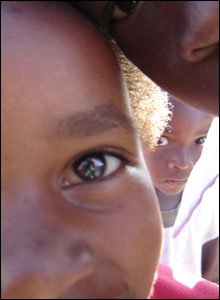
Kargador at Dawn

Kargador at Dawn
Work in the Vineyard

Sunday, December 31, 2006

The Barriers that Divide...

The BARRIERS, that people continue to build, divide, discriminate and separate persons and communities on the basis of beliefs, cultures and ethnicities...

We pray that the New Year 2007 will be a year of building bridges of understanding that will UNITE persons and nations into a compassionate COMMUNITY,,,

Pax et Bonum!

Jun Mercado, OMI

Dhikr for the Feast of the Holy Family...

Text: When his parents saw him, they were astonished, and his mother said to him, "Son, why have you done this to us? Your father and I have been looking for you with great anxiety." (Luke 2: 48)

Meditation: Mary & Joseph gave us an example of loving care and concern for their son, Jesus… They looked for him “with great anxiety”. Do we do it, likewise, in our genuine search for the Lord…?

Visit: www.omigen.org/ipid

www.omigen.org/jpic

Friday, December 29, 2006

Interreligious Leadership Initiative for Peace in the ME...

National Interreligious Leadership Initiative for Peace in the Middle East
December 12, 2006

The Honorable Dr. Condoleezza Rice
Secretary of StateU.S. Department of State
2201 C Street, N.W.Washington, DC 20520

Dear Secretary Rice:

We are writing on behalf of religious leaders of twenty-nine national Jewish, Christian and Muslim organizations to ask for a meeting with you to discuss the urgent situation in the Middle East. We have also written members of Congress to encourage and support active, fair and firm leadership by the United States to promote a comprehensive and lasting Arab-Israeli-Palestinian peace. Enclosed you will find a copy of the remarkable consensus we achieved on “Arab-Israeli-Palestinian Peace: From Crisis to Hope.”

We acknowledge and appreciate your personal commitment to the creation of a viable, independent, and democratic Palestinian state alongside the state of Israel, with security and peace for both peoples, and the crucial role you played in negotiations to reach an agreement on access to and from Gaza after the Israeli unilateral withdrawal (cf. our letter, 11/20/05).

Our statement comes at time when the ceasefire between Israel and the Palestinians raises hope for restarting negotiations and in the wake of the Baker-Hamilton Report that supports renewed efforts for a comprehensive Arab-Israeli-Palestinian peace as essential for achieving U.S. goals in the Middle East.

His Eminence Cardinal Theodore McCarrick expressed our present hopes very well when he acknowledged at the meeting that led to our new interreligious consensus, “We gather at a time of crisis in the Middle East. But times of crisis can also become opportunities for change.” The events and suffering in Gaza, Lebanon and Israel demonstrate once again that there is no such thing as a safe, stable status quo in the Arab-Israeli-Palestinian conflict, and that there is no military solution to the conflicts. The only solution is a negotiated one based on U.N. Security Council Resolutions, realistic compromises, and monitored security arrangements with international guarantees.

In the aftermath of the war in Lebanon and in light of the ongoing crisis in Gaza, there is a new urgency for achieving an effective ceasefire and returning to the path of negotiations among Palestinians, Israelis and neighboring Arab states. This urgency is shared by European and other world leaders. While Palestinian and Israeli leaders have essential roles, U.S. leadership is crucial to halting the violence, and restarting and successfully completing Israeli-Palestinian and Israeli-Arab negotiations for peace.

The principles and practical ideas found in the Road Map, model peace agreements and earlier Israeli-Palestinian, Israeli-Syrian and Israeli-Lebanese negotiations provide important evidence that peace is possible. They help to define the reciprocal steps that will be necessary to achieve a just peace and they offer outlines of what could be accepted by majorities on all sides.
What is most needed now is a renewed commitment by the United States to provide active, creative and determined leadership, in coordination with the Quartet, as a top priority of U.S. foreign policy. Whatever develops in terms of a possible change of course for U.S. policy in Iraq, we believe a commitment by the Administration, with the support of Congress, to actively reengage in pursuing Arab-Israeli-Palestinian peace is essential and will have positive reverberations in the region and around the world.

As members of the National Interreligious Leadership Initiative we are committed to working with the Administration and with Congress to support active, fair and firm U.S. leadership to help Israelis, Palestinians and the Arab states achieve a just peace. We commit ourselves to building public support for peace with justice for all in the region.

We look forward to receiving your response to our united appeal for a meeting to discuss this urgent matter.

Respectfully,

Christian Leaders:
His Eminence, Theodore Cardinal McCarrick, Archdiocese of Washington*His Eminence, William Cardinal Keeler, Archbishop of Baltimore*Most Reverend William Skylstad, President, United States Conference of Catholic Bishops*His Eminence, Archbishop Demetrios, Primate, Greek Orthodox Church in America*His Eminence, Archbishop Khajag Barsamian, Primate, Armenian Apostolic Church in America*Bishop Mark Hanson, Presiding Bishop, Evangelical Lutheran Church in America*Most Rev. Dr. Katharine Jefferts Schori, Presiding Bishop Episcopal Church*John H. Thomas, General Minister & President, United Church of Christ*The Rev. Dr. Sharon Watkins, General Minister, President, Christian Churches (Disciples of Christ)*The Reverend Clifton Kirkpatrick, Stated Clerk, Presbyterian Church (USA)*Ann B. Sherer, Bishop, The United Methodist Church*The Reverend Michael E. Livingston, President, National Council of Churches USA*The Reverend John M. Buchanan, Editor and Publisher, Christian Century*Richard J. Mouw, President, Fuller Theological Seminary*The Reverend Leighton Ford, President, Leighton Ford Ministries*David Neff, Editor and Vice-President, Christianity Today*

Jewish Leaders:
Rabbi Harry K. Danziger, President, Central Conference of American Rabbis*Rabbi Paul Menitoff, Executive Vice President Emeritus, Central Conference of American Rabbis*Rabbi Eric Yoffie, President, Union for Reform Judaism*Rabbi David Saperstein, Director, Religious Action Center of Reform Judaism*Rabbi Jerome M. Epstein, United Synagogue of Conservative Judaism*Rabbi Elliot Dorff, Rector, University of Judaism*Dr. Carl Sheingold, Executive Vice President, Jewish Reconstructionist Federation*Rabbi Brant Rosen, President, Reconstructionist Rabbinical Association*Rabbi Amy Small, Past President, Reconstructionist Rabbinical Association*Rabbi Peter Knobel, Member, Council Parliament of World Religions*Rabbi Alvin M. Sugarman, Vice President, A Different Future*Rabbi Merle S. Singer, Rabbi Emeritus, Temple Beth El, Boca Raton, Florida*

Muslim Leaders:
Dr. Sayyid Muhammad Syeed, National Director, Islamic Society of North America*Imam Mohammed ibn Hagmagid, Vice President, Islamic Society of North America*Imam Feisal Abdul Rauf, Founder, American Society for Muslim Advancement (ASMA)*Imam Yahya Hendi, Chaplain, Georgetown University*Dawud Assad, President Emeritus, Council of Mosques, USA*Iftekhar A. Hai, Founding Director, United Muslims of America*

Monday, December 25, 2006

A Blessed Christmas to all...


Wishing you all a Christmas full of love, prosperity and peace...!

In your midst, a saviour is born and his name is Jesus. He is Emmanuel - God is with us!

A prosperous New Year 2007!

Sunday, December 24, 2006

The Bethlehem Wall that divides...


Christmas is the season to breakdown walls and barriers that divide individuals, communities and nations!

The Lord is BORN... Allelulia. With his birth we are all empowered to tear down walls that divide...

A Blessed Christmas and a Prosperous New Year 2007!

The Birth of Jesus - the Lord...

“And the angel said to them, ‘Be not afraid; for behold, I bring you good news of a great joy which will come to all the people; for to you is born this day in the city of David a Savior, who is Christ the Lord. And this will be a sign for you: you will find a babe wrapped in swaddling clothes and lying in a manger.’ (Luke 2: 10-12)”

The challenge of Christmas, then and now, remains the same… to see and believe God’s life-giving presence in that child wrapped in swaddling clothes and lying in a manger…

Wishing you a Blessed Christmas and a Prosperous New Year 2007!

Pax et Bonum!

Eliseo “Jun” Mercado, OMI
25 December 2006

Monday, December 18, 2006

Catholic - Orthodox Dialogue as Witness...

Interview With Bishop Agathangelos of Fanarion

ROME, DEC. 17, 2006 (Zenit.org).- The theological dialogue between the Catholic and Orthodox Churches "can give witness of Christ," says a Greek Orthodox prelate. Bishop Agathangelos of Fanarion is director general of the Apostoliki Diaconia, which in the Greek Orthodox Church is in charge of the missions, the formation of seminarians and publishing.

Last spring Bishop Agathangelos came to visit Rome with a Greek-Orthodox delegation, to get to know better the tradition and culture of the Catholic Church. According to the bishop, it is important to discover everything that united the two Churches in the first millennium, when they were not yet divided, to get to know and listen to each other. He shared his views in this interview.

Q: What do you think of the relations between the Catholic Church and the Greek Orthodox Church?

Bishop Agathangelos: John Paul II's visit to Greece in 2001 was decisive in the improvement of relations between our Churches. In the Areopagus, the Pope met with Christodoulos, the archbishop of Athens and All Greece. In the years after the visit, that is, since I have headed Apostoliki Diaconia, we have come closer in our relations with the Catholic Church, especially with the Pontifical Council for Promoting Christian Unity.

One of the fruits of our collaboration is the preparation of a facsimile of the ancient and richly decorated manuscript "Menologium of Basil II" on the lives of the saints, which is kept in the Vatican Library. It is a most important work because it was made after the iconoclast period. This manuscript marks a turning point in the history of the Church of the East, which again begins to venerate icons and discovers the importance of beauty. On the occasion of the manuscript's publication, we invited the librarian of the Holy Roman Church, Cardinal Jean-Louis Tauran, to Athens, who brought greetings on behalf of Benedict XVI. On that occasion, Archbishop Christodoulos was invited to visit the Vatican.

Last year we offered, through the Apostolic Nunciature in Athens, scholarships to 30 Catholics so that they could visit our country, learn the language, get to know our culture and Orthodox tradition. In this way, Catholics could draw near the "other part" of the Church with which we "were one" for 1,000 years.

Q: Can the Greek Orthodox Church serve as example for the other Orthodox Churches of ecumenical dialogue with the Catholic Church?

Bishop Agathangelos: I think that every man of good will can discover the meaning of such dialogue and learn to dialogue. Collaboration between the Churches cannot be compared to relations between states. This collaboration has many aspects and one of these is the visits which make it possible to overcome prejudices. It is something that is very important, especially now, when we are beginning the new stage of dialogue between our Churches. I want to underline a fact: many Churches and patriarchates -- the Ecumenical Patriarchate of Constantinople, Patriarchate of Alexandria, of Jerusalem, Church of Cyprus, of Albania -- collaborate with us and appoint Greek professors of theology for the ecumenical contacts.

Q: The Catholic Church is very concerned about the way certain things are going in the European Union, especially in the promotion of the new vision of man and the family, which contradicts Christian anthropology. Does the Orthodox Church share this concern?

Bishop Agathangelos: We have the same fears that you do. We see with sadness that Europe, especially Western Europe, is abandoning Christianity. Politicians do not recognize the identity of our continent which is the fruit of our history and cannot be denied. It is a grave problem therefore which we must address cooperating among ourselves.

Q: But how can one convince the politicians of the European Union to give up the policies that attack the family if certain Protestant churches recognize homosexual unions?

Bishop Agathangelos: That is why the dialogue between the Catholic and Orthodox Church is so important. Very many things unite us: common tradition, theology, apostolic succession, opinions on bioethics, human rights, peace in the world. For 1,000 years, we have lived together, for 1,000 consecutive years we were separated. In the course of history there were dramatic moments, we often felt wounded, but this does not mean that today we cannot live like brothers.

Q: In what way can our Churches oppose jointly the anti-Christian policies and the process of secularization of the Western world?

Bishop Agathangelos: I wish to make only one reflection. Our theological dialogue can give witness of Christ. Today people who are searching for the truth ask us: Why are you divided? How can we convince our faithful of the love of Christ if we are divided?

Q: You have already met with Benedict XVI.

Bishop Agathangelos: For me, it was very important to meet with Pope Benedict XVI and hear his words personally. After the visit, we left strengthened in spirit to work still more for the reunification of our Churches. These are our human plans. But if we have good intentions and open hearts, God will bless us: The history of the world and of the Church are in his hands.

Thursday, December 14, 2006

Children of S Sudan await the dawn of a new nation...


Dhikr for the 3rd week of Advent (C)

Text: “And the crowds asked him (John the Baptizer), "What then should we do?" He said to them in reply, "Whoever has two cloaks should share with the person who has none. And whoever has food should do likewise." (Luke 3: 10-11)

Meditation: The preparation for the coming of the Lord is to accept the challenge to live a life of sharing and solidarity with those who have less in life…

PRAYER

O God of Compassion,
you promise a day of abundance,
when all people shall walk in your way.
Open our ears to your guidance and our
hearts to your teaching.
May we turn neither to the left nor to the right
but walk always in the path of salvation
and so finally reach your holy mountain
where Christ lives and reigns for ever and ever.
Amen.

Friday, December 08, 2006

Dhikr for the 2nd week of Advent (C)

Text: “Prepare the way of the Lord, make straight his paths. Every valley shall be filled and every mountain and hill shall be made low. The winding roads shall be made straight, and the rough ways made smooth, and all flesh shall see the salvation of God." (Luke 3: 5-6)

Meditation: What are the “valley”, “hill”, “winding roads” and “rough ways” in our lives? We need to do something about them… to see the salvation of God!

Prayer for the 2nd week of Advent

O God whose will is justice for the poor and peace for the afflicted,

let your herald’s urgent voice pierce our hardened hearts

and announce the dawn of your kingdom.

Before the advent of the one who baptizes with the fire of the Holy Spirit,

let our complacency give way to conversion,

oppression to justice and conflict to acceptance of one another in Christ.

We ask this through him whose coming is certain,

whose day draws near; Your son, our Lord Jesus Christ,

who lives and reigns with you and the Holy Spirit, one God forever and ever.

Tuesday, December 05, 2006

Beating our swords into plowshares...

It shall come to pass in the latter days that the mountain of the house of the LORD shall be established as the highest of the mountains, and shall be raised above the hills; and all the nations shall flow to it, and many peoples shall come, and say: "Come, let us go up to the mountain of the LORD, to the house of the God of Jacob; that he may teach us his ways and that we may walk in his paths." For out of Zion shall go forth the law, and the word of the LORD from Jerusalem. He shall judge between the nations, and shall decide for many peoples; and they shall beat their swords into plowshares, and their spears into pruning hooks; nation shall not lift up sword against nation, neither shall they learn war any more. O house of Jacob, come, let us walk in the light of the LORD. (Isaiah 2: 2-5)

Friday, December 01, 2006

Advent Theme: The Song of Hannah 1Samuel 2: 1-2, 5, 7-9

ANITPHON Shadow me with your wings until all danger passes.

Extend to me, O God, Your love that never fails.


My heart exults in the Lord,

my strength is exalted in my God.

My mouth derides my enemies,

because I rejoice in my victory.

There is no Holy One like the Lord,

no one besides you;

there is no Rock like our God.


Those who were full have hired themselves out for bread,

but those who were hungry are fat with spoil.

The barren has borne seven,

but she who has many children is forlorn.


The Lord makes poor and makes rich;

God brings low but also exalts.

The Most High raises up the poor from the dust,

lifts the needy from the ash heap,

to make them sit with princes

and inherit a seat of honor.


For the pillars of the earth are the Lord’s

and on them God has set the world.

The most High will guard the feet of the faithful ones,

but the wicked shall be cut off in darkness;

for not by might does one prevail.

Waiting for the dawn to come...

 Posted by Picasa

That we may have an EYE that sees...

 Posted by Picasa

Wednesday, November 29, 2006

Dhikr for the 1st week of Advent (C)

Text: "Beware that your hearts do not become drowsy from carousing and drunkenness and the anxieties of daily life, and that day catch you by surprise
like a trap. For that day will assault everyone who lives on the face of the earth. (Luke 21: 34-35)

Meditation: To have a longing heart and a vigilant spirit else we are caught by surprise like a trap…

PRAYER for the 1st week of Advent...

Above the clamor of our violence
your word of truth resounds,
O God of majesty and power.
Over nations enshrouded in despair, your justice dawns.
Grant your household a discerning spirit and a watchful eye
to perceive the hour in which we live.

Hasten the advent of that day
when the weapons of war shall be banished,
our deeds of darkness cast off,
and all your scattered children gathered into one.
We ask this through him whose coming is certain, whose day draws near:
Your son, our Lord Jesus Christ,
who lives and reigns with You and the Holy Spirit,
one God, forever and ever. Amen

Sunday, November 26, 2006


Torit, Southern Sudan: Listening to people's stories of persecution and trials, because of their belief and ethnicity... Posted by Picasa

Thursday, November 23, 2006

Understanding Some Features of Militant Islamism...

The militant brands of "Islamism" (others refer to this as "Political Islam") cover a broad spectrum from A to Z. While these movements are diverse, there are discernable common features that identify them from the “old” or yet “older” schools and reform movements in the history of Islam. These are the following:

1. The BOOK (Qur'an) and the TRADITION (Hadith) provide the complete and perfect “blueprint” for socio political activism as well as a guide to public and private life.

2. The commitment to remake/refashion the world and community by strictly applying their beliefs with the use of violence.

3. Such endeavor/undertaking usually requires a charismatic and authoritarian leadership.

4. Boundaries are set… the enemy identified, converts are sought, institutions are created and the reconstruction of society becomes the MISSION.

5. Acute patriarchal structure… the leader is the all-powerful Father.

6. Hatred or Anger for the Power that dominates… that insludes among others,
Ø Sacred vs. Profane
Ø Religions vs. Secular
Ø Poor vs. the Rich
Ø Powerless vs. Power
Ø Oppressed vs. Oppressor

Matrix of this Religious Revivalism

There is a need to go into the matrix of this spectacular phenomenon to be able to appreciate both their significance as well as impact not only in the world but also on the relationship between and among our faith-communities.

Within the circle of these movements they believe that a new “dark ages” or Jahiliyya (age of “Ignorance”) has taken roots in the modern world. The world has been transformed into “al-nizam al-jahili (a decadent and ignorant order). Materialism and individualism have become the defining characteristics of our modern culture.

Moreover, the secularist leaders in the modern world have failed miserably to establish a legitimate, effective public order and to adequately address the profound socioeconomic disparities in wealth and class in most 3rd world countries, including the poor in the developed and industrialized ones.

The disillusionment with the secular and modern world coupled by the arrogance of power by the powerful nations have alienated not only the UMMAH (the Community of believers) but also the entire humanity from God.

(A portion of a Talk delivered by E. Mercado, OMI)

Wednesday, November 22, 2006

Dhikr for the Feast of Christ the King (B)

Text: Jesus answered, "My kingdom does not belong to this world. If my kingdom did belong to this world, my attendants (would) be fighting to keep me from being handed over to the Jews. But as it is, my kingdom is not here." (John 18: 38)

Meditation: In Jesus’ utter powerlessness… he proclaims that He is King… It is NOT a reign that the world usually sees and recognizes…

Visit: www.omigen.org/jpic
www.omigen.org/ipid

DHIKR SIMPLE METHOD...
Dhikr is an Arabic word for remembrance. In the “tariqa” (the way) movement, dhikr developed into a form of prayer… It is a prayer of the heart… following three simple steps:

1. Write in one’s heart a certain passage of the Holy Writ…
2. Make the same passage ever present in one’s lips.
3. Then wait for God’s disclosure on the meaning of the passage…that interprets one’s life NOW…!

It takes a week of remembering (dhikr)…or even more days to relish the beauty of this method…

Tuesday, November 21, 2006

Head Cover for Women in Islam...

Is Head Cover For Women Mandatory In Islam?
by Ibrahim B. Syed, Ph.D

Hijab (head cover) for Muslim women is not mandated in the Qur’an. If it is, it is only the subjective interpretation of an ayah (verse) on the part of the reader. Hence, many Islamic scholars say that according to hadith, a woman should cover her whole body, except her face and hands. The majority of Muslims do not know in which hadith this is mentioned. A very limited number of Muslims know that this is in Sunan Abu Dawud. The English translation of Sunan Abu Dawud is in three volumes. Again, nobody ever mentions that it is in Volume Three. Actually, it is in Volume 3, Book XXVII, Chapter 1535, and Hadith number 4092, titled: "How Much Beauty Can A Woman Display?" For the benefit of the readers, the exact hadith is reproduced below:

(4092) 'Aisha said: Asthma', daughter of Abu Bakr, entered upon the Apostle of Allah (may peace be upon him) wearing thin clothes. The Apostle of Allah (peace be upon him) turned his attention from her. He said: O Asthma', when a woman reaches the age of menstruation, it does not suit her that she displays her parts of the body except this and this, and he pointed to her face and hands. (Note 3523)

Abu Dawud said: This is a mursal tradition (i.e. the narrator who transmitted it from 'Aisha is missing) Khalid B. Duraik did not see 'Aisha.

[3523. When a woman reaches the age of puberty, she must observe purdah and have a thick veil which conceals her beauty. She may unveil her face and hands up to the wrists. In modern times, some scholars have prohibited unveiling the face out of precaution.]

It is very interesting to note that no one - neither the Muslim scholars nor the Muslim ummah, ever pointed out that this is a mursal (weak) hadith. It is imperative that when one uses a weak hadith for any reason, then one should explain to the people that it is such. What is a mursal hadith? But first of all, what is hadith?

Hadith is an Arabic word which in its real sense means a tale, speech, chat, conversation, or communication. In a technical sense, hadith or tradition means all the sayings, deeds, decisions of the Prophet Muhammad (s.a.a.w), his silent approval of the behavior of his companions, and descriptions of his personality. Each hadith is prefaced by a chain of narrators called al-'isnad. Al-'isnad was the chain of people through whom the hadith was transmitted. The second part of the hadith is al-matn, the content, which reports the teaching or the incident. Every hadith or tradition must have a chain ('isnad), as well as the text (matn).

There are three main categories of the hadith called (1) as-sahih or the authentic hadith, (2) al-hasan or the good, as some of its narrators have been found to have a weaker memory in comparison to the narrators of sahih hadith, and (3) ad-da'if or the weak. This refers to traditions in which there is some problem in the chain of transmission, in the proper understanding of the transmitter, or in its contents, which may be in disagreement with Islamic belief and practice.

Ad-da'if traditions are further divided according to the degree of problems with their reporter (ruwaat), or in the text (al-matn) of the reports. A few of these divisions are as follows:

1. Al-mursal: A hadith in which a tab'i (those who succeeded the sahabah or companions of the Prophet) transmits from Rasulullah (s.a.w), directly dropping the sahabi from the 'isnad.

2. Al-munqati: A hadith going back to the tab'i only.

3. Al-mu'dal: A hadith in which two continuous narrators are missing in one or more places in the 'isnad.

4. Al-mu'allaq: A hadith in which one or two transmitters are omitted in the beginning of the 'isnad.

In Shari'ah or Islamic law, only the authentic (sahih) and good (hasan) ahadith (plural of hadith) are used in deriving rules. The weak (da'if) ahadith have no value for the purpose of Shari'ah.

As stated above, Imam Abu Dawud himself said that this is a mursal tradition (i.e. the narrator who transmitted it from 'Aisha is missing). What I interpret is that the narrator of this hadith is Khalid B. Duraik, who did not see 'Aisha (radhi Allahu anha, may Allah be pleased with her). Since this is a weak hadith, it has no value for the purpose of Shari'ah. That means that no Muslim, Islamic Republic, or government can pass laws punishing a Muslim woman who does not observe hijab, particularly covering the hair on her head. This is not being practiced in the so-called Islamic countries, where religious police with their canes are threatening and punishing Muslim women who do not observe hijab.

All along, I have maintained in my arguments that Islam emphasizes modesty in the dress of a Muslim woman, but nowhere does it mandate the wearing of the hijab (head cover). As a matter of fact, modesty in dress is also required on the part of Muslim men.

Readers are invited to subscribe to the Aalim (Scholar), which is published quarterly by the Islamic Research Foundation (IRF). Phone: 502-423-1988 or email IslamicResearch@yahoo.com

Friday, November 17, 2006

Dhikr for the 33rd week of the ordinary time (B)

Text: "Learn a lesson from the fig tree. When its branch becomes tender and sprouts leaves, you know that summer is near. In the same way, when you see these things happening, know that he is near, at the gates.” (Mark 13: 28-29)

Meditation: Pray that we, too, may be able to discern God’s “coming” and “going” in our daily life…

Visit: www.omigen.org/jpic
www.omigen.org/ipid

DHIKR SIMPLE METHOD...
Dhikr is an Arabic word for remembrance. In the “tariqa” (the way) movement, dhikr developed into a form of prayer… It is a prayer of the heart… following three simple steps:

1. Write in one’s heart a certain passage of the Holy Writ…
2. Make the same passage ever present in one’s lips.
3. Then wait for God’s disclosure on the meaning of the passage…that interprets one’s life NOW…!

It takes a week of remembering (dhikr)…or even more days to relish the beauty of this method…