Kargador at Dawn

Kargador at Dawn
Work in the Vineyard

Friday, April 06, 2012

Good Friday Reflection


The Science of the cross
On Good Friday, let us remember a Jewish woman, Edith Stein, who loved the cross and embraced its contradiction and mystery throughout her own life. There is a marvellous, life-size, bronze sculpture of Edith Stein in the centre of the German city of Cologne, close to the archdiocesan seminary. The sculpture depicts three Edith Steins at the three critical moments of her life. The first moment presents Edith as the young Jewish philosopher and professor, a student of Edmund Husserl. Edith is presented deep in meditation and a Star of David leans against her knee.

The second depiction of the young woman shows Edith split in two. The artist shows her face and head almost divided. She moved from Judaism to agnosticism and even atheism. Hers was a painful search for the truth.
The third representation is Edith as Sister Teresa Benedicta of the Cross, and she holds in her arms the crucified Christ: “Teresa blessed by the Cross” as her name indicates. She moved from Judaism, through atheism, to Christianity.
In her biography, we find a poignant moment from the critical period in her life, in Breslau, when she was moving beyond Judaism. Before her official entrance into the Carmel of Cologne, she had to face her Jewish mother. Her mother said to her daughter: “Edith, You can be religious also in the Jewish faith, don’t you think?”
Edith responded: “Sure, when you have never known anything else.”
Then her mother desperately replied: “And you, why did you know him? I don’t want to say anything against him; certainly he was a very good man; but why did he become God?”
The last weeks at home and the moment of separation were very painful. It was impossible to make her mother understand even a little. Edith wrote: “And yet I crossed the threshold of the Lord’s house in profound peace.”
Like Edith Stein, we encounter Jesus and his cross, and we have known something else. We have met Someone else: the Man of the cross. We have no alternative but to go to him.
After Edith had entered the Cologne Carmel, she continued to write her great work on the cross: Kreuzwissenschaft – the science of the cross. From Cologne she and her sister Rosa were deported to Echt in Holland and then rounded up with other Jews only to be sent to Auschwitz where she and her sister were burned to death by the evil Nazi regime on August 9, 1942.
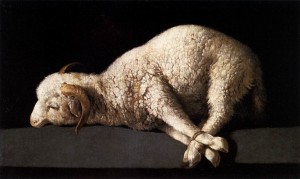
On Good Friday we gather together as the Christian community to “behold the man” – Ecce Homo – and to gaze upon Jesus, who took upon himself all of our sins and failings so that we could experience peace and reconciliation with the One who sent him. If we have not truly encountered and embraced the Man of the cross our efforts are in vain. The validity of all of our efforts is determined by our embracing Jesus and his cross each day, by allowing the Paschal Mystery to transfigure our lives.
The cross of Jesus teaches us that what could have remained hideous and beyond remembrance is transformed into beauty, hope and new life. On Good Friday, may the cross be our true science, our comfort in time of trouble, our refuge in the face of danger, our safeguard on life’s journey, until the Lord welcomes us to our heavenly home. Let us continue to mark ourselves daily with the sign of the cross, and be ever mindful of what we are truly doing and professing with this sign:
“In the Name of the Father” We touch our minds because we know so little how to create a world of justice, peace and hope.
“In the Name of the Son” We touch the centre of our body to bring acceptance to the fears and pain Stemming from our own passage through death to life.
“In the Name of the Spirit” We embrace our heart to remember that from the centre of the Cross of Jesus, God’s vulnerable heart can bring healing and salvation to our own.
Fr. Thomas Rosica, CSB
CEO, Salt and Light Catholic Media Foundation

Wednesday, April 04, 2012

GETHSEMANE AS LIMINAL SPACE


GETHSEMANE AS LIMINAL SPACE

The Garden of Gethsemane is, among other things, "liminal space". Anthropologists use that expression to refer to special times in our lives when our normal situation is so uprooted so that it is possible precisely to plant new roots and take up life in a whole new way. That's usually brought about by a major crisis, one that shakes us in the very roots of our being.

There are times, perhaps soon, we will, like Jesus in the Garden, have to make peace with the fact that we are soon to exit this life, alone, but for our hope in God.

Our own prayer there, I suspect, will be less about necessity than about timing: "Lord, let this cup be delayed! Not yet! I know it's inevitable, but just give me more time, more years, more experience, more life first!"

To feel that way is understandable. Nobody should want to die or want to give up the good things of this life. But Gethsemane awaits us all. Most of us, however, will not enter this garden of liminal space voluntarily, as did Jesus ("Nobody takes my life, I give it up freely!"). Most of us will enter it by conscription on that day when a doctor tells us we have terminal cancer or we suffer a heart attack or something else irretrievably and forever alters our lives.

When that does happen, and it will happen one way or the other to all of us, it's helpful to know that we're in liminal space, inside a new womb, undergoing a new gestation, waiting for new birth - and that it's okay to sweat a little blood, ask God some questions, and feel resistance in every cell of our being.

(Fr. Ron Rolheiser, OMI)

Saturday, March 31, 2012

Passion Sunday (B)


Dhikr for the Holy Week (B): The Passion of the Lord

Selected Passage: “And at three o'clock Jesus cried out in a loud voice, "Eloi, Eloi, lema sabachthani?" which is translated, "My God, my God, why have you forsaken me?" (Mark 15:34)

Reflection: The song “Foot Prints in the Sand” beautifully articulates the meaning of the experiences of “being forsaken” by God.  In those difficult times that we see only a pair of footprints… they are NOT ours but God’s who carried us in his loving arms…


DHIKR SIMPLE METHOD...
Dhikr is an Arabic word for remembrance. In the “tariqa” (the way) movement, dhikr developed into a form of prayer… It is a prayer of the heart… following three simple steps:

1.    Write in one’s heart a certain passage of the Holy Writ…
2.   Make the same passage ever present in one’s lips. 
3.   Then wait for God’s disclosure on the meaning of the passage…that interprets one’s life NOW…!

It takes a week of remembering (dhikr)…or even more days to relish the beauty of this method…


Wednesday, March 28, 2012

GESTATING COMPASSION


GESTATING COMPASSION

What is sad, among many other things, in all of this is that almost all of us, on all sides of virtually every issue, are using truth and the gospel to make hard, non-compassionate judgements. In both civic and church circles there is little to be seen in the way of gentleness, softness, and forgiveness. The zeal for orthodoxy and the passion for justice, especially among the more enlightened and supposedly sensitive, are producing a lot more anger than compassion.  

This is a cruel thing to say, but all this angry zeal and passion, no matter how high the cause which fuels it, is not a sign that truth and the gospel are breaking through. When truth and the gospel break through, the first mark is compassion, not anger.

The word of God first meets the world in compassion, not judgement. Irrespective of whether we attempt to speak our truth and prophecy from a liberal or a conservative pulpit, we want to remember that. We mediate the word of God correctly, speak for truth and justice, when, and only when, we are recognized for our gentleness, compassion, and forgiveness - towards everyone, and not just towards those in the same ideological camp as ourselves.

(Fr. Ron Rolheiser, OMI)

Saturday, March 24, 2012

Short Reflection of the 5th Sunday of Lent (B)

Dhikr for the 5th Sunday of Lent (B)


“Amen, amen, I say to you, unless a grain of wheat falls to the ground and dies, it remains just a grain of wheat; but if it dies, it produces much fruit.” (Jn. 12: 24)

In the coming days, mystery of “falling and dying” and “producing much fruit” will unfold in that event of Jesus’s dying for us and rising from the dead…

The martyrdom of OMI Missionaries in the Sulu Archipelago – Fr. Nelson Javellana, OMI, Jolo Bishop Benjami de Jesus, OMI, Fr. Benjamin Inocencio, OMI and Fr. Jesus Reynaldo Roda, OMI – reminds us of the real ‘falling and dying’….

DHIKR SIMPLE METHOD...
Dhikr is an Arabic word for remembrance. In the “tariqa” (the way) movement, dhikr developed into a form of prayer… It is a prayer of the heart… following three simple steps:

1.    Write in one’s heart a certain passage of the Holy Writ…
2.   Make the same passage ever present in one’s lips. 
3.   Then wait for God’s disclosure on the meaning of the passage…that interprets one’s life NOW…!

It takes a week of remembering (dhikr)…or even more days to relish the beauty of this method…


WHAT DOES GOD LOOK LIKE?

WHAT DOES GOD LOOK LIKE?


It is a perennial question. It's the one that Philip asked Jesus. The answer, therefore, that I will give you is the same one that Jesus gave him: ‘You can look at all you have seen and heard and still ask that question?’ To see certain things is to have seen the Father!' To ask a question like this is tantamount to looking at the most beautiful day in June, seeing all the trees and flowers in full blossom and asking a friend, ‘Where is summer?' To see certain things is to see summer. To see certain things is to see God.’

With those thoughts in mind, I would like here to offer a set of questions that Karl Rahner used to ask people when they asked him about the veil of faith:

-Have you ever kept silent, despite the urge to defend yourself, when you were unfairly treated?

-Have you ever forgiven another although you gained nothing by it and your forgiveness was accepted as quite natural?

-Have you ever made a sacrifice without receiving any thanks or acknowledgement, without even feeling any inward satisfaction?

-Have you ever decided to do a thing simply for the sake of conscience, knowing that you must bear sole responsibility for your decision without being able to explain it to anyone?

-Have you ever tried to act purely for love of God when no warmth sustained you, when your act seemed a leap in the dark, simply nonsensical?

-Have you ever been good to someone without expecting a trace of gratitude and without the comfortable feeling of having been "unselfish"?

If you have had such experiences, Rahner asserts, then you have had experienced God, perhaps without realizing it.

(Fr. Ron Rolheiser, OMI)


Wednesday, March 21, 2012

Jesus takes away the sins of the world!

HOW JESUS TAKES AWAY THE SINS OF THE WORLD


Jesus, as the lamb of God, does not take away the sin of the world by somehow carrying it off so that it is no longer present inside of the community. He takes it away by transforming it, by changing it, by taking it inside of himself and transmuting it. We see examples of this throughout his entire life, although it is most manifest in the love and forgiveness he shows at the time of his death. In simple language, Jesus took away the sin of the community by taking in hatred and giving back love; by taking in anger and giving out graciousness; by taking in envy and giving back blessing; by taking in bitterness and giving out warmth; by taking in pettiness and giving back compassion; he taking in chaos and giving back peace; and by taking in sin and giving back forgiveness.

This is not an easy thing to do. What comes naturally is to give back in kind: hatred for hatred, anger for anger, coldness for coldness, revenge for hurt. Someone hits us so we hit back. Jesus did otherwise. He did not simply pass on what was done to him. Rather he took it in, held it, carried it, transformed it, and eventually gave it back as something else. This is what constitutes the sacrificial part of his love, namely, the excruciatingly pain (ex cruce, from the cross) that he had to undergo in order to take in hatred and give back love.

This dynamic is not just something we are asked to admire in Jesus. The incarnation is meant to be ongoing. We are asked to continue to give flesh to God, to continue to do what Jesus did. Thus our task too is to help take away the sin of the world. We do this whenever we take in hatred, anger, envy, pettiness, and bitterness, hold them, transmute them, and eventually give them back as love, graciousness, blessing, compassion, warmth, and forgiveness.

(Fr. Ron Rolheiser, OMI)


Saturday, March 17, 2012

Short Reflection on the 4th Sunday of Lent (B)

Dhikr for the 4th Sunday of Lent (B)


Selected Passage: “And this is the verdict, that the light came into the world, but people preferred darkness to light, because their works were evil.  For everyone who does wicked things hates the light and does not come toward the light, so that his works might not be exposed.” (Jn. 3: 19-20)

Short Reflection: Lent is a special season to LOOK at the VERDICT on our own life – our deed and our witness do they give life or death…? Life is from God while death is from the evil one!

DHIKR SIMPLE METHOD...
Dhikr is an Arabic word for remembrance. In the “tariqa” (the way) movement, dhikr developed into a form of prayer… It is a prayer of the heart… following three simple steps:

1.    Write in one’s heart a certain passage of the Holy Writ…
2.   Make the same passage ever present in one’s lips. 
3.   Then wait for God’s disclosure on the meaning of the passage…that interprets one’s life NOW…!

It takes a week of remembering (dhikr)…or even more days to relish the beauty of this method…


Friday, March 16, 2012

Letting Go...

LETTING GO

Soul knowledge sends you in the opposite direction from consumerism.
It’s not addition that makes one holy, but subtraction: stripping the
illusions, letting go of the pretense, exposing the false self,
breaking open the heart and the understanding, not taking one’s
private self too seriously. Conversion is more about unlearning than
learning.

In a certain sense we are on the utterly wrong track. We are climbing
while Jesus is descending, and in that we reflect the pride and the
arrogance of Western civilization, always trying to accomplish,
perform, and achieve. We transferred much of that to our version of
Christianity and made the Gospel into spiritual consumerism. The ego
is still in charge. There is not much room left for God when the false
self takes itself and its private self-development that seriously.

All we can really do is get ourselves out of the way, and honestly
wecan’t even do that. It is done to us through this terrible thing
called suffering.

Adapted from Richard Rohr, OMI Radical Grace: Daily Meditations , p.
46, day 49

Saturday, March 10, 2012

3rd Sunday in Lent (B)


Dhikr for the 3rd Sunday of Lent (B)

Selected Passage: “Jesus said, "Take these out of here, and stop making my Father's house a marketplace." (Jn.2: 16)

Meditation: Lent is a special season to cleanse our life of the many “merchandise” that has made God’s abode in us a MARKETPLACE...

DHIKR SIMPLE METHOD...
Dhikr is an Arabic word for remembrance. In the “tariqa” (the way) movement, dhikr developed into a form of prayer… It is a prayer of the heart… following three simple steps:

1.    Write in one’s heart a certain passage of the Holy Writ…
2.   Make the same passage ever present in one’s lips. 
3.   Then wait for God’s disclosure on the meaning of the passage…that interprets one’s life NOW…!

It takes a week of remembering (dhikr)…or even more days to relish the beauty of this method…


Saturday, March 03, 2012

Short Reflection on the 2nd Sunday of Lent (B)


Dhikr for the 2nd Sunday of Lent (B)

 Selected Passage: “And Jesus was transfigured before them, and his clothes became dazzling white, such as no fuller on earth could bleach them." (Mk. 9: 2-3)

Reflection: Lent is a special season to have an “experience” our own TRANSFIGURATION”…  The experience of being transformed by the LOVE and FORGIVENESS of the Lord!

 DHIKR SIMPLE METHOD...
Dhikr is an Arabic word for remembrance. In the “tariqa” (the way) movement, dhikr developed into a form of prayer… It is a prayer of the heart… following three simple steps:
  1. Write in one’s heart a certain passage of the Holy Writ…
  2. Make the same passage ever present in one’s lips. 
  3. Then wait for God’s disclosure on the meaning of the passage…that interprets one’s life NOW…!
It takes a week of remembering (dhikr)…or even more days to relish the beauty of this method…

Saturday, February 25, 2012

Short Reflection on the 1st Sunday of Lent (B)


Dhikr for the 1st Sunday of Lent (B)

Selected Gospel Passage: “This is the time of fulfillment. The kingdom of God is at hand. Repent, and believe in the gospel." (Mk.2 15)

Short Reflection: Lent is a special season to be more attentive to the “disclosure” of the kingdom of God as we journey through life… BELIEVE in the GOSPEL!

DHIKR SIMPLE METHOD...
Dhikr is an Arabic word for remembrance. In the “tariqa” (the way) movement, dhikr developed into a form of prayer… It is a prayer of the heart… following three simple steps:

1.    Write in one’s heart a certain passage of the Holy Writ…
2.   Make the same passage ever present in one’s lips. 
3.   Then wait for God’s disclosure on the meaning of the passage…that interprets one’s life NOW…!

It takes a week of remembering (dhikr)…or even more days to relish the beauty of this method…