Kargador at Dawn

Kargador at Dawn
Work in the Vineyard

Saturday, March 02, 2013

3rd Sunday of Lent (C)


The Dhikr for the 3rd Sunday in Lent (C)
Selected Passage:  'For three years now I have come in search of fruit on this fig tree but have found none. (So) cut it down. Why should it exhaust the soil?' (Luke 13: 7)
Reflection:  Years have we been living on this earth, yet the same question is asked of us… do we bear fruit for others?  Beware… else we too are cut down! Why should we exhaust the soil when we neither bear fruit nor give shade for others to reap…
DHIKR PRAYER SIMPLE METHOD...
Dhikr is an Arabic word for remembrance. In the “tariqa” (the way) movement, Dhikr developed into a form of prayer… It is a prayer of the heart… following three simple steps:
1. Write in one’s heart a certain passage of the Holy Writ…
2. Make the same passage ever present in one’s lips. 
3. Then wait for God’s disclosure on the meaning of the passage…that interprets one’s life NOW…!
It takes a week of remembering (dhikr)…or even more days to relish the beauty of this method…

Sunday, February 24, 2013

1st Lesson in Badaliyya: Mercy and Compassion


1st Lesson: Compassion and Mercy…

The text is taken from Qur’an 57: 27 that states… “…we sent after them Jesus the Son of Mary and bestowed on him the Gospel; and we ordained on the hearts of those who followed him COMPASSION AND MERCY’.  (waja’aalnaa fi qulusbi-lladhina-ttaba’uhu raa’fatan wa –rahmatan).

The two key descriptions of Jesus’ followers are Compassion and Mercy… Is this NOT the very heart of religion and the very heart of God…?

God is Rahmaan and Rahim (“loving-kindness”). This is the very heart of religion and a believer as described in Sura 50:37… A believer who remembers the need for a feeling heart, a hearing mind and a present self… to his/her neighbor… (“…inna fi dhalika la-dhikra li-man kana lahu qalb aw alqa al-sam’wa wa huwa shahid”)

Reflecting on this passage, I wander whether the call for us is, precisely, to retrieve these key description and allow it to bear upon the relationship between the worship that we bring and the behavior that we come by… or putting it in another way, allowing the “coincidence” between the heart of God and the heart of the believer. (Eliseo “Jun” Mercado, OMI)

Badaliyya Philippines


Badaliyya is a movement based on the concept of BADAL (an Arabic word for "Substitution" or "Ransom". The inspiration comes from the "understanding" that interreligious relation, is primarily a movement of LOVE - a PASSIONATE LOVE that moves one to offer his/her life that others may have life and life to the full. It is a movement of self-expenditure... The model is Jesus Christ in the cross who paid the price by being a RANSOM for us!

St. Francis of Assisi and Blessed Charles de Foucault are few examples of Badal.  The Badaliyya movement got the first impetus through the initiatives and efforts of Fr. Louis Massignon, Mary Kahil and their friends in the Academy specializing in Middle East Studies.

As part of the celebration of Lent, the members of our Badaliyya Monthly Prayers Session and the friends of Badaliyya Movement  in the Philippines are invited to reflect on the LOVE of God as revealed in theself-expenditure of Jesus as ransom for our sins…  that we may have life to the full.

 For more information, visit the website of the Badaliyya Philippines at http://www.badaliyya.blogspot.com/

Pace e Bene,
Bapa Eliseo "Jun" Mercado, OMI

Saturday, February 23, 2013

Transfiguartion


The Hidden Glory of Mount Tabor


2nd Sunday of Lent Year C – February 24, 2013
The readings for the Second Sunday of Lent are Genesis 15:5-12, 17-18; Philippians 3:17-4:1 or 3:20-4:1; and Luke 9:28b-36

Today’s Gospel presents us with the Transfiguration of the Lord, one of the New Testament’s most mysterious and awesome visions related to us in the three synoptic Gospels (Mark 9:2-8; Matthew 17:1-8; Luke 9:28-36).

Luke’s version of the Transfiguration is found in Chapter 9 in a collection of incidents that focuses on the identity of Jesus. The whole chapter centers on the question that Herod asks in this Gospel: “Who then is this about whom I hear such things?” (9:9).

In subsequent episodes, Luke reveals to the reader various answers to Herod’s question. Jesus is one in whom God’s power is present and who provides for the needs of God’s people (9:10-17). Peter declares Jesus to be “the Messiah of God” (9:18-21). Jesus says he is the suffering Son of Man (22:43-45). Jesus is the Master to be followed, even to death (9:23-27). Finally, Jesus is God’s son, his Chosen One (9:28-36), as revealed in today’s majestic scene of the Transfiguration.

Luke joins Matthew and Mark in placing this story immediately after the first prediction of the passion, a position that gives the Transfiguration a strategic importance parallel to Jesus’ baptism (3:21-22). After submitting to the baptism of preparation and before beginning his public ministry, Jesus received heaven’s confirmation as Son of God. Situated shortly after the first announcement of the passion, death, and resurrection, the scene of Jesus’ Transfiguration provides the heavenly confirmation to Jesus’ declaration that his suffering will end in glory (9:32).
The six days, the high mountain, the radiance of Jesus’ face, and the cloud, are all in the story of Moses on Mount Sinai (Exodus 19:16; 24:15-18; 34:29-35). The “mountain” is the regular place of prayer in Luke (cf. 6:12; 22:39-41). Elijah and Moses represent the Old Testament law and the prophets. According to Jewish tradition, they did not die, but went directly to heaven. The “tabernacles” or tents suggest the Festival of Booths.

Luke identifies the subject of the mountaintop conversation as the “exodus” (v. 31) of Jesus, a reference to his death, resurrection, and ascension that will take place in Jerusalem, the city of destiny (9:51). The mention of exodus also calls to mind the Israelite Exodus from Egypt to the Promised Land. At the end of this episode, the heavenly voice, with words similar to those spoken at Jesus’ baptism identify him as the one to be listened to now (9:35).

Background of the Transfiguration story

Luke’s Transfiguration is told in a most striking fashion so as to call to mind several passages of the Old Testament. Let us recall another mountaintop revelation of God in Exodus 24:12-18. In that story, the “glory of the Lord covered the mountain and on the seventh day the Lord called to Moses from within the cloud. To the Israelites the glory of the LORD looked like a consuming fire on top of the mountain. Then Moses entered the cloud as he went on up the mountain. And he stayed on the mountain forty days and forty nights.”

The account of the Exodus theophany shares many details with the transfiguration story: the mountain, the cloud, six days (Mark 9:2; Luke has eight), Moses, the voice, the glory. In addition, the shining of Moses’ face after being in the presence of God (Exodus 34:29-35) surely influenced today’s Gospel and helps to place the transfiguration in the context of revelatory events.

Following the days and nights of temptation in the desert wilderness, and preceding the blackness of Golgotha, the glorious rays of the transfiguration burst forth in today’s Gospel. One thing is clear on Mount Tabor: Jesus and his three disciples have a profound experience of God’s presence. It has been said that the destiny of every Christian is written between two mountains: from Calvary to the mountain of the Transfiguration. When we look closely at today’s Gospel, we find some affirmation and hope for our own Lenten journey. Each of us needs a dose of glory, to get us through our own terrifying nights.

The Geography of Luke’s Transfiguration story

Geography sheds light on our understanding of the Transfiguration event. We need to situate Mount Tabor in relation to Dabboriyeh and Nain, two nearby villages to the mountain. In Chapter 7 of Luke’s Gospel, Jesus raises the widow’s son in the little village of Nain, just opposite Mount Tabor. Jesus struggles with the death of the widow’s only son and his fame spreads throughout the countryside. Through the miracle, Jesus broke through boundaries by touching the dead boy and restoring him to life.

Then immediately after Luke’s account of the Transfiguration, Jesus and the disciples descend the mountain to a little town at the foot of the mountain. Though not named in the New Testament, that town is called today Dabboriyeh in Arabic, after the legendary prophetess and judge Deborah in the Old Testament book of Judges. As Jesus draws near the village, a man from the crowd runs forth to describe the epileptic condition of his only son. Once again Jesus struggles with human suffering and sadness; he rebukes the unclean spirit, heals the boy, giving him back to his father (9:42).

The Transfiguration event takes place between Nain and Dabborriyeh, almost like a moment of transition and breakthrough during Jesus’ journey up to Jerusalem. The raising of the widow’s son and the healing of the epileptic boy bracket the whole Tabor experience. The Apostles’ desire to remain atop the mountain illustrates the great temptation to want to stay put; to avoid the difficulties, risks, controversies and challenges of life. Just when they would prefer to remain secluded, far from the madding crowds, distant from the risks of touching the dead, immune from the ritual impurity, free from battling with the demons, Jesus leads them down the mountain of vision to confront more demons and bring God’s gratuitous healing to all those who suffer.
The lessons of the mountaintop
What do the apostles learn on the mountaintop? They peered deeply into the identity of Jesus and understood better his divine mission from heaven. The Mount Tabor experience is necessary in the midst of the journey up to Jerusalem, for it strengthened Jesus and the apostles and helps us, also, to gain the necessary perspective, vision and strength required for our Christian lives and discipleship.
Of the Transfiguration experience we might ask ourselves: Why did God hide all the glory on Tabor, where no one other then Peter, James and John could witness? Why didn’t God save it for the cross? Before light flows over us, we need to go through darkness. The transfiguration teaches us that God’s brilliant life included death, and there is no way around it — only through it. It also reminds us that the terrifying darkness can be radiant and dazzling.

Our own Tabor moments

Looking back over the past year, let us try to identify some “Tabor” moments in our own journeys. Who was with us during those moments? Why were such moments important? What made us afraid on the mountain? Why was it good to be there? What frightens us about going down from the mountain of the vision? Who or what is waiting for us at the foot of the mountain? What part of our journey speaks the most to us and sends us forth with renewed vision? What is that new vision? How can we become compassionately hopeful people in the midst of the transitions and breakthroughs of our life?

On this second Sunday of Lent, let us look upon the Transfiguration as the presence of Christ, which takes charge of everything in us and transfigures even that which disturbs us about ourselves. God penetrates those hardened, incredulous, even disquieting regions within us, about which we really do not know what to do. God penetrates them with radiant light, with the life of his Spirit, and gives them God’s own face.

This week let us be counted among those who listen to Christ’s Word and are transfigured by it. As we come down from the mountain of vision, let us pray the beautiful words of Blessed Teresa of Calcutta, who was inspired by the Blessed John Henry Cardinal Newman to formulate this prayer for her community:
Dear Jesus, help me to spread Your fragrance everywhere I go.
Flood my soul with Your spirit and life.
Penetrate and possess my whole being so utterly
That all my life may only be a radiance of Yours.
Shine through me and be so in me that every soul
I come in contact with may feel Your presence in my soul.
Let them look up and see no longer me but only Jesus!
Stay with me and then I shall begin to shine as You shine,
So to shine as to be a light to others;
The light, O Jesus, will be all from You; none of it will be mine:
It will be You shining on others through me.
Let me thus praise You in the way You love best:
By shining on those around me.
Let me preach You without preaching,
Not by words, but by my example,
By the catching force, the sympathetic influence of what I do,
The evident fullness of the love my heart bears to You.
Amen.

Thursday, January 31, 2013

The Cost of Authentic Prophecy


The Cost of Authentic Prophecy

January 29, 2013 by Fr. Thomas Rosica Leave a Comment
Share  
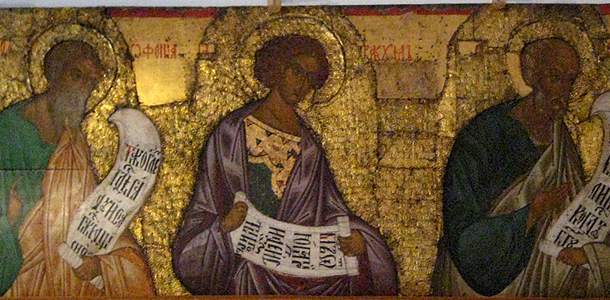
ferapontov_prophets_610x300
Fourth Sunday in Ordinary Time – February 3, 2013

The readings for this Sunday are: Jeremiah 1:4-5, 17-19; 1 Corinthians 12:31-13:13 or 13:4-13; and Luke 4:21-30
Today’s Old Testament reading from Jeremiah (1:4-5, 17-19) and Gospel passage from Luke (4:21-30) offer us an opportunity to reflect on the blessings, burdens and risks of authentic prophets in our Judeo-Christian tradition.
Among the Biblical prophets, we probably know Jeremiah best of all. The son of the priest Hilkiah, he was born in Anathoth — eight miles northeast of Jerusalem — and was called very early to carry out his prophetic mission, perhaps in 626, during the reign of Josiah (Jeremiah 22:16).
Jeremiah was so young that he begged the Lord to allow him to lead a normal life and to spare him the task of scourging the people of Israel and prophesying an invasion of foreigners “from the north” who would deport the Jews and destroy Solomon’s Temple.
Jeremiah saw the catastrophe of his people as an inevitable consequence of the guilt of an entire people who no longer remembered its history. The Hebrews, blindly counting on the Covenant guaranteed by the Lord, and on the Ark preserved in the Temple, felt that the Lord was with them, and as a result they could allow themselves any kind of sin!
Having pulled out from under the yoke of the Lord, Jeremiah told the chosen people that they would fall under the yoke of strangers. But the task assigned to him by God was not only destructive: “Look, today I have set you over the nations and kingdoms, to uproot and to knock down, to destroy and to overthrow, to build and to plant” (1:10). It was also to build and to plant, then. But first it was necessary to uproot so that true growth could occur.
Jeremiah prefigures Christ
Jeremiah has often been seen as a figure foreshadowing Christ. Not only does he speak in God’s name and predict the future, but his very life and ministry have prophetic overtones.
Just as Jesus would do after him, Jeremiah foretold the destruction of the Temple, wept over the future ruin of Jerusalem, condemned the conduct of the priests, was misunderstood by his countrymen, and was humiliated and sentenced to death. Yet the prophet’s condemnation of sin and prophecies of misfortune are always linked to a message of hope and the prospects for rebirth, for return from the Babylonian exile.
Christ, too, in order to affirm his victory over death, would first have to endure the cross on Calvary. The prophet Jeremiah’s very life prepares for the acceptance of the bitterness of the cross and the glory of the resurrection. We should not be surprised then, when Jesus asked his disciples what people were saying about him, they answered, “Some say You are John the Baptist, others the prophet Elijah, others Jeremiah.”
The madding crowd in Nazareth
Today’s Gospel story (Luke 4:21-30) is a continuation of Jesus’ great inaugural moment in the Nazareth that we read last Sunday. In the Nazareth synagogue, Jesus set forth his universal mission repeating the words of the prophet Isaiah (61:1-2).
Into this scene of hometown pride in Nazareth, Jesus brings confusion. A murmur of excitement rippled through the congregation. “Is not this Joseph’s son? Don’t we know this son of Nazareth?”
Yet Jesus knows that his townspeople want to possess him for themselves: “Do here in your own town what we have heard you did in Capernaum.” But he refuses to do so. “No prophet is accepted in his own native place.” Jesus resists the possessive attitude manifested by his people. Jesus refuses to place his extraordinary gifts at the service of his own people, putting strangers first.
The references to Elijah and Elisha (Luke 4:25-26) serve several purposes in this episode: They emphasize Luke’s portrait of Jesus as a prophet like Elijah and Elisha; they help to explain why the initial admiration of the people turns to rejection; and they provide the scriptural justification for the future Christian mission to the Gentiles.
The mood in the synagogue turned rather ugly. The crowd grew terribly envious of one of their own and tried to get rid of him (4:22-30). Jesus did not succeed in making himself heard and understood and he had to depart in haste — for his life (4:30). The rejection of Jesus in his own hometown hints at the greater rejection of him by Israel (Acts 13:46).
Reason for discontent
The people of Nazareth took offense at him and refused to listen to what Jesus had to say. They despised his preaching because he was from the working class; a carpenter, a mere layman and they despised him because of his family. Jesus could do no mighty works in their midst because they were closed and disbelieving toward him.
If people have come together to hate and to refuse to understand, then they will see no other point of view than their own and they will refuse to love and accept others. Does the story sound familiar to us? How many times have we found ourselves in similar situations?
The most severe critics are often people very familiar to us, members of our families, relatives, members of our communities, neighbors we rub shoulders with on a regular basis. The people of Nazareth refused to renounce their possessive attitude toward Jesus. When possessive love is obstructed it produces a violent reaction. This sort of reaction provokes many dramas of jealousy and passion. “Everyone in the synagogue was enraged (Luke 4:28-29) and they sought to kill him.” Refusal to open our heart can lead to such extremes.
Universal vision
Jesus was bitterly criticized because he demonstrated great openness of heart, particularly toward people on the fringes and borders of society. His openness caused rising opposition that led him to the cross.
In the Acts of the Apostles we read more than once that the success of St. Paul’s preaching to the gentiles provoked jealousy among some of the Jews, who opposed the Apostle and stirred up persecution against him (Acts 13:45; 17,5; 22,21-22). Also within the Christian community, we need only recall the situation in Corinth where similar possessive attitudes caused serious harm when many believers attached themselves jealously to one apostle or another; causing conflict and division in the community. Paul had to intervene forcefully (1 Corinthians 1:10-3:23).
Today’s Gospel shows how difficult it is for us to attain to a universal vision. When we are faced with someone like Jesus, someone with a generous heart, a wide vision and a great spirit, our reactions are very often filled with jealousy, selfishness, and meanness of spirit. His own people couldn’t recognize the holiness of Jesus, because they had never really accepted their own. They were suffering from a particular form of blindness.
They couldn’t honor Jesus’ relationship with God because they had never fully explored their own sense of belonging to the God. They couldn’t see the Messiah standing right beside them, because he looked too much like one of them. Until we see ourselves as people beloved of God, miracles will be scarce and the prophets and messengers who rise among us will struggle to be heard and accepted for whom they truly are.
Called to be prophets
Jesus was called to break boundaries and take God’s message of salvation to unexpected people and unexpected places. Obviously, pain and hostility must be endured before Jesus’ new age comes to glory.
Through our common baptism, each of us is called to be a prophet for the Kingdom of God. We will encounter many reactions from those to whom we are sent, not all of them positive. Like Jeremiah and Jesus, unswerving dedication bold courage, and deep, biblical hope must be our trademarks.
Today’s Gospel warns us to be on guard against certain attitudes that are incompatible with the example of Jesus: the human tendency to be possessive, and egoistic and small in mind and heart. We cannot forget that Jesus is the Savior of the world (John 4:42), and not of the village, town, city or nation!
Let us pray that Jesus not be amazed at our own unbelief, but rather rejoice in our small, daily acts of fidelity to him and our service to our sisters and brothers. May the Lord grant us magnanimous hearts so that we may look far beyond ourselves and recognize the goodness, greatness and beauty of other people, instead of being jealous of their gifts.
God’s power alone can save us from emptiness and poverty of spirit, from confusion and error, and from the fear of death and hopelessness. The gospel of salvation is still “Good News” for us today. How do we speak the Word of God with authority today? How do we share the “Good News” with others? How do we use our authority to further the Kingdom of God? How are our words, gestures, messages and lives prophetic today, in the Church and in the world?

Thursday, January 10, 2013

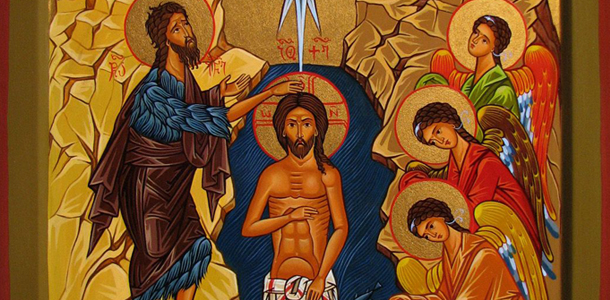
The Baptism of the Lord


Baptism Is a Call to a Prophetic Career

January 8, 2013 By Fr. Thomas Rosica Leave a Comment
Share  

Feast of the Lord’s Baptism Year C – January 13, 2012
The readings for the feast of the Baptism of the Lord are Isaiah 42:1-4, 6-7, or Isaiah 40:1-5, 9-11; Acts 10:34-38, or Timothy 2:11-14; 3:4-7; and Luke 3:15-16, 21-22
The theme of Christ’s epiphany — of Jesus inaugurating his divine mission on earth — reaches its fulfillment in the feast of the Baptism of the Lord. The feast seemingly brings an end to the Christmas season, but Christmas really ends with the feast of the Presentation of the Lord on Feb. 2.
In today’s Gospel story (Luke 3:15-16, 21-22), Jesus begins his ministry in Galilee after the baptism preached by John. In describing the expectation of the people (3:15), Luke is characterizing the time of John’s preaching in the same way as he had earlier described the situation of other devout Israelites in the infancy narrative (2:25-26, 37-38). John the Baptist tells of one far greater than he, one with a more powerful baptism.
In contrast to John’s baptism with water, Jesus is said to baptize with the Holy Spirit and with fire (Luke 3:16). From the point of view of the early Christian community, the Spirit and fire must have been understood in the light of the fire symbolism of the pouring out of the Spirit at Pentecost (Acts 2:1-4). As part of John’s preaching, the Spirit and fire should be related to their purifying and refining characteristics (Ezekiel 36:25-27; Malachi 3:2-3).
When Jesus is baptized, the voice from heaven booms out and names him: “You are my Son, the Beloved; with you I am well pleased.” This affirmation is the defining moment for the prophet from Nazareth. It is God’s declaration of love to God’s new Israel; it is God’s naming to supreme accountability; it is God’s surprise for the world of the proud and powerful.
Through his baptism by John in the muddy waters of the Jordan, Jesus opens the possibility to us of accepting our human condition and of connecting with God the way we were intended to. Jesus accepts the human condition, and this includes suffering and death. He stretched his arms out in the Jordan River and on the cross. In the Jordan, Jesus received his commission. On the cross he completed it. Jesus’ baptism by John in the Jordan identifies him deeply with the people he has come to redeem.
We, too, are called to a prophetic career.
When we were baptized into Christ Jesus, we were baptized into his death. Our baptism is a public, prophetic and royal anointing. We receive the life of the Church and are called to sustain that faith life. Faith is about concern for others. Faith is a public — not private — responsibility.
Baptism is a call to a prophetic career. How we live that out may vary from person to person. The ways may not be as dramatic as the adventures of an Isaiah or a John the Baptist, yet they are in that same great prophetic tradition. To be prophetic is to become involved and to get our hands and feet dirty.
Through our own baptism, we can become a light to others, just as Jesus is a light to us, and to the world. Our own baptism fills us with a certain boldness, confidence and enthusiasm, reminding us that the Gospel must be proclaimed with gratitude for its proven beauty.
When we slowly discover the demands of that faith, and where the way of repentance leads, when we can tell good from evil; when we search for what God wants to do in our lives and ask him to help us accomplish it; when we learn as much as we can about God and his world; when we come near to God, then — at that moment — the person for whom the heavens opened is revealed also to us.
Baptism in today’s Church
In many parts of the world today, baptizing children has already become the exception. The number of unbaptized infants, children, young people, and adults is on the rise. The decline in the practice of baptism is the result of an erosion of family ties and a departure from the Church. During numerous priests’ retreats, gatherings of priests and pastors, I have often heard it discussed that when the priest does not see visible signs of the practice of faith, then the Church would have the right to refuse the sacraments to people, especially baptism. It is a very complex question.
Could we not, however also listen anew to the Gospel missionary injunction to “baptize, preach and teach” not by waiting for the people to come to us but by going out to meet the people where they are in today’s messy world? What is demanded of us is a new missionary fervor and zeal that do not require extraordinary events. It is in ordinary, daily life that mission work is done. Baptism is absolutely fundamental to this fervor and zeal.
The sacraments are for the life of men and women as they are, not as we would like them to be! I can hear Venerable Pope John Paul II crying out to us: “Duc in altum!” It is not in the shallow, familiar waters that you will find those who most need you!
The dilemma of withholding baptism and other sacraments from those believed to be unfit because they are not practicing has always been present in the Church. It is a dilemma that Cardinal Joseph Ratzinger experienced personally as a young man, and finally resolved later in life. Listen to what Ratzinger, now Benedict XVI, said in replying to a related question from a priest of Bressanone in northern Italy, in a public question-and-answer session with the clergy of the diocese on Aug. 6, 2008. The priest, Father Paolo Rizzi, a pastor and professor of theology, asked Benedict XVI a question about baptism, confirmation, and first communion:
“Holy Father, 35 years ago I thought that we were beginning to be a little flock, a minority community, more or less everywhere in Europe; that we should therefore administer the sacraments only to those who are truly committed to Christian life. Then, partly because of the style of John Paul II’s Pontificate, I thought things through again. If it is possible to make predictions for the future, what do you think? What pastoral approaches can you suggest to us?”
Benedict XVI responded with these words, so fitting for us on the feast of the Baptism of the Lord this year:
I must say that I took a similar route to yours. When I was younger I was rather severe. I said: the sacraments are sacraments of faith, and where faith does not exist, where the practice of faith does not exist, the Sacrament cannot be conferred either. And then I always used to talk to my parish priests when I was Archbishop of Munich: here too there were two factions, one severe and one broad-minded. Then I too, with time, came to realize that we must follow, rather, the example of the Lord, who was very open even with people on the margins of Israel of that time. He was a Lord of mercy, too open — according to many official authorities — with sinners, welcoming them or letting them invite him to their dinners, drawing them to him in his communion. [...]
I would say, therefore, that in the context of the catechesis of children, that work with parents is very important. And this is precisely one of the opportunities to meet with parents, making the life of faith also present to the adults, because, it seems to me, they themselves can relearn the faith from the children and understand that this great solemnity is only meaningful, true and authentic if it is celebrated in the context of a journey with Jesus, in the context of a life of faith. Thus, one should endeavor to convince parents, through their children, of the need for a preparatory journey that is expressed in participation in the mysteries and that begins to make these mysteries loved. [...]
I would say that this is definitely an inadequate answer, but the pedagogy of faith is always a journey and we must accept today’s situations. Yet, we must also open them more to each person, so that the result is not only an external memory of things that endures but that their hearts that have truly been touched. The moment when we are convinced the heart is touched — it has felt a little of Jesus’ love, it has felt a little the desire to move along these lines and in this direction, that is the moment when, it seems to me, we can say that we have made a true catechesis. The proper meaning of catechesis, in fact, must be this: to bring the flame of Jesus’ love, even if it is a small one, to the hearts of children, and through the children to their parents, thus reopening the places of faith of our time.
May today’s feast of the Lord’s Baptism be an invitation to each of you to remember with gratitude and renew your own baptismal promises. Relive the moment of the water that rushed over you. Pray that the grace of your own baptism will help you to be light to others and to the world, and give you the strength and courage to make a difference in the world and in the Church.

Saturday, January 05, 2013

The Feast of the Epiphany


A Star and a Pure Heart

January 1, 2013 By Fr. Thomas Rosica Leave a Comment
Share  

Biblical Reflection for the  Solemnity of the Epiphany, Year C – January 6, 2013
The readings for the feast of the Epiphany are Is 60:1-6; Ephesians 3:2-3a, 5-6; and Matthew 2:1-12
The term epiphany means “to show,” “to make known” or “to reveal.” The solemnity of the Epiphany had its origin in the Eastern Church. In Jerusalem, close to Bethlehem, the feast had a special reference to the Nativity. Today in Eastern Orthodox churches, the emphasis for this feast is on the shining forth and revelation of Jesus Christ as the Messiah and second person of the Holy Trinity at the time of his baptism. Usually called the feast of the Theophany, it is one of the great feasts of the liturgical year. “Theophany” comes from the Greek for “God shining forth.”
The West
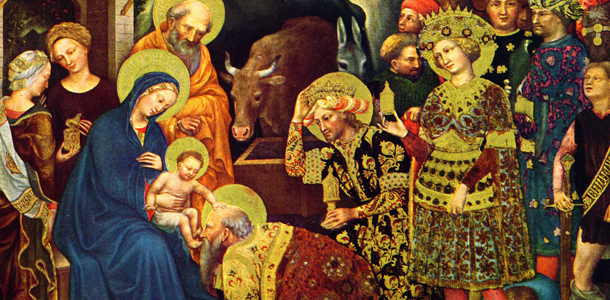
The West took up the Oriental January feast, retaining all its chief characteristics, though attaching overwhelming importance, as time went on, to the visit of the Magi who bring gifts to visit the Christ child, and thus “reveal” Jesus to the world as Lord and King. The feast is observed as a time of focusing on the mission of the Church in reaching others by “showing” Jesus as the Savior of all people. The future rejection of Jesus by Israel and his acceptance by the Gentiles are retrojected into this scene of the Matthew’s narrative.
Details
King Herod reigned from 37 to 4 B.C. The “magi” were a designation of the Persian priestly caste and the word became used of those who were regarded as having more than human knowledge. Matthew’s Magi are astrologers. As for the star in Matthew’s story, it was a common ancient belief that a new star appeared at the time of a ruler’s birth. Matthew also draws upon the Old Testament story of Balaam, who had prophesied that “a star shall advance from Jacob” (Numbers 24:17), though there the star means not an astral phenomenon but the king himself.
The act of worship by the Magi, which corresponded to Simeon’s blessing that the child Jesus would be “a light for revelation to the Gentiles” (Luke 2:32), was one of the first indications that Jesus came for all people, of all nations, of all races, and that the work of God in the world would not be limited to only a few.
At home in their distant, foreign lands, the Magi had all the comfort of princely living, but something was missing — they were restless and unsatisfied. They were willing to risk everything to find the reality their vision promised.
Unlike the poor shepherds, the Magi had to travel a long road; they had to face adversity to reach their goal. The shepherds also knew adversity, and it had prepared them to accept the angels’ message.
But once they overcame their fright, they simply “crossed over to Bethlehem” to meet the Christ child. It was anything but a romantic, sentimental pilgrimage that we often see in our manger scenes!
The Magi from the East, foreigners in every sense of the word, were guided not only by their own wisdom and knowledge of the stars, but were aided by the Hebrew Scriptures that now form the Old Testament.
The meaning of this is important — Christ calls all peoples of all nations, Gentiles as well as Jews, to follow him. We could say that Jerusalem and the Old Testament serve as a new starting point for these Gentile pilgrims on their road to faith in Jesus. The people of the big city, indeed even Herod himself, were instrumental in leading the magi back to Christ!
A tragic adult story
Matthew’s Gospel shows us that right at the beginning of the story of Jesus, the one who is to rule Israel is greeted with the cheers of some and the fearful fury of others. Matthew introduced “all the chief priests and scribes of the people” as advisers of the sinister Herod.
It might appear that they do no more than answer a theological question. Matthew certainly implies something else. In the first place, they, too, had been troubled by the Magis’ word of birth of the Messiah. Knowing that he was paranoid on the subject of any threat to his throne, the Magi should have realized that he would not look kindly upon an infant “king of the Jews.”
By disclosing to Herod the birthplace of the Messiah, the advisers became, effectively, collaborators in his evil intent. In fact it is they, not Herod, who will later bring about the death of the “king of the Jews.” It is the “chief priests and elders of the people” who will plot to arrest and kill Jesus [Matthew 26:3-5, 47; 27:1-2, 12, 20]; “the scribes” are mentioned in 26:57 and 27:41. He was a threat to Herod and to them: to the throne of one, to the religious empire of the others.
The negative reaction of Herod and his advisers, the chief priests and scribes, turns the infancy narrative into a veritable gospel. If we read the story carefully, we realize that far from being a children’s tale, it is a tragic adult story.
Already at Christmas, we see a hint of the inevitable sacrificial death of this “newborn king” — the schism between a worldly ideology and a godly one. The battle lines are drawn and the forces are being marshaled.
Matthew’s Gospel shows us that right at the beginning of the story of Jesus, the one who is to rule Israel is greeted with the cheers of some and the fearful fury of others. To those who are alert to the signs of the times and the places, the coming of Jesus is an invitation to risk and to embark on a journey of faith and a journey of life.
Finding Christ today
A child is born at the same time as a death-dealing power rules. King Herod tries to co-opt the wise men to betray their journey, to end their commitment to future possibility and new life. At the centre of the whole story of striking contrasts lies a baby who is joy. Herod is afraid of this “great joy for all the people.”
Our societies and cultures are becoming increasingly afraid of human life — the greatest joy for all peoples! We must recommit ourselves to life — preserving it, upholding it, blessing it and giving thanks to God for this greatest of gifts.
Some of us are destined to find the Christ child only after a long, tedious journey like that of the Magi. Our worldly wisdom and worldly ways, our ecclesiastical façades need to disappear; we must make sacrifices to find our deepest meaning and peace that is Christ. Most wise people need to make quite a trek if they are to find any lasting meaning.
Simple folk can usually find the Lord by crossing a field like shepherds; they bring their poverty, humility and simple openness. But knowledge, wisdom, power, prestige, and the lack of humility often lead to despair. People who believe they have the immediate, final truth and clarity about anything often are led into bleak, dead-end streets or they remain lost in the desert of solitude, self-sufficiency, selfishness and despair.
In the end, the magi went their own way, and because they refused to be seduced by cynicism, because they allowed themselves to be surprised by this great joy, the star to which they had committed themselves appeared again. This is not only the description of the times into which Jesus was born, but also our times. When we have found our lasting joy in the midst of the encircling gloom, cynicism, despair, indifference and meaninglessness, the only thing to do is to kneel and adore.
If we are truly wise, let us do what the wise astrologers did. When we hear the voice of the old king of death and fear and cynicism, let us have the courage to go our own way — rejoicing. The star and the journey will send us onwards, by newer paths, to come into the presence of the Child of Light and the Prince of Peace, who is the fulfillment of humanity’s deepest hopes and desires for light, justice, love and peace.
The journey continues
The words of the great French Catholic writer Georges Bernanos (1888-1948) speak beautifully of the meaning of this great feast in our day: “From the beginning, My Church has been what it is today, and will be until the end of time, a scandal to the strong, a disappointment to the weak, the ordeal and the consolation of those interior souls who seek in it nothing but myself.
“Yes [...] whoever looks for Me there will find Me there; but he will have to look, and I am better hidden than people think, or than certain of My priests would have you believe. I am still more difficult to discover than I was in the little stable at Bethlehem for those who will not approach Me humbly, in the footsteps of the shepherds and the Magi.
“It is true that palaces have been built in My honor, with galleries and peristyles without number, magnificently illuminated day and night, populated with guards and sentries. But if you want to find Me there, the clever thing is to do as they did on the old road in Judea, buried under the snow, and ask for the only thing you need– a star and a pure heart.”

Saturday, December 22, 2012

4th Sunday of Advent (C)


The readings for the 4th Sunday of Advent are Micah 5:1-4a; Hebrews 10:5-10; and Luke 1:39-45A Biblical Reflection for the Fourth Sunday of Advent, Year C
The Infancy Narrative of Luke’s Gospel contains some of the most touching, well-known biblical scenes in the New Testament.

Not only does the annunciation of the Baptist’s beginnings precede that of Jesus (1:5-24), but the birth of John the Baptist precedes Jesus’ birth (1:26-38). The announcement to Mary of the birth of Jesus (Luke 1:39-45) is parallel to the announcement to Zechariah of the birth of John.
In both stories the angel Gabriel appears to the parent who is troubled by the vision (Luke 1:11-12, 26-29), and then told by the angel not to fear (Luke 1:13, 30). After the announcement is made (Luke 1:14-17, 31-33) the parent objects (Luke 1:18, 34) and a sign is given to confirm the announcement (Luke 1:20, 36). The particular focus of the announcement of the birth of Jesus is on his identity as Son of David (Luke 1:32-33) and Son of God (Luke 1:32, 35).

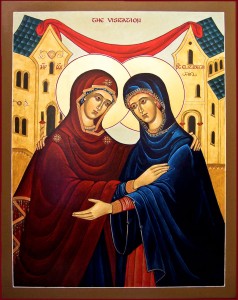
In the very personal scene of Mary’s visitation to Elizabeth (1:39-45), the Precursor and the Lord are both hidden from each other. Yet even before the two women embrace, John leaped for joy in his mother’s womb, having recognized the presence of the Lord and Messiah in the womb of Mary. Both births are hailed by two beautiful canticles: the Benedictus sung by Zechariah, father of the Baptist, at his son’s birth (1:68-79), and the “Nunc Dimittis” prayed by Simeon, the “righteous and devout” man in the Jerusalem temple, as he takes the infant Jesus in his arms (2:22-35).

The two pregnant women of today’s Advent gospel, Mary and Elizabeth, recognized in each other signs from God. The angel Gabriel offered Mary a lesser parallel to her own virginal conception: “Know that Elizabeth your kinswoman has conceived a son in her old age; she who was thought to be barren is now in her sixth month, for nothing is impossible with God” (Luke 1:36). Elizabeth in her turn senses in the movement of the child in her womb on Mary’s arrival that something extraordinary was happening. “Who am I that the mother of my Lord should come to me?” Each of the women experienced in herself the possibility of the impossible.

Trust in God
The visitation of Mary to Elizabeth turned out to be a divine visitation, the Ark of God bringing not terror but blessing as it did to the house of Obededom the Gittite (1 Samuel 6:9-11). Unlike Sarah, who had laughed at the notion that she could conceive and bear a child in her old age to Abraham (Genesis 18:12), and unlike Zechariah, her husband, who had been struck dumb for questioning God’s power in this matter (Luke 1:8-20), Elizabeth gives thanks to God and trusted in his providence: “So has the Lord done for me at that time when he has seen fit to take away my disgrace before others” (Luke 1:25). Mary, for her part, deserved to be acclaimed by Elizabeth as “she who trusted that the Lord’s words to her would be fulfilled.”

Although Mary is praised for being the mother of the Lord and because of her belief, she reacts as the servant in a psalm of praise, the Magnificat. The Magnificat celebrates the wonders of God’s graciousness in the lives not only of these two Advent women but of all for whom “the Mighty One has done great things” (Luke 1:49).

There are two aspects of today’s Visitation scene to consider. The first is that any element of personal agenda of Mary and Elizabeth is put aside. Both had good reason to be very preoccupied with their pregnancies and all that new life brings. Both women had a right to focus on themselves for a while as they made new and radical adjustments to their daily lives.
Mary reaches out to her kinswoman to help her and also to be helped by her. These two great biblical women consoled each another, shared their stories, and gave each other the gift of themselves in the midst of the new life that they must have experienced: Elizabeth after her long years of barrenness and now sudden pregnancy, and Mary, after her meeting with the heavenly messenger, and her “irregular” marriage situation and pregnancy.

The second point to consider is Mary’s quick response and movement. Luke tells us that she undertook “in haste” the long and perilous trek from Nazareth to a village in the hill country of Judea. She knew clearly what she wanted and did not allow anyone or anything to stop her.
In his commentary on Luke’s Gospel, St. Ambrose of Milan describes this haste with a difficult Latin phrase, “nescit tarda molimina Spiritus Sancti gratia,” which could mean: “the grace of the Holy Spirit does not know delayed efforts,” or “delayed efforts are foreign to the grace of the Holy Spirit.” Mary’s free choice to move forward and outward reflects a decision taken deep within her heart followed by immediate action.

Procrastination
How many things exist in our lives that we dreamed of doing, should have done, and never did — letters that should have been written, dreams that should have been realized, gratitude that was not expressed, affection never shown, words that should have been spoken, etc.? Postponements and delays weigh heavily upon us, wear us down and discourage us. They gnaw away at us. How true St. Ambrose described Mary’s haste: The Spirit completely possessed the Virgin Daughter of Nazareth and compelled her to act.

The story of the Visitation teaches us an important lesson: When Christ is growing inside of us, we will be led to people, places and situations that we never dreamed of. We will bear words of consolation and hope that are not our own. In the very act of consoling others, we will be consoled. We will be at peace, recollected, because we know that however insignificant our life and issues seem to be, from them Christ is forming himself.
The women of today’s Gospel show us that it is possible to move beyond our own little, personal agendas and engage in authentic ministry and service in the Church. Ministry and service are not simply doing things for others. Authentic Christian ministers and servants allow themselves to serve and be served, taught, cared for, consoled and loved. Such moments liberate us and enable us to sing Magnificat along the journey, and celebrate the great things that God does for us and His people.

Consider these words of Blessed Mother Teresa of Calcutta (1910-1997): “In the mystery of the Annunciation and the Visitation, Mary is the very model of the life we should lead. First of all, she welcomed Jesus in her existence; then, she shared what she had received. Every time we receive Holy Communion, Jesus the Word becomes flesh in our life — gift of God who is at one and the same time beautiful, kind, unique.
“Thus, the first Eucharist was such: Mary’s offering of her Son in her, in whom he had set up the first altar. Mary, the only one who could affirm with absolute confidence, ‘this is my body,’ from that first moment offered her own body, her strength, all her being, to form the Body of Christ.”

God’s choice
Let me conclude with these thoughts given to me years ago by an elderly Italian religious sister who made a retreat I preached in a small Umbrian town in Italy just prior to Christmas. The poem is entitled “Bellezza” meaning “Beauty,” and speaks about God’s choice of Mary for a special mission.

Don’t smile, brothers and sisters,
And don’t shrug your shoulders:
Our God is fascinating and what he does always surpasses the impossible.


God looked upon a woman and loved her,
And he who loves even before looking at the face
Seeks the beauty that lies in the heart.

God looked upon a woman who was from the race
Of the little ones without name,
Those that live far away from palaces.


Those who work in kitchens,
Those who come from the numbers of the humble and the forgotten,
Those that never open their mouths and who are accustomed to poverty.


God looked upon her and found her to be beautiful,
And this woman was joined to him as if she were his beloved –
For life and for death.


From now on all generations will call her blessed.
God looked upon a woman. Her name was Mary.


As a woman who gives herself, she believed,
And during the night, in a grotto, she cried out with pain,
And from her womb God himself was born,
Brining with him salvation and peace, like treasures for all eternity.

As a woman who surrenders herself and never regrets it,
She believed against all the obscurity that enveloped her,
Against all the doubts that filled her.


From now on her name will be sung, because God took her
And she gave herself to him, she, Mary, one of us.

And God crowned her with stars and robed her with the sun,
And under her feet God placed the moon.


Her name is Mary, and if you looked upon her Lord, it is because on Our earth filled with women and men, you found such beauty.
__._,_.___

Sunday, November 11, 2012

Two Mighty and Courageous Widows...


Two Mighty and Courageous Widows

November 6, 2012 By  Leave a Comment
inShare  


Thirty-second sunday in ordinary time – November 11, 2012
The readings for this Sunday are: 1 Kings 17:10-16; Hebrews 9:24-28; Mark 12:38-44 or 12:41-44


Today’s Old Testament reading from 1 Kings 17:10-16 and the Gospel story from Mark 12:38-44 present us with two remarkable widows who challenge us by their conviction, generosity and faith. They force us to reexamine our understanding of the poor and poverty, and look at our own ways of being generous with others. I would like to offer some reflections on the stories of these two biblical figures and then apply their example to our own lives, through the lenses of Pope Benedict XVI’s encyclical letter Caritas in Veritate.

Elijah’s faith
Whenever I read stories from the Elijah and Elisha cycle in the first and second books of Kings, I always say a prayer of thanksgiving for one of my professors from the Pontifical Biblical Institute in Rome, Jesuit Father Stephen Pisano, who taught the best course I had in the Old Testament: “The Man of God in the Books of Kings.” God knows how many times I have gone back to those notes and appreciated anew the stories of Elijah and his disciple Elisha, and their efforts to make God’s Word known and loved in the land of Israel! In I Kings 17:8-16, God continues to test the Prophet Elijah. While today’s lectionary reading begins with Verse 10, it is important to go back to Verse 8 to understand the full meaning of the text. In Verse 8 we read: “Then the word of the Lord came to him, saying… .”

Elijah did not set out until he received the message from God. It is essential for us to be in communication with God through listening to God’s Word before setting out on mission.

Elijah is then told to go to Zarephath (v 9), which is part of Sidon. Verse 9 contains three commands: “arise,” “go,” and “stay.” The prophet will be tested with each of these commands through faith, trust, obedience, availability and commitment. When Elijah is told to “arise,” it is not only a physical movement but a spiritual one. For Elijah, following the Lord obediently is the result of his own spiritual reawakening.

The second command – “go to Zarephath” – carries with it the idea of a journey, including risks, hardships and dangers. Elijah is sent to a specific place, Zarephath, which means “a smelting place, a place of testing.” Furthermore, Zarephath was in the land of Sidon, which belonged to the wicked Jezebel. Elijah is hardly being sent to a vacation destination for rest and relaxation!

The third command – “stay there” – was a great challenge to his commitment, trust and vision as a man of God who was simply seeking to serve the Lord. Elijah’s provision would come from a poor, destitute, depressed widow facing starvation in the pagan nation of the Sidonians who represented the forces clearly in opposition to the God of Israel.


Elijah encounters his benefactress, not living in a large house and sharing her excess with itinerant prophets, but rather at the gate of the city, collecting a few sticks since she had no fuel at home to cook even a meagre meal.

The God who commanded the ravens and who provided for Elijah in the desert (I Kings 17:1-7), was the same God who had commanded the widow and would provide for the prophet through her. At Zarephath, the poor woman listened to Elijah’s instruction and it was just as he had promised according to the Word of the Lord. She saw the power of God: The widow, her son, and Elijah were all sustained.

What lessons can we learn from this passage?
Because of a poor woman’s generosity and goodness, and Elijah’s faithfulness, God strengthened the prophet’s faith, renewed his capacity for ministry, using him to comfort the widow and her son at the same time. The Lord God will provide for us, beyond outward appearances of weakness, failure and fear. God always does far more than we can ever ask for or imagine.

Just a mite
In today’s well-known Gospel story (Mark 12:38-44), Jesus praises the poor widow’s offering, and makes it clear that the standard measurement for assessing gifts is not how much we give to the works of God or how much we put in the collection basket, but how much we have left for ourselves. Those who give out of their abundance still have abundance left.

Is Jesus exalting this woman because she emptied her bank account for the temple? Is Jesus romanticizing and idealizing the poor? I have yet to meet people who dream of growing up destitute, poor, hungry and homeless. I don’t know anyone who delights in living from one government social assistance check to the next, nor people who enjoy rummaging through garbage bins and are proud that they cannot afford to pay for electric and water bills for their inadequate and even dangerous housing situations during cold Canadian winters.

The woman in today’s provocative Gospel story was poor because she was a widow. She was completely dependent on her male relatives for her livelihood. To be widowed meant not only losing a spouse, but more tragically, losing the one on whom you were totally dependent. Widows were forced to live off of the generosity of other male relatives and anyone in the community who might provide for one’s needs.

The two coins in the woman’s hand were most likely all she had. When one has so little, a penny or two isn’t going to move that person from complete social assistance to employment. With the coins or without them, the widow was still a dependent person. She had no status in life. She was totally dependent on the grace of God, yet she was indeed rich in God’s mercy.

Jesus never condemns the rich but simply says that they will find it difficult to enter the kingdom. What matters is not how much money is stored in bank accounts or kept in stocks and bonds, but rather for what that money is destined.

Will the money be used to assist others, to make the world a better place? Will be it used to feed the hungry, clothe the naked, provide for the homeless and destitute poor? Will it be used to build a culture of life? Do our lives revolve around the money or are we dependant on God who truly makes us rich? Do we behave as owners or live as stewards?

The widow tossed her only signs of independence into the collection basket, but she maintained her complete dependence on God and neighbour. Her example of faith is grounded in the love of God: her love for God and God’s love for her. She was a steward and not an owner of her meagre possessions. This poor widow teaches us that dependence, far from being oppressive and depressive, can really lead to a life lived in deep joy and profound gratitude.

Charity in truth
Four brief sections from Benedict XVI’s encyclical letter Caritas in Veritate merit our careful reflection and meditation this week.
1. The search for love and truth is purified and liberated by Jesus Christ from the impoverishment that our humanity brings to it, and he reveals to us in all its fullness the initiative of love and the plan for true life that God has prepared for us. In Christ, charity in truth becomes the Face of his Person, a vocation for us to love our brothers and sisters in the truth of his plan. Indeed, he himself is the Truth (cf. John 14:6).
23. The mere fact of emerging from economic backwardness, though positive in itself, does not resolve the complex issues of human advancement, neither for the countries that are spearheading such progress, nor for those that are already economically developed, nor even for those that are still poor, which can suffer not just through old forms of exploitation, but also from the negative consequences of a growth that is marked by irregularities and imbalances.

42. For a long time it was thought that poor peoples should remain at a fixed stage of development, and should be content to receive assistance from the philanthropy of developed peoples. Paul VI strongly opposed this mentality in Populorum Progressio.

Today the material resources available for rescuing these peoples from poverty are potentially greater than before, but they have ended up largely in the hands of people from developed countries, who have benefited more from the liberalization that has occurred in the mobility of capital and labor. The world-wide diffusion of forms of prosperity should not therefore be held up by projects that are self-centred, protectionist or at the service of private interests.
75. While the poor of the world continue knocking on the doors of the rich, the world of affluence runs the risk of no longer hearing those knocks, on account of a conscience that can no longer distinguish what is human. God reveals man to himself; reason and faith work hand in hand to demonstrate to us what is good, provided we want to see it; the natural law, in which creative Reason shines forth, reveals our greatness, but also our wretchedness insofar as we fail to recognize the call to moral truth.
Fr. Thomas Rosica, CSB
CEO, Salt and Light Catholic Media Foundation