Kargador at Dawn

Kargador at Dawn
Work in the Vineyard

Friday, October 26, 2012

Badaliyya: Fatiha


Badaliyya 004: Fatiha 

Fr. Louis Massignon’s clear message to the BADALIYYA movement is to effect peaceful relations and reconciliation with those of other faith traditions.  To achieve this, we must begin by opening our own minds and hearts to conquer our fear of differences.

Fr. Massignon spoke often of the need to “cross over” to the “other”, to learn their language, study their beliefs, practices and culture as the beginning of mutual respect and understanding. In the process of learning to truly know others, from the inside out so to speak, we find that our own values and belief systems become more defined and clear.

Our faith experience is enhanced rather than diminished. The goal of “substitutionary prayer” of “Badaliya” is to see the face of Christ in every human person and learn to love them as Christ loves us.

As Christians we are challenged to overcome centuries of misinformation and prejudice that we have sometimes even unconsciously absorbed.

In one of his books the Fransiscan Fr. Giulio Basetti-Sani writes about his own journey of studying the condemning writings of the scholars of his time about Islam and Muhammad and approaching Louis Massignon with those ideas. He wrote:

“Once, when Professor Massignon was in Cairo, I went to see him at the French Institute of Oriental Archeology.... Only someone who has known Massignon can fully imagine his reaction to my ideas. His usual grave expression changed to a smile like the lighting of a lamp and his eyes twinkled. He said, ‘The medieval world taught that Muhammad was a messenger of Satan and that the Allah of the Qur’an was not the God of Abraham. We should not do to others what we would not have them do to us’.

Basetti-Sani quotes much more than this as he describes how, following Massignon’s advice, he began to move in a totally different direction in what became years of Islamic studies. He wrote: “Islam is a mystery linked with the blessing obtained by Abraham from God for his son Ishmael and Ishmael’s progeny.

This line of thought, derived from the Bible, is the one to take in order to grasp the significance of Islam....
Before we parted, Massignon gave me two thoughts meant as guidelines in my reorientation, one from St. Augustine, ‘Love sees with new eyes.’ and the other from St. John of the Cross, ‘Where there is no love put love, and you will find Love Himself’.

It was true, my eyes had seen badly... Later, when my eyes were to see clearly, I would discover in Islam and the Muslims the reflections of the infinite goodness of God”. (From Basetti-Sani.1977. “The Koran In the Light of Christ”)

With the inspiring examples of Fr. Giulio Basetti-Sani, Massignon himself and his own mentor, Bl.Charles de Foucauld, and in the spirit of St. Francis, let us begin our process of learning about Islam. We begin with the opening Sura (chapter) of the Qur’an:

One of the first prayers in the Qur’an memorized very early by every Muslim child is the opening Sura called the Surat-al -Fatiha. The language of Islam and the Qur’an is Arabic and therefore all Muslims learn to chant the verses in this poetic language. The Fatiha is a wonderful summary of Muslim belief that God is the Lord of all being, entirely separate from the world yet forever present and aware, providing a Path from darkness into light and a direction for worship and praise:


“In the name of God, the Merciful, the Compassionate.
Praise be to God, the Lord of all being.
The Merciful, the Compassionate.
Master of the Day of Judgement.
It is you alone that we serve,
It is only from you that we seek aid
Guide us on the straight path.
The path of those whom you have blessed.
Not of those with whom you are displeased.
Nor of those who go astray.”
(Translated by Matthew S. Gordon)

In his letters to members of the Badaliya, Fr.  Massignon often invited them to join in both the fasts and the feasts of both Islam and Judaism. We have an opportunity to fast and pray the Fatiha in spirit with our Muslim brothers and sisters, as Fr. Massignon did, during the Muslim month of Ramadan. He chose always to pray the Fatiha on the feast of the 27th day of Ramadan marking “the Night of Destiny” when Muhammad received the first revelation of the Qur’an.

May we look neither for likenesses nor differences as we learn about all faith traditions but rather see just what is there. That is seeing with the eyes of Love.

Peace to you…
Fr. Jun Mercado, OMI


30th Sunday in Ordinary Time (B)


Master, I Want to See!

October 23, 2012 By Fr. Thomas Rosica Leave a Comment
Share  

Thirtieth Sunday in Ordinary Time – October 28, 2012

The readings for this Sunday are: Jeremiah 31:7-9; Hebrews 5:1-6; Mark 10:46-52
Mark’s healing stories of the blind man of Bethsaida (8:22-26) and the healing of Bartimaeus, the blind man on the road to Jericho (10:46-52) were undoubtedly popular stories in the early Church and they remain very significant stories for the contemporary Church.
These miracles have always fascinated me because I grew up with my father who was an eye doctor. How frequently we spoke about sight impairments, eye diseases, astigmatisms, cataracts and 20/20 vision! My father was also a member of a charitable society that assisted the blind, and I vividly remember volunteering as a child with my father and his doctor colleagues who hosted memorable Christmas parties for blind people.
Road to Jericho
Mark tells the story of Jesus’ encounter with Bartimaeus, a blind man and a beggar (10:46-52) in the Gospel for the 30th Sunday in Ordinary Time (Year B). Jesus had made the long, arduous journey down the desert valley from Galilee in the north. He was on his way to Jerusalem, a daunting climb from an oasis on the desert floor to the hills of Judea.
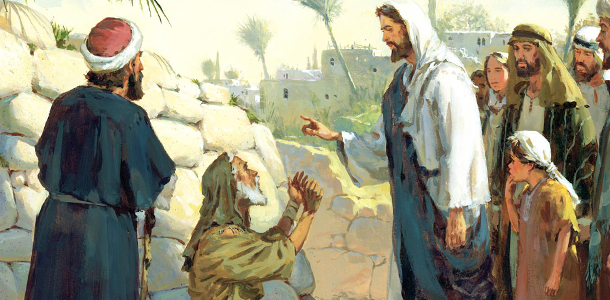
As Jesus passed through Jericho, Bartimaeus heard the din of the crowd and knew that the chance of a lifetime was within his grasp. Bartimaeus was not about to miss this opportunity! From the roadside, he began to cry out, “Jesus, Son of David, have mercy on me!” Some people in Jesus’ entourage were embarrassed to have this dirty, rude beggar bother the master and they attempted to silence him.
What were they embarrassed about? Bartimaeus was simply trying to engage the culture around him and let the people know that he, too, had a right to see Jesus. If individuals in the crowd had heard the rumours about Jesus’ healing powers, wouldn’t they be kind to this poor beggar and bring him to Jesus for healing?
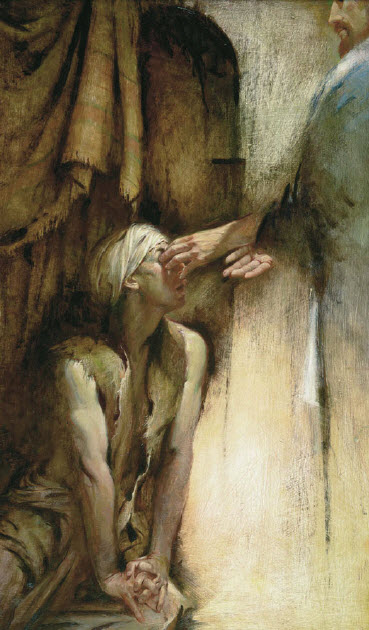
Bartimaeus would not be denied – and neither would Jesus. As the shouts of the beggar reached his ears, Jesus brushed aside the restraints of his disciples and called to the blind man. Bartimaeus threw off his cloak and drew near to that welcoming voice, which responded to his pleas, “What do you want me to do for you?”
“My teacher, let me see again.” And Bartimaeus did see, not just with his eyes but more importantly, with his heart. Though Bartimaeus was blind to many things, he clearly saw who Jesus is. Seeing “who Jesus is” is the goal of faith, and it leads to discipleship. At the end of the story, Bartimaeus regained his sight and followed Jesus on the way. Given that the very next verse in Mark narrates the entry into Jerusalem, we can be certain that Bartimaeus followed Jesus on the way to the cross.
Blindness metaphor
Compassion for the outcast was a hallmark of Jesus’ ministry and healing stories in the Gospels never seem to be simply a reversal of physical misfortune. In the stories of those who “once were blind, but now they see,” the connections between seeing and believing are so strong that these miracles worked by Jesus are more about growing in faith than letting the scales of blindness fall away.
Disciples of Jesus have vision problems. How often do we use the metaphor of blindness to describe our inability to grasp the meaning of the suffering we endure? We sometimes describe our blindness as an inability to see the forest for the trees, but that is a rather simplistic analysis. More worrisome is the inherited blindness which so often assumes that there are no lessons left to learn. Arrogance is very often the root of our blindness. We need the miracle of restored sight each day.
What corners of the Church, of society and of our culture need serious healing, restoration and reformation in our time? Where are our blind spots? Where are the big problems with near-sightedness and far-sightedness? How often do we prefer monologue to dialogue, refusing to believe that we might learn from those who oppose us and disagree with us; refusing to engage the culture around us and preferring a narrow, obstinate and angry way of existing? How often do we say that there are no other ways to look at an issue than our way … or the highway!
How often do we behave like those who tried to prevent Bartimaeus from seeing and meeting the Lord? Against the cries of the scoffers and cynics in our midst, do we dare to bring our friends, colleagues and loved ones into the very presence of the Lord? How can we not, when we know the result of a lifetime without Christ?
Healing, restoration and sight
Abortion is the most serious wound inflicted not only on individuals and their families who should provide the sanctuary for life, but inflicted as well on society and its culture, by the very people who ought to be society’s promoters and defenders. It is important to recall Benedict XVI’s words and pro-life vision at theWelcoming Celebration by the Young People of World Youth Day 2008 in Sydney, on July 17, 2008:
And so we are led to reflect on what place the poor and the elderly, immigrants and the voiceless, have in our societies. How can it be that domestic violence torments so many mothers and children? How can it be that the most wondrous and sacred human space – the womb – has become a place of unutterable violence?
The Roman Catholic Church offers a teaching on the inviolability, the sacredness and the dignity of the human person: a 20/20 vision for which we must strive each day if we claim to be pro-life.
Opposition to abortion and euthanasia does not excuse indifference to those who suffer from poverty, violence and injustice. We must strive to see the whole picture, not with tunnel vision.
To say that we are pro-life means that we are against whatever is opposed to life itself, such as any type of murder, genocide, abortion, euthanasia or wilful self-destruction.
We stand firmly against whatever violates the dignity of the human person such as mutilation, torments inflicted on body or mind, attempts to coerce the will itself, whatever insults human dignity such as subhuman living conditions, arbitrary imprisonment, deportation, slavery, prostitution, the selling of women and children, and disgraceful working conditions where people are treated as instruments of gain rather than as free and responsible persons. All of these things and more destroy human life and poison human society.
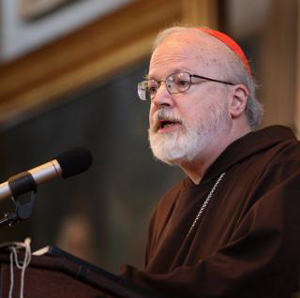
Capuchin Cardinal Sean O’Malley, archbishop of Boston, recently wrote:
Our ability to change people’s hearts and help them to grasp the dignity of each and every life, from the first moment of conception to the last moment of natural death, is directly related to our ability to increase love and unity in the Church, for our proclamation of the Truth is hindered when we are divided and fighting with each other.
Being pro-life is one of the deepest expressions of our baptism: We stand up as sons and daughters of the light, clothed in humility and charity, filled with conviction, speaking the truth to power with firmness, conviction and determination, and never losing joy and hope.
Being pro-life is not an activity for a political party or a particular side of the spectrum. It is an obligation for everyone: left, right and centre! If we are pro-life, we must engage the culture around us, and not curse it. We must see others as Jesus does, and we must love them to life, even those who are opposed to us.
As we recognize the things that blind us from the Lord and paralyze us from effective action, let us never cease begging the Lord to heal us! “Lord, that I may see!” And when our vision is restored, let us get up to follow him joyfully along the way to the Kingdom.
A Prayer for Sight
Origen (185-253)
May the Lord Jesus touch our eyes,
As he did those of the blind.
Then we shall begin to see in visible things
Those which are invisible.
May he open our eyes to gaze not on present realities, But on the blessings to come.
May he open the eyes of our heart
to contemplate God in Spirit, Through Jesus Christ the Lord,
To whom belong power and glory
through all eternity. Amen.
Fr. Thomas Rosica, CSB
CEO, Salt and Light Catholic Media Foundation

Saturday, September 15, 2012

24th Sunday in Ordinary Time (B)


Affirmation, identity and purpose of Jesus’ mission

September 11, 2012 By 
inShare  

Twenty-fourth Sunday in Ordinary Time, Year B

The readings for this Sunday are: Isaiah 50:5-9; James 2:14-18; Mark 8:27-35


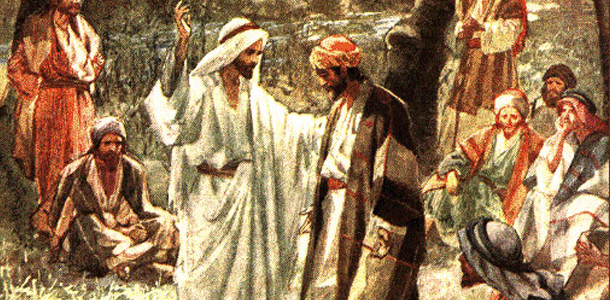
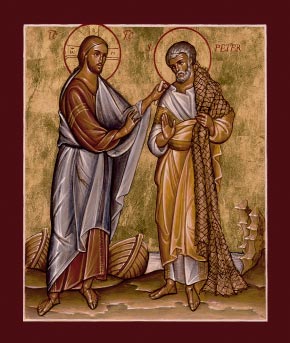
Today’s Gospel story (Mark 8:27-35) is about affirmation, identity and purpose of Jesus’ mission. Mark makes this episode the centrepiece of his Gospel. It comes immediately after Jesus’ healing of the blind man of Bethsaida.
This restoration of sight must surely set the scene for Peter’s confession of faith and the glorious moment of the Transfiguration. Jesus’ nature is now gradually revealed to the disciples. Their blindness is cured but they still do not understand the full meaning of what they see. From this point on, everything in Mark’s Gospel moves toward the crucifixion.
If there was ever a “turning point” in Mark’s account of Jesus’ public ministry, it is today’s story. During my graduate studies in Israel in the 1990s, I had the privilege of working closely with the Israeli archeological team on the excavations in Caesarea Philippi, now known as “Banias” referring back to “Paneas” or the Greek god Pan. Sexual excess and violence ran rampant in this centre for the worship of the Greek god Pan.  At the time of Jesus, a fertility cult was thriving in this pagan temple on the border of northern Israel and Syria at the foot of majestic Mount Hermon. Jesus and his disciples entered the area of Caesarea Philippi as part of a long journey from their familiar surroundings.


Caesarea Philippi had been built by Philip, another generation of the Herodian family, and it was a garrison town for the Roman army. Here in this centre of pagan worship to the Greek god Pan, Jesus asks about their understanding of his identity. Jesus asks what people are saying about him. How do they see his work? Who is he in their minds? Probably taken aback by the question, the disciples dredge their memories for overheard remarks, past conversations, opinions and gossip circulating in the fishing towns of the lake area. Jesus himself is aware of some of what is being said and knows only too well the hurtful attitudes of his own townsfolk of Nazareth.

In response to Jesus’ question, the disciples list a whole series of labels that people have applied to Jesus. These names reveal the different expectations held about him. Some thought of him as an Elijah, working toward a real confrontation with the powers that be. Some saw him more like Jeremiah, no less vehement but concentrating more on the inner journey, the private side of life.

Jesus pursues the question further – “Who do you say that I am?” and Peter responds, “You are the Christ” of the one true God. Jesus acknowledges this identification but forbids them from making his messianic role known to avoid confusing it with ambiguous contemporary ideas associated with that title. Then Jesus goes on to say, somewhat enigmatically, that the Son of Man must suffer, be rejected, die, and rise again.

The concept of Messiah in Judaism

There was no single concept of “Messiah” in Judaism. The idea of Messiah “anointed one” as an ideal king descended from David is the earliest known to us, but in the Maccabaean period (163-63 B.C.) the Greek Testaments of the Twelve Patriarchs give evidence of belief in a Messiah from the tribe of Levi, to which the Maccabaean family belonged. The Dead Sea Scrolls contain various ideas: a priestly Messiah and the (lay) Messiah of Israel; a prophet like Moses (Deuteronomy 18:18-19) who is also the star coming out of Jacob (Numbers 23:15-17); but also the Davidic Messiah. Melchizedek is a deliverer also, but is not called Messiah.

To proclaim Jesus as the Messiah was a loaded and dangerous statement. It was all that Jesus’ enemies needed to use against him, and already there were many who were ready to enlist under the banner of a royal pretender. But, far more than this, such a role was not Jesus’ destiny. He would not and could not be that kind of militaristic or political Messiah.

Identifying Jesus’ role today

The struggle to identify Jesus and his role as Messiah continues today. Some say individual Christians and the whole Church should be Elijah figures, publicly confronting systems, institutions and national policies. That was the way Elijah saw his task. Read the First Book of Kings (Chapters 17 to 21) to see what Elijah endured. Those filled with violence don’t usually bring about peace and justice in situations that are terribly unjust and wrong. Some say, like Jeremiah, that the reign of Christ, through his Church, is the personal and private side of life. And there are indeed many who would like to reduce religion and faith to a private affair in our world today.

Jesus probes beyond both approaches and asks, “You, who do you say I am.” In Peter’s answer, “You are Christ,” blurted out with his typical impetuosity, we are given a concept that involves both of the above ideas and goes beyond them. The Messiah came into society, and into individual lives, in a total way, reconciling the distinction between public and private. The quality of our response to this question is the best gauge of the quality of our discipleship. Everyone at some stage must come to Caesarea Philippi and answer the question, “You, who do you say I am?”

Some facts about Jesus

As we continue to give answer to the question: “Who is Jesus for us?” let us recall certain facts about Jesus’ background, identity and mission that have prepared the mission of the Church in the world today:
  1. Jesus was born of the political tribe of Judah–not the priestly tribe of Levi nor the priestly family of Zaddok. Jesus was not a politician.
  2. Jesus did, however, have a keen sense of politics. World mission cannot be undertaken independently without serious interaction with politics.
  3. Jesus established himself at Capernaum rather than at Qumran in the desert or in some remote village or place away from the thick of things. In Capernaum, on the northwest shore of the Sea of Galilee, there was a mainroad, tax collectors, and dealings with the Roman centurion. Jesus was very much at home in Capernaum, not in Jerusalem.
  4. Jesus bonded himself with the unclean, the sick and dying, with sinners, and those living on the fringes of society. Through his life, Jesus puts biblical justice into practice in proclaiming the Beatitudes. Authentic justice is a bonding of one’s self with the sick, the disabled, the poor and the hungry. But he did not neglect others as well. He dined with the rich and the mighty as well as with the poor and downtrodden. He befriended sinners and the wretched of his times – never condoning their behavior, but inviting them to an alternative lifestyle. He teaches us that by “being with people” he also teaches and heals. His human solidarity with the unclean, the unjust and sinners also saves.
  5. Jesus did not preach the political kingdom of David but the Kingdom of God. He had a great ability to appeal to everything and incorporate everything into his vision of kingdom. During his lifetime, he only tried to fulfill the hopes of Israel. The Good News he preached was ultimately about love. Contrary to some popular opinions still around today, Jesus was not a social revolutionary. He did not denounce injustice, but confronted it with love. It is striking how many of his parables assume situations of injustice, not to condemn the injustice but to show the zeal, ingenuity and perseverance of the unjust as a model for those who would live by love. Still, those who lived by injustice made no mistake when they recognized in Jesus and in those who followed him a fundamental challenge to their way of life.
Following Jesus today


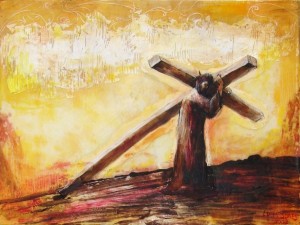
Jesus’ words at the end of today’s Gospel “Whoever wants to become my follower, let him deny himself and take up his cross and follow me. For whoever wants to save their life will lose it, but whoever loses their life for my sake, and for the sake of the Gospel, will save it.” (v 34-35) challenge all believers to authentic discipleship and total commitment to himself through self-renunciation and acceptance of the cross of suffering, even to the sacrifice of life itself. The Way of the Cross was not for Jesus alone but also for everyone who professed to follow him. There might be victory and glory ahead, but it was only for those who could take up the Cross. If Peter or anyone else should reject this demand it meant to be on the side of Satan. Life seen as mere self-centred earthly existence and lived in denial of Christ ends in destruction, but when lived in loyalty to Christ, despite earthly death, it arrives at fullness of life.

Fr. Thomas Rosica, CSB
CEO, Salt and Light Catholic Media Foundation

Monday, June 25, 2012

Badaliyya # 1


BADALIYYA #1

The Badaliya movement was created in Cairo in 1934 by Fr. Louis Massignon. The same spirit was shared by his friend and mentor, Charles de Foucauld.

The backdrop of the movement was the shared concern for the mounting religious conflicts in the Middle East, especially in Palestine/Israel.

By renewing the spirit of the Badaliya in the Philippines, we hope to encourage mutual respect, understanding and dialogue between Massignon's three Abrahamic traditions here in the Philippines with few modifications.  We can substitute, Indigenous Peoples’ beliefs to Judaism. 


The Badaliya began with a vow made by Louis Massignon and Mary Kahil in an ancient Franciscan church to dedicate themselves to the well-being of the Muslim community.

Since we are a small group it is reassuring to realize that the Badaliya began with only two. The initial responses to the idea of a vow led us to begin to realize the seriousness of our endeavor.

The vows are essentially a deepening of our baptismal promises. This is an invitation for us to struggle more intently with what we are called to become. We discuss the meaning of the Arabic word, badaliya, substitution, and begin some reflection on Massignon's understanding in light of his intense Christian faith.

Substitution is a controversial and challenging call which we will continue to explore through the writings of Massignon and others at our badaliya prayer session.

In keeping with the original spirit of the Badaliya we shall have moments before the Blessed  Sacrament in silence. We conclude the adoration in silence with intercessory prayers that include a plea for peaceful resolution to the unpeace in Southern Philippines and for conversion of hearts of all those whose hatred leads them to terrorist actions.

We pray for the courage to forgive them by offering ourselves in their place to be reconciled to a benevolent God. We closed with the prayer of our Church, the Lord's Prayer.

We center our gathering on the theme of peace and each person shares his/her experience on the issue of Muslim-Christian relations.  In solidarity with all the badals worldwide, we agree to join them in praying for peace in the world, especially in the Holy Land.

Peace to everyone.
Fr. Jun Mercado, OMI
25 June 2012

Badal Concept


Peace!

Badaliyya is a movement based on the concept of BADAL (an Arabic word for "Substitution" or "Ransom". The inspiration comes from the "understanding" that interreligious relation, is primarily a movement of LOVE - a PASSIONATE LOVE that moves one to offer his/her life that others may have life and life to the full. It is a movement of self-expenditure... The model is Jesus Christ in the cross who paid the price by being a RANSOM for us!

St. Francis of Assisi and Blessed Charles de Foucault are few examples of Badal.  The Badaliyya movement got the first impetus through the initiatives and efforts of Fr. Louis Massignon, Mary Kahil and their friends in the Academy specializing in Middle East Studies.

Beginning this June 28th, 2012, Thursday, we shall revive our monthly Badaliyya  Session (every last Thursday of each month) at the Conference Hall of the Institute for Autonomy and Governance (2nd Floor of NDU Main Canteen) from 3: 30 pm to 5:00 pm.

Bring also your friends and members of your community…

For more information, visit the website of the Badaliyya Philippines at http://www.badaliyya.blogspot.com/

Be well!

Bapa Eliseo "Jun" Mercado, OMI

Blessed Charles de Foucauld


Badaliyya Philippines


Badaliyya Philippines
June 2012

Dear Friends,

The present ambiguities in Southern Philippines and in the world, have become a source of an extra push to revive the Badaliyya Prayer on each last Thursday of the month.  We will begin the monthly updates at 3:30 pm and conclude with a 30-minute prayer beginning at at 4:30 pm.  The first session is scheduled on the 28th of June 2012 at the Conference Hall of the Institute for Autonomy and Governance (2nd Floor of the NDU Main Canteen).
.
In this first session, we shall reflect on the call to “substitutionary prayer” following Louis Massignon’s own suggestion to turn to Charles de Foucauld and Saint Francis for inspiration and enlightenment.

At Tamanrasset in the southern Algerian desert Foucauld realized that he needed to know and understand theTouareg people in order to truly live with them. In fact he wanted to assimilate himself into their way of life, in a sense to “become Touareg”. Not only did he allow himself to eat what those to whom he dedicated his life ate but he learned their language as intimately as they knew it, as well as their history, traditions, folklore, poetry and beliefs. “To make oneself understand is the beginning of everything, in order to do something good”, he wrote. “It isn’t enough to pray for the salvation of others, nor even to lovingly give oneself to them, but to offer oneself body and soul for their souls”.

Please join us in person and invite your friends or in spirit as we pray for peace and reconciliation in the Mindanao and other parts of the planet. .

Peace to you.
Eliseo “Jun” Mercado, OMI

Saturday, June 09, 2012

Invitation to Monthly Badaliyya Session


Dear Friends of the Badaliya,

The Badaliya Movement began in Cairo in 1934 with Fr. Louis Massignon and companions. In keeping with Massignon's spirituality as well as that of his friend and mentor, Blessed Charles de Foucauld. The movement began with a shared concern for the mounting religious conflicts in the Middle East, especially in Palestine/Israel. 

By renewing the spirit of the Badaliya for our time in Southern Philippines, we are hoping to encourage mutual respect, understanding and dialogue between Massignon's two of the three Abrahamic traditions that are found here in the Southern Philippines and wherever others join us in spirit around the world. In the spirit of our friends and guides, Louis Massignon and Charles de Foucault, we believe, as they did, that any efforts at reconciliation and social action must begin in prayer.

We are planning to begin, again, the Badaliyya in Cotabato starting July 27th 2012.  The suggested day for the monthly Badaliyya session is every last Friday of each month. We can begin our session at 3:00 p.m. and conclude with a light merienda at about 5 p.m. The place of our monthly meeting is at the conference room of the Institute for Autonomy and Governance (2nd Floor of the University Main Canteen).

The revival of the Badaliyya Session each month is an invitation for us to struggle more intently with what we are called to become as people of faith and dialogue. We shall discuss and share the meaning of the Arabic word, badaliya, substitution, etc. Substitution is a controversial and challenging call that we will continue to explore through the writings of Massignon and others at our gatherings.

We shall begin our prayer together in silence. We can use a piece of music to help us focus our prayer, and then spent some time in silent reflection. We shall center our gathering on the theme of peace in Southern Philippines. There will be scripture passages, a reading from the Qur'an. Our intercessory prayers will include a plea for peaceful resolution to the crises in the Southern Philippines and the Middle East and for conversion of hearts of all those whose hatred leads them to terrorist actions. We pray for the courage to forgive them by offering ourselves in their place to be reconciled to a benevolent God. We shall close with the prayer of our Church, the Lord's Prayer.

Peace and Blessing to everyone.
Fr. Jun Mercado, OMI
June 09, 2012

Please access our website at www.badaliyya.blogspot.com